Asahi flag
Norwegian WoodThe Rising Sun flag is the focal object of a strictly timed ceremony in the student dormitory where Toru Watanabe lives from the spring of 1968 to the spring of 1970. Raised to the national anthem at six each morning and lowered at dusk, it turns the compound’s shared space into a stage for patriotic routine. Its visibility, handling, and nightly disappearance make it more than a decorative emblem: the flag draws attention to the dormitory’s rules and political atmosphere, while Watanabe’s detached observations reveal how ceremony can become both conspicuous and strangely ordinary.
Setting and Visibility
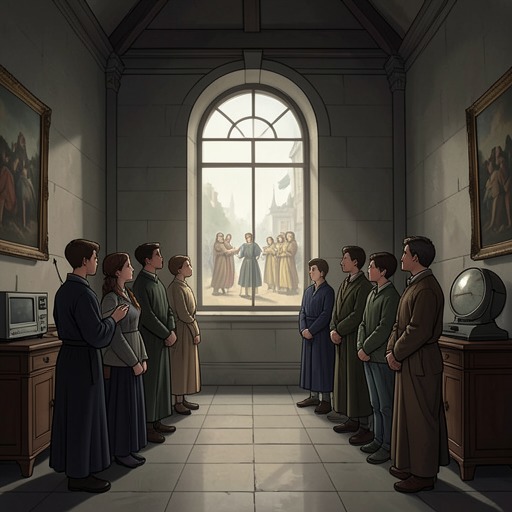
The flagpole stands at the exact center of the dormitory compound, visible from every window in all three dormitory buildings. The compound itself occupies a hill in the middle of the city, enclosed by a concrete wall and arranged around a broad quadrangle. A zelkova tree, said to be at least 150 years old, grows just inside the front gate; beyond it, paths cross lawns toward the three-storey dormitories and common building. Against this orderly, open layout, the centrally placed pole makes the flag impossible for residents to overlook.
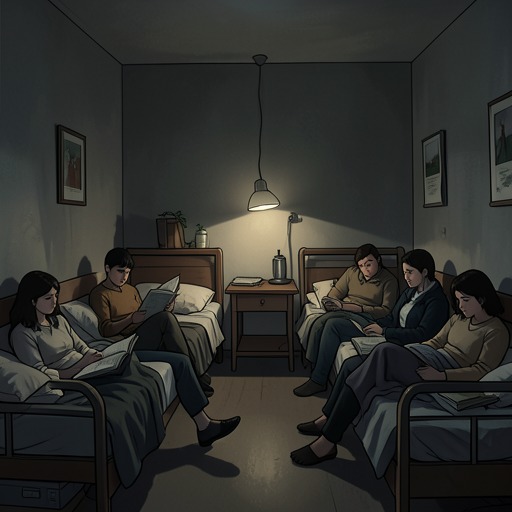
That visibility gives the ceremony a collective quality even when no resident chooses to take part. The flag can be seen from every building, but the people responsible for raising it perform the ritual in the quadrangle, below the students’ windows. The arrangement connects private rooms to a public display: the residents may continue their daily routines indoors, yet the ceremony occupies the visual center of the place where they live.
The Morning Ceremony
Each day begins with the solemn raising of the flag to the national anthem. The man in charge is the head of the east dormitory, a tall, eagle-eyed figure in his late fifties or early sixties, with bristly grey-flecked hair and a long scar on his sunburned neck. A student assistant stands beside him, though Watanabe does not know the assistant’s name, room, or even for certain whether he is a student. His uniform earns him the nickname Uniform. Watanabe regards the pair as a creepy couple, but their work is exact and formal.
At almost the precise moment the radio gives the six o’clock signal, the two appear in the quadrangle. Uniform wears his navy-blue student uniform and black leather shoes; the head of the east dormitory wears a short jacket and white trainers. Uniform carries a ceremonial box of untreated paulownia wood, and the older man brings a Sony tape recorder. He sets down the recorder at the pole’s base while Uniform opens the box and presents the neatly folded banner. The older man clips it to the rope, revealing the bright red circle on a pure-white field; Uniform then switches on the anthem. These distinct, repeated actions—box, banner, rope, recording—make the raising less like casual flag display than a small, rehearsed rite.
The flag’s ascent unfolds alongside the anthem’s lines. It climbs the pole, reaches halfway, and then arrives at the top. On a clear, windy day, Watanabe finds the sight impressive. When he first enters the dormitory, the novelty sometimes prompts him to rise early and watch. His attention is not presented as political commitment: he is drawn to the unusualness of the event, to a routine whose solemnity stands out precisely because it recurs every morning.
The Evening Reversal
At dusk, the flag is lowered with the same ceremonial reverence, but in reverse. The banner descends and returns to its box; the national flag does not fly at night. The morning’s measured sequence is therefore completed each evening, and the object that had been displayed across the compound is carefully put away rather than left to mark the dormitory after dark.
Watanabe questions the logic of that disappearance. The nation continues to exist at night, he observes, and people still work then: railway construction crews, taxi drivers, bar hostesses, firemen, and night watchmen. He wonders whether it is unfair that such people should be denied the protection of the flag, or whether the matter makes little difference and nobody cares. The thought does not become a campaign or a settled objection; he adds that he does not really care either. Its importance lies in the brief friction it creates between an official ritual and the ordinary lives that do not fit neatly within its schedule.
Political Atmosphere and Narrative Significance
The ceremony belongs to a dormitory that Watanabe understands as politically “fishy,” although he cannot establish which rumors about it are true. Residents speculate about a privileged club of elite students, study groups, and guaranteed employment after graduation; other theories circulate too. For Watanabe, however, the dormitory’s political orientation makes little practical difference to everyday life. The recurring flag ritual gives that ambiguous institutional setting a visible form without resolving what the dormitory stands for.
The novel later places the motionless flag in a different seasonal scene. On a windless Sunday morning in autumn, after Watanabe has bought daffodils, he notices the Rising Sun flag hanging limp from its pole. The image contrasts with the earlier ascent on clear, windy days: the same emblem remains in the same central position, but its movement depends on the weather. In both scenes, the flag is part of the compound’s observable routine rather than an object Watanabe explains through a firm political judgment.
Its recurring schedule also sets institutional order against the disorder of the wider period. During the summer holidays, the university calls in riot police, the barricades are broken, and students are arrested; when lectures resume under police occupation, former strike leaders return to class. Watanabe condemns the leaders’ apparent reversal and responds to the restored routine with silence at attendance, a gesture that isolates him further from other students. The dormitory flag does not directly cause or resolve this crisis. Instead, its dependable raising and lowering provide a sharp contrast to political performances whose slogans and commitments, in Watanabe’s view, shift with circumstance.
The flag’s significance rests on this combination of spectacle and routine. Its red circle is conspicuous against white, its pole occupies the compound’s shared center, and its daily presentation is governed by exact gestures and hours. Yet the ritual’s own boundaries invite an ordinary question: why should the nation’s emblem vanish at night when the nation and its workers remain? Watanabe never supplies an answer. The unresolved question leaves the flag balanced between imposed ceremony and an emblem whose meaning, in daily life, is less settled than its carefully repeated display suggests.