Dormitory curfew and overnight-pass policy
Norwegian WoodThe Dormitory curfew and overnight-pass policy governs residents’ movement between the men’s dormitory and the city: curfew limits ordinary late-night outings, while a granted overnight pass allows a resident to stay away until morning. The arrangement is both a practical boundary and a social mechanism. It constrains Toru Watanabe’s choices, but Nagasawa’s ability to obtain permissions also makes the rule a route into a more transgressive life outside the dormitory.
The Dormitory and Its Boundaries
The policy operates within an institution built to contain the practical difficulties of student life as well as to regulate it. Toru, an eighteen-year-old first-year student new to Tokyo and living alone, was placed in a private dormitory by his anxious parents. The arrangement cost less than a private room and provided meals and facilities; although Toru would have preferred the solitude of a flat, he felt unable to insist when his parents were paying his university expenses.
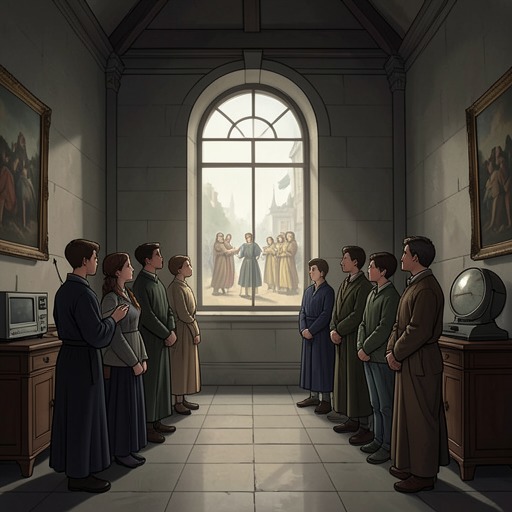
The compound’s substantial, orderly layout gives the rules a physical setting. Set on a hill, it had a walled quadrangle, a paved path passing a huge zelkova tree, and two long concrete dormitories facing each other. A common building held the dining hall and bathrooms, with an auditorium, meeting rooms, and guest rooms upstairs. Lawns, sprinklers, sports grounds, and tennis courts completed an environment that seemed to provide almost everything residents needed. The enclosed compound is not presented as squalid or dark; rather, its amenities make the contrast between provision and restriction especially clear.
Curfew and Overnight Permission
The distinction between curfew and an overnight pass is clearest in Toru’s outings with Nagasawa. When Toru stayed out with women he had met, the dormitory’s midnight curfew made an overnight permission necessary: he could not simply return late and ignore the rule. The pass kept him away until morning, after which he returned to the dormitory. The rule thus did not prevent nighttime excursions, but formalized them as authorized absences.
Nagasawa’s own circumstances explain why he lived in the dormitory despite his affluent background. His father, concerned that he would do nothing else if left to live alone in Tokyo, required him to remain there throughout all four university years. Nagasawa did not allow the dormitory’s rules to deter him. When he wanted to go out looking for women or stay at his girlfriend’s flat, he obtained overnight permission; securing it was not easy, but he treated the passes as readily usable opportunities. Toru could benefit from this arrangement when Nagasawa made the request on his behalf.
The permissions therefore reveal an uneven relationship between institutional regulation and individual agency. A rule that could impose a real obstacle on an ordinary resident became, for Nagasawa and sometimes Toru, a means of organizing time away. The contrast does not mean that the curfew disappeared: the men still needed permission, and the pass carried the consequence of remaining out until morning. Instead, the policy’s limits could be negotiated through access to a recognized exception.
Toru’s Experience of the Rule
For Toru, the pass is bound to the emotional aftermath of his nights out. He describes returning after sleeping with women he did not know as feeling self-loathing and disillusionment. His account emphasizes the morning return rather than presenting the permission as uncomplicated freedom: the outing ends under the dormitory’s schedule, and the pass leaves him away from home until morning. The rule marks a boundary he can cross only through formal leave, while his own response makes clear that permission to be absent does not resolve his dissatisfaction.
The dormitory’s social life also turns Toru’s movements into a public performance. When he received calls from Naoko or went out on Sunday mornings, the other residents assumed he had found a girlfriend. They teased him with questions about their supposed sexual relationship, and he supplied the answers they expected rather than explaining the truth. The policy itself does not disclose that truth; instead, the everyday visibility of leaving and returning invites the dormitory’s mistaken interpretation of his relationship with Naoko.
The Rule in Practice and Contrast
A night out in Shinjuku shows how curfew shapes even an unsuccessful excursion. Toru and Nagasawa travelled there after dinner, spent time at bars, and approached women who were either waiting for their boyfriends or needed to return to their own dormitories before curfew. After trying several places, Nagasawa was ready to give up at 11:30. The episode presents curfew not simply as a prohibition imposed on Toru’s dormitory, but as part of a wider pattern of timed access and departure that affected the women they met as well.
The novel also places the men’s dormitory rules beside the much stricter movement limits at Ami Hostel, though the two systems should not be mistaken for one policy. There, residents were generally prohibited from going into town, and a person who left could not return. By contrast, the men’s dormitory rule described here allowed a resident to leave overnight when permission was secured. The difference clarifies the specific character of curfew and overnight passes: they regulate absence through a limited exception, rather than making departure itself irreversible.
Narrative Significance
The policy gives the dormitory a threshold between scheduled institutional life and the city’s less regulated nighttime world. Daily routines continue inside the compound, while a pass makes certain departures possible without abolishing the rules that define the boundary. Its significance lies in this combination of constraint and negotiated access: the institution governs residents’ time, but people with initiative—or with help from someone such as Nagasawa—can arrange an authorized way beyond its ordinary limits.
That arrangement also sharpens the contrast between outward conduct and inward experience. Toru can join Nagasawa’s outings and comply with the procedure for staying away, yet the experiences do not make him feel more settled or connected. The dormitory’s assumptions about his relationship with Naoko further show how shared rules and routines produce a ready-made social story about residents, even when that story misses the truth. Curfew and overnight permission thus function not merely as logistical details, but as a recurring measure of who can move, under what conditions, and how little those conditions guarantee emotional freedom.