Dormitory flag-raising and lowering ritual
Norwegian WoodThe dormitory’s flag-raising and lowering ritual is a formal daily observance in which two residents raise the Rising Sun flag at six in the morning to the national anthem and take it down again at dusk. The ceremony’s exact sequence and prominent setting make it a visible feature of communal life; the narrator’s detached, sometimes comic attention to its details also turns it into a small study of the distance between public ritual and private conviction.
Setting and Daily Schedule
The flagpole stood in the center of the compound, visible from every window in all three dormitories. The ceremony therefore occupied no obscure corner: it was staged where residents could see it from throughout the complex. Each day began with the solemn raising of the flag, accompanied by the national anthem. At six in the evening the banner was lowered, folded, and put away; the national flag did not fly at night.
The routine formed part of the dormitory’s distinctive atmosphere during the narrator’s two years there, from spring 1968 to spring 1970. He describes the institution as surrounded by suspicions about its politics and its privileged connections, but says that its ideological character made little practical difference to his everyday life. The flag ritual, in contrast, was impossible to miss: it began at a fixed hour, took place in full view, and was repeated each day with ceremonial solemnity.
Participants and Procedure
The head of the east dormitory, the narrator’s building, was responsible for the flag. He was a tall man in his late fifties or early sixties, with bristly, graying hair, a sunburned neck, and a long scar. Residents whispered that he had graduated from the wartime Nakano spy school, though the narrator makes clear that no one knew whether the rumor was true. His assistant was equally mysterious: the narrator did not know the student’s name or room and had never seen him in the dining hall or bath. The uniform he always wore supplied his nickname, Uniform.
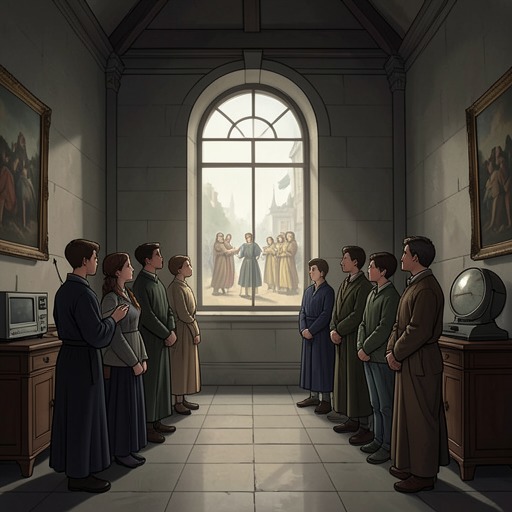
At the signal from the radio, the two appeared in the quadrangle at almost exactly six. Uniform wore his navy-blue student uniform and black leather shoes; the dormitory head wore a short jacket and white trainers. Uniform carried a ceremonial box of untreated paulownia wood, while the head brought a Sony tape recorder. He set the recorder at the foot of the flagpole. Uniform opened the box and reverentially presented the neatly folded banner; the head clipped it to the pole’s rope, exposing the red sun on its white field, and Uniform switched on the anthem.
As the flag climbed, the song’s verses marked its progress. At the line “May Our Lord's Reign...” the ascent began; at “Until pebbles turn to boulders...” it had reached halfway, and at “And be covered with moss” it arrived at the top. The two men then stood rigidly at attention, looking up. On clear, windy days, the narrator found the sight striking. At dusk the sequence was reversed with the same reverence: the flag came down and returned to its box.
Observation, Routine, and Irony
When he first moved into the dormitory, the novelty of the spectacle often got the narrator out of bed early to watch. Its carefully arranged objects and gestures—the wooden box, tape recorder, folded banner, anthem, and synchronized appearance—make the observance seem both public performance and tightly managed routine. The narrator records its ceremony precisely, but does not claim to share the conviction it appears to express. The sequence is solemn; his perspective remains inquisitive and dryly skeptical.
The nightly lowering prompts a small private objection. The narrator wonders why a nation that continues to exist after dark should have its flag taken down, especially when railway construction crews, taxi drivers, bar hostesses, firemen, and night watchmen are still working. He speculates that these people are thereby denied the flag’s protection, then immediately undercuts the thought: perhaps it does not matter, and perhaps nobody cares besides him. He does not claim to care much either; the question has merely crossed his mind. The aside makes the ritual’s rules feel at once absolute in their repetition and arbitrary in their application.
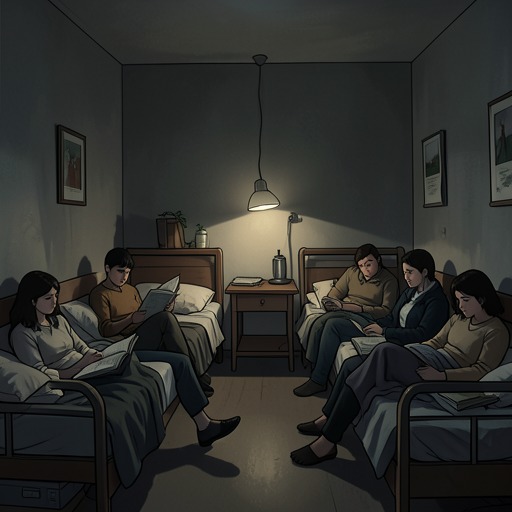
The flag also enters the dormitory’s changing daily landscape without requiring a ceremony to be described anew. After dark, with the flag lowered, the complex is hushed; during one holiday evening, only half the dining-hall lights are on, and the smell of cream stew rises through the building. The flag’s absence is part of that scene’s atmosphere: the observance has ended, and communal life continues in the dimly lit compound.
Recurrence and Meaning
The ritual becomes part of the narrator’s sense of how habits organize life in the dormitory. Its six-o’clock music is not useless to everyone: Storm Trooper, his roommate, wakes to the strains of the anthem, washes, lays his towel on the radiator, puts his toiletries back, and joins the nation’s radio calisthenics. The ceremony thus supplies a practical cue within a larger morning routine, even for a resident whose uniform is a matter of convenience rather than political commitment. Its public symbolism and everyday utility coexist without becoming the same thing.
That contrast is characteristic of the narrator’s treatment of the dormitory. The raising and lowering are performed with exactness and reverence, yet residents’ responses range from curiosity to indifference, and the narrator’s attention shifts quickly from national symbolism to the discomforts and oddities of shared life. The ceremony does not resolve the suspicions surrounding the institution or reveal what its participants privately believe. Instead, its repetition makes the dormitory’s public order tangible: a flagpole at the compound’s center, a pair of men arriving on cue, and a national symbol displayed by day and boxed away at night.