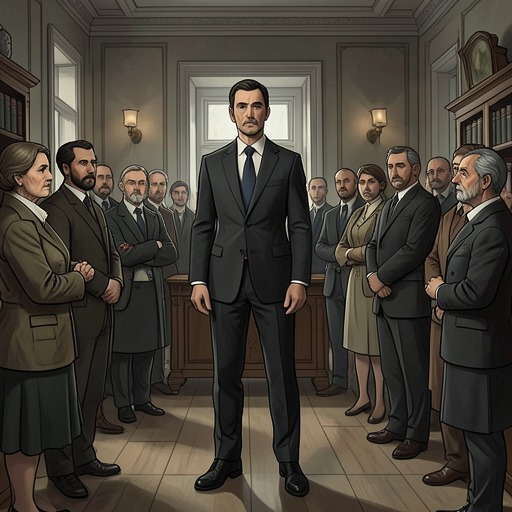
Hatsumi
Norwegian WoodHatsumi is Nagasawa’s long-term girlfriend, a woman whose quiet intelligence, humor, care, and exacting good taste make her more than a graceful presence beside him. She recognizes the harm in the relationships around her and offers Toru Watanabe a clear moral judgment, yet her own love for Nagasawa leaves her asking what to do next. Her later suicide gives that question a devastating afterlife: Toru understands that she had awakened in him a dormant longing, but his belated recognition cannot alter what happened.
Identity and Background
Hatsumi is the same age as Nagasawa and has been his girlfriend since his first year at university. Toru has met her several times and likes her immediately. Her beauty is not the kind that commands instant attention; at first, he even wonders why Nagasawa could not do better. Conversation changes his impression. People who speak with her take to her at once, and Toru sees her as quiet, intelligent, funny, caring, and impeccably dressed.
She attends the country’s top girls’ college. The social distance Toru imagines between her and himself matters to his own conduct: although Hatsumi tries to set him up with a first-year student in her club so that they can double-date, he makes excuses. He does not want to repeat earlier mistakes, and he doubts he could talk comfortably with the wealthy young women he associates with her college. Her warmth toward him therefore exists alongside his reserve, rather than turning into a separate romance.
A Kindness That Sees the Cost
Hatsumi knows, at least in broad terms, that Nagasawa sleeps with other women. She does not complain or make demands, though she is seriously in love with him. Her silence is not presented as proof that she is unhurt or indifferent; the narration places her devotion beside the inequity of their arrangement. Nagasawa himself once tells Toru that he does not deserve a girl like her, and Toru agrees. The judgment is unusually plain in a circle where Nagasawa’s appetite for freedom often appears to set the terms.
Toru’s admiration is sharpened by contrast with Nagasawa’s conduct. He thinks that if he had a girlfriend like Hatsumi, he would not sleep around with a succession of women. When he tells Nagasawa that the one thing he envies is having such a terrific girlfriend, Nagasawa falls silent and eats. The pause gives Toru’s remark its force: Hatsumi is not simply a possession that confers status, but the person whose worth Nagasawa can acknowledge while continuing to behave in ways that injure the relationship.
Counsel to Toru
At dinner with Nagasawa and Toru, Hatsumi listens as Toru describes his complicated situation. She cannot fully identify what makes it complicated, but she tells him that what he has just described is not right for him: he is not that kind of person. She places her hands on the table and looks him in the eye, making her response direct rather than consoling or evasive. Toru admits that he has sometimes felt the same way.
Later she asks what Toru thinks she ought to do about Nagasawa from then on. The question turns her from an observer of Toru’s predicament into someone seeking counsel about her own future. The available exchange establishes that she is weighing what comes next, but it does not disclose the decision she makes at that moment. Toru, for his part, tells her that all he wants is for her to be happy and wonders how someone who seems capable of happiness with almost anyone ended up with Nagasawa. His tenderness and bewilderment do not provide an answer to the problem she has brought to him.
Their intimacy remains affectionate but bounded. After playing pool, Toru tells her that although he grew up an only child and never wished for siblings, he suddenly wished he had had an elder sister like her: stylish, striking in a midnight-blue dress and gold earrings, and excellent with a pool cue. Hatsumi is delighted, calling it the nicest thing anyone has said to her in the past year. The image makes clear the shape Toru gives his affection: he treasures her and imagines closeness with her, but expresses it as a wish for an older sister rather than a claim upon her.
Death and Toru’s Retrospective Grief
The account of Hatsumi’s death arrives later, through a letter Nagasawa sends from Bonn. Two years after Nagasawa leaves for Germany, Hatsumi marries; two years after that, she slashes her wrists with a razor blade. The compressed chronology sets a new marriage between her long relationship with Nagasawa and her death, without explaining her motives or circumstances beyond those facts. The narration refuses to convert the outcome into a warning that could have been easily read in advance: Toru says that neither he nor Nagasawa could have saved her.
Nagasawa’s letter says that her death has extinguished something and that the loss is unbearably sad and painful, even to him. Toru tears the letter to shreds and never writes to Nagasawa again. That response marks a lasting rupture between the men, but the account does not reduce it to a single stated cause. It places Toru’s rejection of Nagasawa’s belated grief beside his earlier agreement that Nagasawa did not deserve Hatsumi, and beside the knowledge that her death has made their old judgment powerless.
In a later memory, Toru sees a vivid red scene and suddenly understands the tremor Hatsumi had stirred in him. She had awakened a childhood longing he had forgotten: innocent, almost burnt into him, and destined to remain unfulfilled. The realization brings him close to tears. He calls her an absolutely special woman and thinks that someone should have done anything to save her, then recognizes the limits of his own and Nagasawa’s power. The belatedness is essential: her significance becomes newly legible to Toru only after there is no possibility of acting on what he understands.
Narrative Significance
Hatsumi’s role is defined partly by what Toru can see and partly by what remains beyond his knowledge. He remembers her character in concrete acts of attention, her advice at the dinner table, her question about what to do, and the pleasure she takes in his sisterly compliment. But the account gives no interior explanation for her eventual suicide. Her death therefore cannot be treated as the predictable result of a single relationship or reduced to an answer that the narrative has not supplied.
Her story also deepens the novel’s account of grief without offering a consoling lesson that makes loss manageable. Toru’s memory of Hatsumi links her to the wider pattern in which death becomes part of the lives of those left behind, while his response to her loss remains distinct: he destroys the letter that tells him of it and ends his correspondence with Nagasawa. The earlier intimacy does not disappear, but survives as recognition, regret, and an irreparable absence. Hatsumi’s importance lies in that contrast between the vivid person Toru remembers and the helplessness of remembering her only after she is gone.