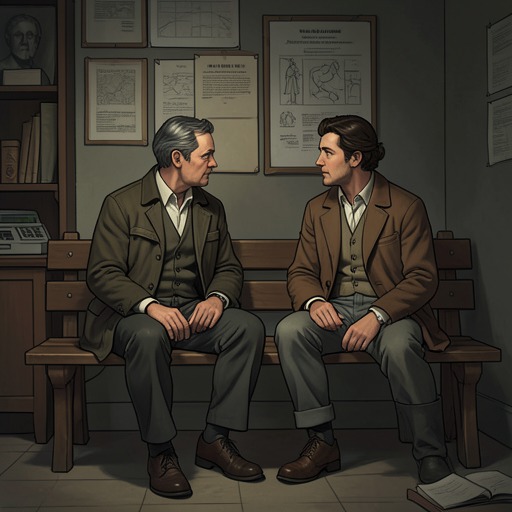
Midori Kobayashi
Norwegian WoodMidori Kobayashi is a university student whose candor and initiative draw Toru Watanabe into a relationship that grows from an unexpected introduction into an explicit declaration of love. Her story is marked by her irreverent account of her family’s modest bookshop, a tentative kiss after a nearby fire, and her father’s illness, during which Watanabe offers practical companionship. Midori’s directness does not spare her from uncertainty: she is seeing someone when she and Watanabe first kiss, and later has to ask him plainly whether he understands that she loves him. Her place in the novel is sharpened by its retrospective frame: while the narrator’s recollection of Naoko and his younger self becomes increasingly difficult, Midori’s voice and choices keep pressing the living claim of connection.
Introduction and Background
Midori first approaches Watanabe in a small restaurant after recognizing him from the university. She has come with three other students, but leaves their table to ask whether he is Watanabe and whether she can sit with him. Watanabe cannot remember having met her. Her opening is practical as well as personal: she says she has missed two drama lectures and asks to borrow his notes because she knows no one else in the class. The encounter establishes a pattern in which Midori crosses the distance between them herself, turning a chance recognition into a conversation and a reason to meet again.
She introduces herself by explaining that her name means green, though she jokes that green looks terrible on her and that this makes her feel cursed. She contrasts her name with her sister’s, Momoko, whose name means peach girl. The joking manner is characteristic, but it also lets her frame family details in her own terms rather than present them as a polished story. Her descriptions are specific and unsentimental, especially when she explains what it meant to grow up above the family business.
Midori’s family owns Kobayashi Bookshop, which she describes as a small shop whose entrance opens onto stacks of magazines. Its steady sellers include women’s magazines, comics, weeklies, practical how-to books, and writing supplies; the serious literature she names is absent because it does not sell there. At school, other students imagined that a bookshop-owning parent meant access to a grand store and unlimited reading. Midori’s account corrects that assumption with the actual scale and inventory of the shop. Her humor does not conceal the difference between the glamorous image her classmates projected and the ordinary business she knew.
Encounters and Growing Closeness
Midori and Watanabe’s connection takes shape through visits and conversation rather than a single decisive meeting. She is willing to ask for what she needs, whether that means lecture notes or Watanabe’s company, and she often makes the next step explicit. Their relationship also develops amid competing attachments. After an afternoon together at her family’s home, they go to the laundry deck to watch a fire nearby. The episode is recalled as an odd, spontaneous turn in an otherwise ordinary Sunday: they watch the emergency from above and kiss.
The kiss is gentle and bounded, but it changes the terms of their friendship. Midori is the first to explain what complicates it: she is seeing someone. Watanabe says he has sensed as much and acknowledges that he likes another girl. The exchange makes their mutual attraction plain without pretending that either is free of other commitments. Midori holds his hand while telling him about her situation, and Watanabe answers honestly about his own. Their closeness therefore begins not with an uncomplicated promise, but with recognition of the emotional complication between them.
Later, Midori returns to that kiss in conversation with Watanabe, saying she has been thinking about it and that it felt nice. She then asks whether he is free on Sunday and invites him to spend the day with her. The recurrence matters: rather than treating the kiss as a passing accident, she names it and tests whether the connection can continue. Her initiative repeatedly keeps their relationship from dissolving into unspoken possibility.
Care, Family, and Responsibility
Midori’s family circumstances become more urgent when she tells Watanabe that they are going to the hospital. Her father is there, and she has been assigned to stay with him for the day. Watanabe is surprised because he believed her father had gone to Uruguay. Midori explains that this was a lie: her father had long talked about going, but had never been able to do so. The revelation is matter-of-fact, and it redirects attention from the story Midori had previously told to the practical burden she is facing now.
At the hospital, Midori tells Watanabe that her father has a brain tumour, the same illness from which her mother died less than two years earlier. The University Hospital is crowded with weekend visitors and patients, and Midori’s father is in a semi-private room near the door. Watanabe stays with her and her father through the day. When he has to leave at five for his job selling records in Shinjuku, Midori walks him to reception and thanks him. Watanabe says he would be willing to come again the following week and that he would like to see her father. The offer turns his concern into continued, practical support rather than a one-day gesture.
The scene reveals another dimension of Midori’s directness. She tells Watanabe what is happening, including the false account of Uruguay and the seriousness of her father’s condition, while carrying the responsibility of being with him. His presence does not solve the illness or undo her earlier loss, but it gives her someone to share the day with. Their bond is expressed here through time spent in a hospital, a promise to return, and her gratitude at the end of the visit.
Confession and Narrative Significance
Midori eventually states the feeling that her earlier invitations and questions have been testing. She tells Watanabe that she likes him more than the man she is currently involved with, adds that she wishes she had fallen in love with someone more handsome, and then says that she fell in love with him. The confession is frank and teasing at once: it admits that love has not followed an ideal preference, but does not soften the certainty of what she feels. Watanabe cannot immediately answer; the words catch in his throat.
This declaration clarifies the stakes of a relationship that has unfolded through repeated acts of approach. Midori first crosses the room to speak to a stranger who knows her name, then asks for notes, returns to the memory of their kiss, seeks his company, and finally names her love without relying on hints. Her directness is not simply a comic manner or a succession of bold lines. It is how she asks Watanabe to meet her in the present, even while he remains emotionally entangled elsewhere.
The novel’s frame gives that request added weight. In the meadow memory that opens the narrative, the adult Watanabe can recover the landscape in vivid detail while the people who once occupied it, including his younger self and Naoko, seem absent. He describes the delay in bringing Naoko’s face back to mind growing from seconds to a minute, and fears that memory may lose what matters most. He writes because this is the only way he knows to keep a promise to Naoko. Against that movement toward distance, Midori appears through concrete encounters and decisions: she asks, returns, explains, cares for her father, and speaks her feelings aloud. The contrast does not make her a cure for grief; it makes her a living person whose claim on Watanabe cannot be answered by memory alone.
Watanabe’s remembrance of Kizuki also reveals the novel’s unequal measures of time. He feels guilty when he realizes that he did not think of Kizuki immediately while playing pool, but recognizes that Kizuki remains seventeen while Watanabe is approaching twenty. The shared past has changed even as the effects of Kizuki’s death remain vivid. In that context, Midori’s relationship with Watanabe belongs to the continuing movement of a life that cannot restore the dead or hold the past unchanged. Her confession asks for a response in the present, and the story’s emotional force rests partly in the difference between what can be preserved by recollection and what must be chosen among the living.