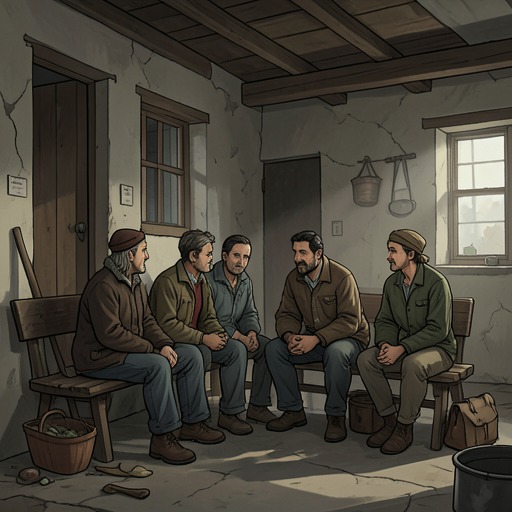
Naoko and Reiko's Sanatorium
Norwegian WoodNaoko and Reiko's Sanatorium is a quiet, voluntary community for convalescence rather than an ordinary hospital, and its open, nature-filled life gives shape to one of the novel’s most compassionate but limited visions of care. Residents share work, recreation, and the knowledge of their own differences; yet when Naoko’s condition worsens, the community cannot keep her safe. Her transfer for intensive treatment, a seemingly hopeful visit, and her death in the woods expose the distance between making room for suffering and being able to cure it.
Setting and Purpose
The sanatorium is explicitly distinguished from a conventional hospital. Reiko explains that its few doctors hold regular sessions to check residents’ conditions, but do not administer the sort of treatment associated with an ordinary hospital. There are no bars on the windows, and the gate remains open: residents enter and leave voluntarily, and admission depends on whether someone is suited to this kind of convalescence. The institution is therefore defined less by confinement or medical intervention than by the conditions under which residents live together.
Its scale reinforces that character. About seventy people live there, with just over twenty staff members, in a place so spacious and quiet that it can seem like the normal, real world. That apparent peace depends on particular preconditions, rather than representing ordinary life in miniature. The sanatorium is a refuge from the pressures and harms residents have encountered outside, but its calm is sustained by a distinctive shared environment.
Everyday Life and Mutual Acceptance
Residents learn about stars, birds, flowers, and insects, knowledge cultivated in part because there is little to do after sunset. Reiko’s account places this quiet attention to the natural world alongside the community’s everyday activities. Residents play tennis and basketball; in one game, staff and patients share a team, and the distinctions between them recede while they play. The narrator’s description of everyone appearing equally deformed leads to a doctor’s explanation of the community’s approach: its purpose is not simply to correct each person’s difference, but to help people become accustomed to it and find a place for the pain it causes.
That approach does not claim that suffering can be removed or that residents will quickly adapt. The doctor describes differences in how people think, feel, and see the world as difficult to change; forcing change in one area could upset something else. The sanatorium offers a place to get away from pain that residents cannot yet accommodate within themselves, while acknowledging that complete adaptation may never come. Its care rests on recognizing limits rather than treating difference as a defect that can be repaired on demand.
The residents also grow vegetables together, from tomatoes and aubergines to cucumbers, watermelons, strawberries, and daikon radishes. They use greenhouses, read farming books, consult experts, and discuss fertilizer and soil. The narrator comes to enjoy watching the crops grow, and residents eat freshly picked produce alongside meat and fish. Sports, cultivation, and shared meals give convalescence a material, recurring structure: attention is directed toward a game, a growing plant, or a regular meal, not solely toward illness.
The community’s ethic is captured by the idea that residents wear their deformities openly. The residents know that they are not free of differences and vulnerabilities, and that recognition helps them avoid hurting one another or being hurt. The image reverses the outside world’s presumed normality: what distinguishes the sanatorium is not that its inhabitants have no difficulties, but that their difficulties are treated as a shared condition rather than concealed. Its quiet is a practice of mutual accommodation, not evidence that pain has vanished.
Reiko and the Community’s Boundaries
Reiko occupies a revealing position within this arrangement. Although people sometimes call her the Music Doctor, she is another patient, not a physician. She has lived at the sanatorium for seven years, teaches music as a form of therapy, and helps in the office; over time, she says, it has become difficult to tell whether she is a patient or a member of staff. This overlap makes the institution’s everyday support visible while preserving the distinction between the work residents do and medical authority.
Reiko is Naoko’s roommate, enjoys living with her, and says that they talk about many things, including Watanabe. Their closeness gives the community a personal form: accommodation is not only an institutional principle but also companionship between residents. At the same time, Reiko is candid that the sanatorium is not suitable for everyone. People who need specialized therapy may be sent to a specialist hospital. The open-gate model does not mean that every level of care can be provided within the community.
Naoko’s Transfer and Final Visit
That limit becomes urgent as Naoko’s emotional state grows harder to manage. In a letter, Reiko says that Naoko is well much of the time, but can become extremely unstable, requiring constant watch. During intense episodes of hearing voices, she shuts down and retreats into herself. After a long conversation involving Naoko’s mother, the doctor, and Reiko, they decide that Naoko should move to a hospital for intensive treatment, with the possibility of returning to the sanatorium depending on the results. Reiko supports the decision despite knowing that she will miss and worry about her roommate.
A later letter brings temporary hope: after tests at the hospital in Osaka, Naoko has improved more rapidly than expected, speaks lucidly on the telephone, and may be able to return. But the improvement does not settle her longer-term course. The hospital recommends that she remain for a more extended period of intensive therapy, and her mother asks Reiko whether Naoko can visit the sanatorium before doing so. On 25 August, Naoko arrives with her mother. The two women pack Naoko’s belongings and talk; when her mother leaves, Reiko is not alarmed, because Naoko appears healthier than expected, smiling, joking, and speaking more normally. Naoko says that she intends to let the hospital doctors cure her, and tells Reiko she would like them to leave the sanatorium and live together somewhere. They discuss the future, take a walk, and visit the aviary.
The visit turns abruptly into a disappearance. At six the next morning, Reiko finds that Naoko’s clothes, trainers, and the torch kept beside her pillow are gone; Naoko’s nightdress remains, and a note asks Reiko to give her clothes to her. The missing torch makes Reiko realize that Naoko left in the dark. Residents search the dormitories and surrounding woods, and it takes five hours to find her. Naoko has brought her own rope and died by suicide. The promise of a longer treatment and the ordinary warmth of her visit are set against the care community’s inability to prevent her death.
Aftermath and Significance
An ambulance takes Naoko away, and police question Reiko. With a note indicating suicide, they treat the death as straightforward and conduct what Reiko describes as a pro forma inquiry. The sanatorium remains the site from which the institutional response begins, but it cannot contain the consequences of Naoko’s death. Reiko telegraphs Watanabe, while he later leaves the funeral feeling that Naoko’s family resents his knowing that she died by suicide. He returns to the road, carrying grief away from the community that had been Naoko’s home.
The sanatorium’s meaning is not that acceptance and routine are enough to overcome every crisis. Its practices—shared games, food, work, and the willingness to acknowledge differences—give residents a way of living together without demanding that they appear normal. Naoko’s transfer recognizes a need for care beyond what that setting can provide; her apparent improvement makes the subsequent loss more painful, not less. The novel consequently presents the community as neither a cure nor a failure in simple terms: it offers real companionship and a gentler mode of convalescence, yet its openness and mutual support cannot guarantee recovery or safety.
That tension connects the place to the novel’s wider understanding of death and grief. The thought that death is part of life may be articulated as a philosophy, but it cannot cure the sorrow of losing someone. For Watanabe, Naoko’s death remains an absence that no insight or sincerity can undo. The sanatorium’s quiet world makes the work of living alongside vulnerability imaginable; its limits show why that work cannot spare the living from loss.