Naoko’s clothes
Norwegian WoodNaoko’s clothes are not merely possessions left behind after her death. Shared with Reiko during their life together at the sanatorium and named in Naoko’s only specific written instruction about her belongings, they pass into Reiko’s care and remain present in the final encounter with Watanabe. Their practical intimacy makes them a quiet material bond among the dead, the bereaved, and the living person who must keep going.
Shared at the Sanatorium
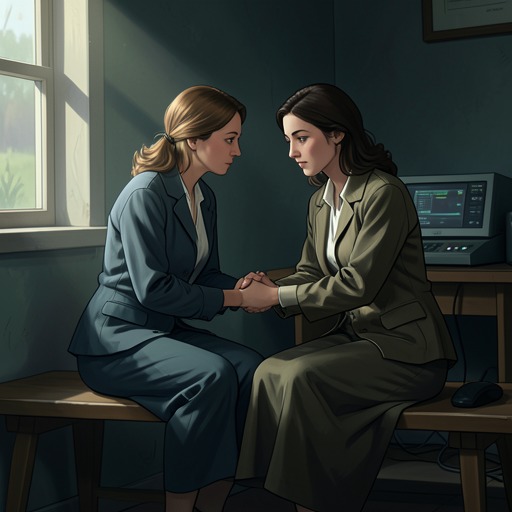
Reiko explains that she and Naoko were nearly the same size, so they could exchange blouses, trousers, shoes, and hats; bras were the principal exception. Naoko gained a little weight after arriving at the sanatorium, but the two remained close enough in size to share much of what they wore. Reiko describes the arrangement as more than occasional borrowing: it was almost joint ownership. The clothes belonged to everyday life together, where physical resemblance and routine exchange made the boundary between one woman’s wardrobe and the other’s less important.
That history changes the meaning of the garments after Naoko’s death. When Reiko arrives in Tokyo, Watanabe recognizes her shirt as attractive before learning that it belonged to Naoko. Reiko then clarifies that the jacket and trousers are Naoko’s as well: the outfit is hers. The clothes are visible evidence of an intimacy Watanabe had not known in its full practical detail, and Reiko’s body, which he had thought of as smaller and slimmer than Naoko’s, proves surprisingly solid and almost identical in build. What is worn makes the women’s physical likeness newly legible.
Naoko’s Instruction
Naoko left no will, Reiko says, except for one handwritten line on a memo pad: she asked that all her clothes be given to Reiko. The note is strikingly specific against the absence of any broader testament. Reiko wonders why Naoko would concern herself with clothes while preparing to die, when there might have been so much else she wanted to say. Watanabe cannot offer a definitive explanation, and the exchange preserves that uncertainty rather than turning the instruction into a fully explained message.
Yet the request has a clear consequence: Reiko has the clothes, wears them, and brings them into the world beyond the sanatorium. The garments are not simply a symbolic substitute for Naoko, since they had already been part of an ordinary reciprocal practice between the two women. Their afterlife grows out of that prior closeness. The written instruction makes a practical act of giving carry the weight of a final, limited choice without claiming to settle what Naoko meant by it.
Grief Made Material
Watanabe tells Reiko he is glad she is wearing Naoko’s clothes, adding that Naoko would probably be glad to see her wear them. His response matters in a story where the fact of death cannot be made harmless by a consoling truth. He has traveled far along the coast, thinking about Naoko and struggling to accept that she is gone; after returning to Tokyo, he shuts himself in his room and spends his time with memories of the dead rather than the living. Against that withdrawal, the clothes offer no cure and do not restore Naoko. They do, however, let her remain materially present in a living relationship that continues after her death.
The novel’s earlier understanding that death is part of life finds a concrete, domestic form here. A person’s clothes can be worn, exchanged, and passed on; the person herself cannot be returned. That distinction gives the garments their emotional force. They preserve contact without undoing loss, and Watanabe’s acceptance of Reiko wearing them marks a small acknowledgment that Naoko’s possessions can belong in the world of the living without betraying her.
Worn into a New Journey
When Reiko leaves Tokyo to travel to Asahikawa, she wears the same tweed jacket and white trousers she wore when she arrived. Watanabe accompanies her to Ueno Station, carrying her suitcase while she carries her guitar. The clothes thus accompany Reiko out of the city and toward a new destination, rather than remaining sealed away as relics. They connect the farewell to an earlier domestic intimacy while remaining part of Reiko’s own present life.
Their significance rests in that double use: they are Naoko’s remembered things and Reiko’s clothing. The novel does not resolve the mystery of why Naoko singled them out in her note, nor does it make them a remedy for bereavement. Instead, their movement from shared use to inheritance, and then into Reiko’s journey, gives material shape to the continuing ties between the dead and the living. Naoko is absent; her clothes are not, and their presence allows remembrance to take the form of something worn rather than something only looked back upon.