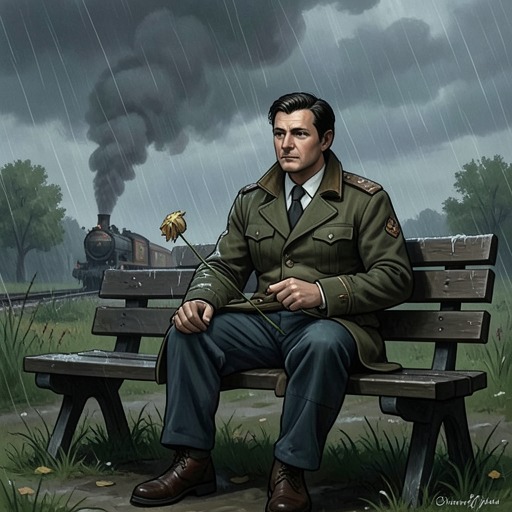
Spring as an image of painful renewal
Norwegian WoodSpring in Norwegian Wood is an image of renewal that repeatedly fails to bring comfort to Toru Watanabe. Its blossoms, fragrance, and return mark the passage of time, but they sharpen rather than soften his awareness of Naoko’s illness and death. As the season advances from the sanatorium garden to the lonely months of April and May, spring becomes a measure of life continuing without offering release from grief.
The Garden and the Season’s Reversal
On 31 March, after reading a letter about Naoko’s treatment, Watanabe sits on the porch looking out at a garden newly filled with spring. An old cherry tree is near the height of its bloom; a breeze moves through the garden, and Seagull, a cat, settles beside him. The scene initially gathers the customary signs of seasonal renewal, but Watanabe cannot make them reassuring. He feels drained and does not want to think about what may come next.
As the afternoon darkens, the blossoms take on a disturbing aspect in his imagination. Their apparent beauty becomes an image of bodily illness, and he thinks of Naoko’s condition. The shift does not mean that spring literally causes or explains her illness; rather, the season’s signs become inseparable from the fear and helplessness he feels for her. What should signify flourishing instead makes her vulnerability harder for him to ignore.
The reversal continues indoors. Drawing the curtains does not free Watanabe from the season: he experiences spring as filling everything around him, and the associations it has acquired provoke an intense aversion. Spring’s arrival has become an unwelcome reminder of what he fears it may bring. Renewal is present as a fact of the world, but not as a promise that suffering will lift.
Isolation as Spring Advances
Watanabe’s response to the garden scene is followed by three days of profound withdrawal. He describes himself as cut off from direct contact with others, as though a barrier separates him from the outside world. He remains in his room, neglects ordinary routines, and reaches for food, water, or whisky rather than engaging with those around him. The season’s outward movement contrasts with his retreat: the world continues to change while he feels unable to join it.
April makes that contrast visible in public. Watanabe sees other people enjoying the sunshine and one another’s company, while he remains alone. Naoko, Midori, and Nagasawa are all absent from the place where he stands, and he has no one to exchange even a greeting with. His attempts to speak to Midori meet her repeated refusal, deepening an isolation that spring’s sociable scenes only throw into relief.
May brings no recovery. At sunset, when magnolia fragrance hangs in the air, Watanabe’s heart can swell and lurch with pain; he waits for each episode to pass, but it leaves a lingering ache. The seasonal details are not a simple backdrop to his state. Evening light and the scent of flowers mark the recurrence of distress, giving spring a rhythm in which apparent gentleness and emotional pain arrive together.
Letters and the Work of Remembering
During these episodes Watanabe writes to Naoko. He selects gentle or beautiful subjects for his letters: grasses, a spring breeze, moonlight, a film, a song, or a book that moved him. Rereading what he has written comforts him, and for a moment he can feel that the world he inhabits is a wonderful one. The letters therefore provide a limited countercurrent to spring’s painful associations. They do not report a cure or answer from Naoko; Watanabe writes repeatedly without hearing from either her or Reiko.
That practice also makes the motif more complicated than a contrast between a beautiful season and a grieving man. Watanabe can attend to beauty and use the act of describing it to steady himself, even while he remains lonely and distressed. Spring can furnish the subjects of a consoling letter, but it cannot guarantee connection or reverse the silence that follows. Its renewal is real, yet partial: it offers moments of attention without resolving the loss around which his attention turns.
After Naoko’s Death
After Naoko dies, spring’s promise of return meets a grief that Watanabe cannot leave behind by changing place. During his travels he moves down the coast, sleeping on the sand, making fires from driftwood, and thinking about her. Memories arrive with such force that he feels he has entered a place where Naoko is still present; when that experience recedes, he is left alone again. The recurring movement between felt nearness and renewed absence gives loss its own return, distinct from the season’s renewal.
Watanabe’s reflections clarify the limits of any consoling interpretation. The idea that death is part of life, a belief he had formed after Kizuki’s death, does not cure his sorrow over Naoko. He concludes that no truth, sincerity, strength, or kindness can remove the sadness of losing someone loved; grief must be lived through, and what is learned from one loss cannot prevent the next from hurting. The seasonal cycle cannot supply a lesson that makes bereavement manageable.
When Watanabe returns to Tokyo, he shuts himself away for days, with his memory fixed on the dead rather than the living. Spring’s earlier promise of renewal thus remains unresolved. It has made beauty available to him, and it has repeatedly intensified his consciousness of illness, separation, and death; it does not itself bring him back into connection. The motif’s significance lies in that tension: the world renews, but renewal is not the same as restoration, and the living must continue without expecting nature’s return to undo human loss.