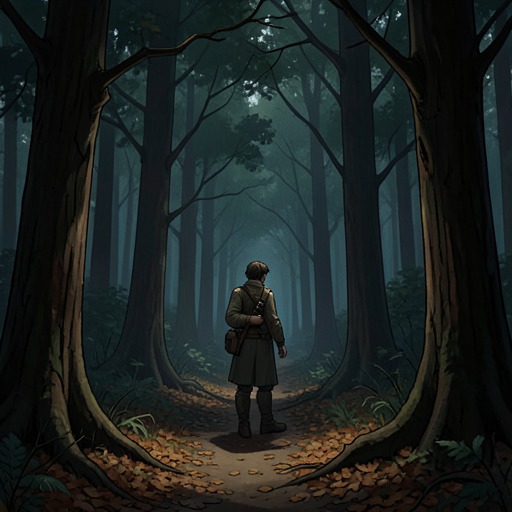
The Lonely Forest Imagery of “Norwegian Wood”
Norwegian WoodThe Lonely Forest Imagery of “Norwegian Wood” turns Naoko’s response to a song into a compact image of isolation, vulnerability, and grief. A deep wood is at once a place she imagines herself wandering alone and, in Watanabe’s later mourning, a figure for the strange inner country where memories bring the dead close without restoring them to life.
The song and Naoko’s imagined forest
During Watanabe’s visit, Naoko asks Reiko to play “Norwegian Wood.” The request has a small ritual attached: Naoko pays ¥100 into a porcelain beckoning-cat coin bank whenever she asks for the song, because it is her favorite and she makes a point of paying when she really wants to hear it. Reiko plays only at Naoko’s request; the arrangement makes the song’s sadness something Naoko chooses to approach, not a tune imposed on her casually.
Naoko explains that the song makes her imagine herself wandering through a deep wood, alone in the cold and dark, with nobody coming to save her. The image is spare but decisive: the wood offers no companion or rescue, and its depth makes her solitude feel like an enclosing environment rather than a passing mood. Reiko’s restraint in waiting for a request gives that imagined landscape a boundary, while Naoko’s repeated choice to hear the song keeps the image in circulation.
A forest of memory and death
The image resonates with Watanabe’s earlier effort to understand death. After trying to put distance between himself and painful reminders, he comes to recognize death not as life’s opposite but as something present within life. His formulation develops from a vague inner knot into an idea he can express, but the novel stresses that this is lived understanding, not an abstract maxim: death remains bound to the objects and experiences of the living.
After Naoko’s death, Watanabe’s memories gather around concrete scenes and gestures: Naoko cleaning the aviary in a yellow raincape, the collapsed birthday cake and her tears soaking his shirt, her winter coat, the hairslide she touched, and her quiet posture on the sofa. These images arrive like an incoming tide and carry him into a mental place where he can speak with Naoko and hold her. There, death does not simply end life; it is one of the elements through which the dead remain in his experience. The forest’s darkness and isolation thus echo the terrain of grief, where memory makes presence feel immediate even as loss remains irreversible.
The limit of the metaphor
That remembered country cannot keep Watanabe there. When the tide recedes, he is alone again, overwhelmed by sadness and tears. His journey down the coast, sleeping on sand and thinking of Naoko, gives grief a physical course, but distance does not make her death absorbable. He recognizes that the philosophy learned after Kizuki’s death cannot cure the sorrow of losing Naoko: no truth, sincerity, strength, or kindness can remove it. Grief must be lived through, and what one loss teaches cannot protect a person from the next.
The forest image therefore does not promise rescue or reconciliation. Naoko’s imagined wanderer is alone and unsaved; Watanabe’s memories briefly soften the separation, then leave him exposed to it again. When he returns to Tokyo, his attention remains fixed on the dead rather than the living, and he shuts himself away for days. The lonely wood is not merely a metaphor for Naoko’s private sadness: it anticipates the isolating force of bereavement and the difficult return from memory to life.