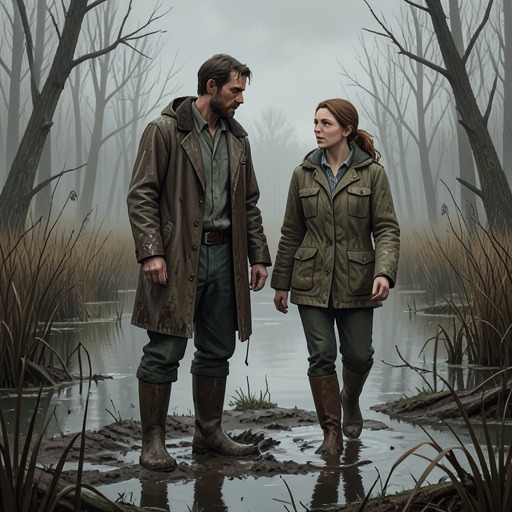
The swamp of 1969
Norwegian WoodThe swamp of 1969 is Toru Watanabe’s image for a year in which time moves, but his life seems not to. Its endless mud gives shape to grief and isolation, while the trudging through it anticipates a harsher knowledge after Naoko’s death: a philosophy may explain death, but no truth can cure the pain of loss.
The Year as a Landscape
Looking back on 1969, Watanabe sees a deep, sticky bog that seems ready to pull off his shoe at every step. The metaphor turns an inward condition into a landscape with no clear horizon: darkness stretches both ahead and behind, and the year offers neither a firm foothold nor a visible destination. Its force lies in the combination of obstruction and motion. Watanabe does keep walking, but each step feels precarious and tiring rather than like progress.
Time itself follows the rhythm of those faltering steps. Other people have gone ahead, while Watanabe and his time remain behind in the mud. The image makes alienation temporal as well as emotional: he is not simply separated from other people, but out of step with the pace at which the world appears to be changing. He does not know where he is or whether he is headed in the right direction. The one certainty is the requirement to keep moving, one step at a time.
Promised Change and Private Stasis
The landscape stands in deliberate contrast to the era’s language of transformation. The world seems poised for great change, and people announce revolutionary upheaval as if it were waiting just around the next bend. Yet what arrives, in Watanabe’s judgment, resembles two-dimensional stage scenery: a backdrop without substance or meaning. The political promise of a changed world and his own felt experience of immobility occupy the same period without meeting. The swamp is thus not simply an image of personal sadness; it is the ground from which he watches public claims of renewal appear theatrical and unreal.
His daily life gives that stalled time concrete form. He turns twenty, autumn becomes winter, and nothing significant changes. He attends lectures without excitement, works three nights a week in a record shop, returns to The Great Gatsby, and spends Sundays doing laundry and writing a long letter to Naoko. These repeated routines keep the days moving while preserving their sameness. His occasional meals, zoo visits, and films with Midori offer company, but do not dissolve the deeper condition represented by the bog.
The lives around him do register changes. The sale of the Kobayashi Bookshop goes ahead, and Midori and her sister move to a two-bedroom flat near Myogadani. Midori enjoys the brighter, more comfortable home and imagines living alone once her sister marries. Watanabe visits for lunch, but her altered domestic circumstances do not correspond to an equivalent renewal in him. The contrast sharpens the metaphor: life can reorganize itself nearby even while he experiences his own time as stalled.
Grief Beneath the Routine
Naoko remains emotionally present through the letters Watanabe writes to her, and the past continues to shape what he wants from the present. He declines Nagasawa’s invitations to go out with women, not because he has lost all desire, but because the process feels like too much effort. He also finds himself happier thinking about Naoko than sleeping with an anonymous stranger; the memory of her touch in a grassy field remains vivid. The swamp therefore contains not only numbness but attachment: his inward life is still oriented toward someone absent, and memory gives the otherwise monotonous year its strongest emotional charge.
That attachment is not a simple escape from grief. Earlier, when Watanabe tried to begin his life in the dormitory, he had resolved to stop taking everything so seriously and establish distance between himself and the past. Instead, a vague knot inside him gradually took a clear form: death exists not as life’s opposite but as part of life. The change from an inarticulate knot to a sentence offers understanding, but it does not make death safely separate or grief manageable. The dead remain folded into the life of the living, just as Naoko remains within Watanabe’s ordinary routines and desires.
From the Swamp to the Road
Watanabe’s image of trudging through the bog recurs in his parting from Nagasawa: after they shake hands and go their separate ways, Nagasawa heads toward a new world while Watanabe returns to his swamp. The contrast gives the metaphor a social edge. It names Watanabe’s sense that his friend can move forward into a new life while he remains caught in an interior landscape he cannot simply leave behind.
After Naoko’s death, that enclosure takes a more physical form. Watanabe withdraws in Tokyo, shuts himself in his room, and spends much of his time in rooms he had set aside for Naoko, with the furniture covered and the windowsills dusty. His attention remains fixed on the dead rather than the living. He eventually travels west, moving between unfamiliar towns by train, bus, or hitchhiking and sleeping wherever he can. On the coast, he listens to the waves and thinks about Naoko, unable to absorb that she is dead. The movement through actual places does not immediately end the inward immobility: the road becomes another way of living inside loss.
During those travels, memories of Naoko return in sensory, specific fragments, and in imagination Watanabe reaches a place where he can speak with and hold her. The imagined coexistence of death and life briefly softens the separation, but the tide of memory recedes and leaves him alone with sadness. From Naoko’s death he learns that no truth, sincerity, strength, or kindness can cure the sorrow of losing a loved one. The swamp’s lesson is therefore not that grief can be reasoned away, but that it must be lived through without any guarantee that what is learned will protect someone from the next loss. The image binds 1969’s daily stagnation to the novel’s larger insistence that continuing to live does not mean escaping the dead.