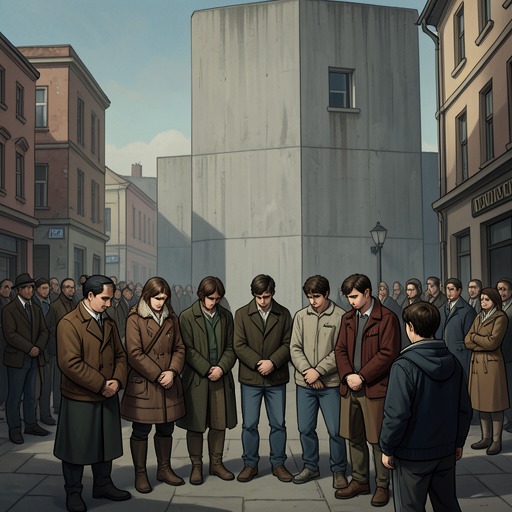
University student strike and police crackdown
Norwegian WoodThe University student strike and police crackdown turn the university’s political upheaval into a test of what its participants are actually prepared to change. The strike begins with calls to dismantle the institution, but after riot police remove the barricades, its former leaders return to class and resume taking notes. Toru Watanabe watches the gap between the rhetoric and the conduct widen, while his own grief leaves him unable to invest in either the protest or the restored order.
Causes and the strike’s language
At the end of May, students call for the university to be dismantled. Toru’s response is not a considered political program: he welcomes the prospect of destruction because, in his emptiness, almost any rupture seems preferable to the existing world. He says he is ready for anything and willing to help, but the intensity of the thought comes from his private desolation rather than allegiance to an organized movement.
That distinction shapes his view of the strike. Toru understands that the students who blockaded the campus were not literally trying to abolish the university. Their demand, as he sees it, was to shift the balance of power within its structure. The institution’s substantial investment and established interests also make its dissolution implausible. The slogans promise a sweeping break; the underlying political aim is narrower, and Toru remains detached from both.
The strike nevertheless changes his daily life. With the campus blockaded and lectures suspended, he takes a delivery job, loading and unloading lorries five days a week, while keeping his three-night-a-week job at the record shop. The physical work is harder than expected, but staying in motion helps him forget the emptiness inside. On nights without work, he drinks whisky and reads. The political disruption thus redirects him into labor and routine without resolving the isolation that makes the disruption momentarily attractive.
Police intervention and the return to campus
During the summer holidays, the university calls in riot police. They break through the barricades and arrest the students inside. The crackdown is presented as a familiar outcome of the period’s campus conflicts, not as the destruction of the institution: the authorities remove the blockade, while the university itself remains standing. Toru feels nothing when the strike is crushed, a reaction that sets his personal numbness against the collective drama around him.
In September, he returns expecting to find rubble. Instead, the library’s books remain in place, the tutors’ offices have not been destroyed, and the student affairs office has not burned. The untouched campus astonishes him. The physical result makes the apparent scale of the confrontation seem at odds with what it accomplished: the barricades have fallen, but the institution has not been dismantled.
Lectures resume under police occupation. The first students to take their places are the same people who led the strike. They take notes and answer when the register is called, although, in Toru’s understanding, nobody has declared the strike over; police have simply removed the barricades. He confronts the former leaders about their return, but they cannot give him a straight answer. He suspects that attendance marks may have mattered more than continuing the protest, and reads their quick adjustment as a revealing retreat from their earlier declarations.
Political rhetoric and the classroom
The campus conflict reappears in a lecture on Greek tragedy. A professor has been discussing the use of the deus ex machina in Euripides when two helmeted students enter. One carries political handbills; the other tells the professor that they intend to use the second half of the lecture for political debate. He presents this as an announcement rather than a request, invoking the world’s supposedly more urgent problems. The professor doubts that these problems outrank Greek tragedy, but recognizes that his objection will not be heard and leaves the room with his cane.
The handbills call for action against a fraudulent university-president election, a new all-campus strike, and the imperial-educational-industrial complex. Toru does not object to their political positions so much as to their language: he finds the writing uninspiring and the speaker’s address merely a recycled tune. In his judgment, the students’ real enemy is not State Power but Lack of Imagination. The interruption condenses the wider contradiction of the strike: radical language claims urgency, yet its delivery seems formulaic, while the lecture displaced in its name had been engaging a different account of political and dramatic meaning.
Midori arrives late to the lecture and sits beside Toru, returning his notebook with a note apologizing for Wednesday and asking whether he is angry. When the political meeting takes over, she suggests that they leave. Toru agrees, and they walk out while the speaker is still addressing the class. Their departure is a small, immediate refusal to let the agitators dictate their attention; it also contrasts with the former strike leaders’ return to the classroom as if the confrontation had changed nothing.
Disillusionment and consequence
Toru’s judgment of the leaders is sharpened by their reversal. He remembers them denouncing students who opposed the strike or voiced doubts, sometimes subjecting dissenters to improvised tribunals. Now they attend lectures and pursue good marks. He sees their retreat as evidence that their boldest words were not backed by a willingness to bear the ordinary costs of continuing the action. His bitter imagined address to Kizuki—that the dead are missing nothing in this world—connects the political spectacle to his persistent grief and distrust of the society the students will help reproduce.
For a time, Toru attends lectures but refuses to answer when his name is called. He knows the gesture cannot alter the university or revive the strike; its only immediate effect is to make the room uncomfortable for a few seconds and further isolate him from his fellow students. By the second week of September, he concludes that university education is meaningless, but he does not leave. Instead, he recasts it as training in techniques for dealing with boredom, attends class, takes notes, and spends his free time reading or looking things up in the library.
The episode therefore ends not with political victory but with routines reasserting themselves: the campus is open, the former leaders are back at their desks, and Toru continues his studies without believing in their larger purpose. The crackdown exposes the strike’s limited practical reach; the classroom confrontation shows how hollow its slogans can sound to him. His silence and continued attendance do not resolve that disillusionment. They establish a private, largely ineffective way of living inside an institution whose public promises he no longer trusts.