Watanabe's Dormitory
Norwegian WoodWatanabe's Dormitory is the Tokyo residence where Toru Watanabe spends his first two university years, from spring 1968 to spring 1970. A place of lawns, sports grounds, and communal facilities, it is also an ideologically charged institution governed by ritual and regulation; its orderly enclosure offers practical shelter while setting the terms of everyday life.
Setting and Layout
The dormitory occupies a hill in the middle of the city, within a large quadrangle enclosed by a concrete wall. Just inside the gate stands a towering zelkova said to be at least 150 years old, its dense leaves obscuring the sky. A paved path curves around the tree and runs straight across the grounds between two three-storey concrete dormitory buildings. Their many windows and identical cream-coloured curtains give them the aspect of apartments converted into jails, or jails converted into apartments, though the buildings are clean and not gloomy; radios sound through their open windows.
Beyond the dormitories, the path leads to a two-storey common building. Its first floor contains a dining hall and bathrooms, while its second has an auditorium, meeting rooms, and guest rooms whose purpose remains unclear to Toru. A third dormitory stands beside it. Green lawns and sprinklers fill the quadrangle, and behind the common building are fields for baseball and football and six tennis courts. The compound is equipped to meet much of a resident's daily needs within its walls.
Residence and Institutional Character
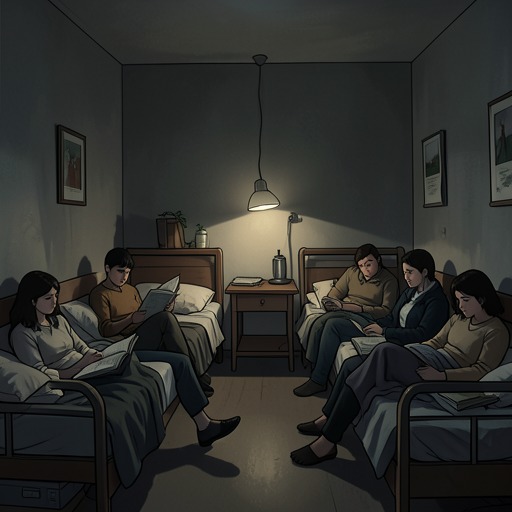
Toru is eighteen, a first-year student newly arrived in Tokyo and unused to living alone when his anxious parents arrange for him to stay there. The dormitory provides meals and other facilities at a lower cost than a private room, and requires little furnishing beyond bedding and a lamp. Toru would rather have lived alone in a flat, but he knows the expense of his private-university tuition gives him little basis to insist; he also says that he does not particularly care where he lives.
The institution's public language presents a national purpose: its pamphlet describes a founding spirit of nurturing people to serve the nation through educational fundamentals. The dormitory is run by a foundation centred on an extreme right-wing figure, and Toru finds something politically suspect in its rules and public image. The foundation's wealthy financial backers have contributed to the buildings, while explanations for the project circulate without resolution: it may be a tax dodge, a publicity exercise, or a cover for obtaining valuable land. Toru cannot establish which account, if any, is true. What he does know is that an elite club links students from several universities with the founders through study groups held several times a month, and that club membership can secure a good job after graduation.
Daily Order and Boundaries
Every day begins with a solemn flag-raising, accompanied by the national anthem. The flagpole stands at the centre of the compound, visible from the windows of all three dormitories, making the ritual part of the shared view as well as the shared schedule. Toru remains there for two years, although he cannot give a decisive reason for putting up with the place. Its political character makes little practical difference to his routine, whether the institution is described as right-wing, left-wing, or something else.
The dormitory's enclosure contrasts with other bounded places Toru encounters. On the route to Ami Hostel, he finds a private road marked against trespass; there, residents are forbidden to go into town as a rule, and leaving means they cannot return. The hostel's women live in Area C, a row of ten houses divided into four units each, with two people per unit: a capacity of eighty, though only thirty-two women are there at the time. These details describe a different institution, but sharpen the novel's recurring attention to how walls, access rules, and organized routines shape where people can go and whom they can meet.
Narrative Significance
The dormitory gives Toru a place to live during the years when he is learning to keep distance from what troubles him, but its orderly ceremonies do not insulate him from loss. After Kizuki's death, Toru tries to put earlier images aside; over time, he comes to understand death not as the opposite of life but as part of it. The dormitory is the setting for this period of adjustment, not a cure for it: its practical comforts and predictable rituals coexist with Toru's inner disturbance.
Across the novel, the dormitory's visible central flagpole, enclosing wall, and extensive amenities make institutional order concrete, while its opaque foundation and uncertain purpose unsettle the official account of that order. The contrast between a self-contained compound and Toru's later movements through cities, mountain roads, and unfamiliar towns extends the book's concern with spaces that both shelter and constrain. Its significance lies in that double character: it houses Toru, yet the political and social world it embodies remains something he observes from a distance rather than embraces.