Blackstable
Of Human BondageBlackstable is the seaside village that gives Philip Carey both his first home after his mother’s death and a recurring place of refuge. Its ordered vicarage, church, and local social hierarchy shape his childhood, while the harbor and sea carry an imaginative promise of escape. When Philip returns as an adult, the unchanged setting measures how much he has suffered and how little its inhabitants have altered.
Setting and the Vicarage
Sixty miles from London, Blackstable is reached by a short walk from the station to the vicarage. Philip recognizes its red, five-barred gate, which swings easily in both directions although children are forbidden to play on it. The house distinguishes carefully between visitors and household traffic: the front door is reserved for Sundays and special occasions, the side door serves the family, and a back door is used by the gardener and by beggars and tramps. These practical divisions make the vicarage an ordered home, but also a place governed by rank and rules.
Inside, the hall’s red and yellow tiles alternate the Greek Cross with the Lamb of God. Its imposing polished-pine staircase was made from surplus wood left after the church was refurnished, and its balusters bear emblems of the Four Evangelists. Household architecture and church symbolism thus meet in a domestic interior, reflecting the central place that religious life occupies in the village and in the Careys’ household.
Village Life and Social Boundaries
Blackstable is a fishing village organized around a high street of shops, a bank, a doctor’s house, and the homes of several coal-ship owners. Poorer fishermen live in shabby streets around the small harbor. The social hierarchy is not merely economic: the Vicar and Mrs. Carey regard their own standing as above that of farmers, while chapel-going residents are treated as outside the dominant social world. The village’s local distinctions help form Philip’s early sense of rank, respectability, and who belongs where.
Even the circulation of news follows a settled local arrangement. After breakfast, Mary Ann brings in The Times, which Mr. Carey shares with two neighbors. The paper passes from him to a gardener, then to Mr. Ellis at the Limes, and later to Miss Brooks at the Manor House; in summer, Mrs. Carey sometimes borrows it back to line jam pots. The newspaper’s circuit gives a concrete shape to a community in which information, favors, and ordinary routines move along familiar paths.
Josiah Graves, the churchwarden, is one of the village’s prominent guardians of custom. His objection to the Vicar’s second-hand altar candlesticks as popish provokes Mr. Carey, who has a private sympathy for Roman Catholic ceremonial and would welcome processions and candles, though not incense. Their recurring disagreement shows how religious taste and local authority can become part of everyday village life. Years later, Graves still disapproves of candles on the altar, a surviving point of friction in a place otherwise marked by continuity.
Philip’s Childhood and Imaginative Geography
At the vicarage, Philip’s loneliness is no greater than it had been as an only child with his mother. He befriends Mary Ann, the thirty-five-year-old daughter of a fisherman, who has lived in the household since she was eighteen and has no intention of leaving, though she teases her timid employers by holding the possibility of marriage over them. On her evenings out she visits her parents in a small house off Harbour Street. Her stories of the sea ignite Philip’s imagination, and the narrow harbor alleys acquire the romance of an unknown world.
Philip asks to accompany Mary Ann to her parents’ home, but his aunt fears he might catch something and his uncle warns that bad company corrupts good manners. The refusal reveals a boundary between the protected vicarage and the working fishing community; it also leaves the harbor vivid in Philip’s mind precisely because he is kept at a distance from it. At school, his clubfoot compounds his social timidity: he knows the local tradesmen’s and farmers’ daughters by sight but thinks they laugh at his deformity. Blackstable’s class distinctions and his bodily difference therefore shape not only where he may go, but how he imagines himself among others.
Returns, Memory, and Change
When Philip returns from Germany, he sees his uncle and aunt as old people for the first time. The Vicar seems stouter, balder, and grayer, and Philip recognizes the weakness and self-indulgence of a man he had once viewed chiefly through the authority of his office. Aunt Louisa embraces him, weeping with happiness; he is moved and embarrassed as he discovers how deeply she has loved him. Blackstable is thus not only a stable backdrop but a setting where his altered perception changes the meaning of familiar relationships.
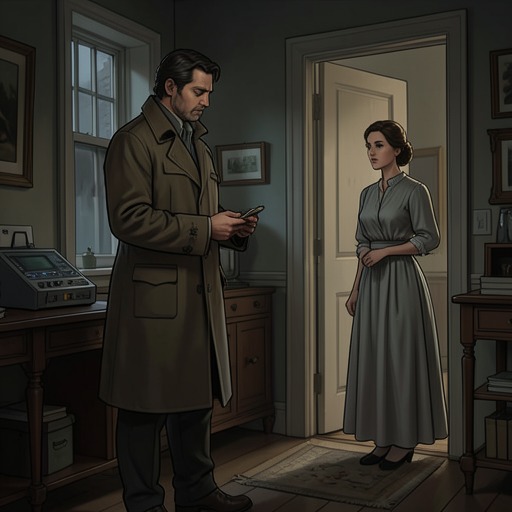
After a later period of suffering in London, Philip hurries to Blackstable to escape the rooms associated with his unhappiness and breathe clean air. The vicarage’s corner bedroom is still the best spare room: an old tree blocks one window, while the other looks beyond the garden and field to broad meadows. Familiar early-Victorian watercolors, stiff muslin around the dressing table, and the old tall-boy have remained in place. Their unchanged presence gives him pleasure he had not known he felt, making homecoming an experience of recognition rather than triumph.
The village’s broader routines have endured as well. The Vicar eats the same food, repeats the same remarks, and takes the same walk, though he has grown fatter, quieter, and narrower. He has become accustomed to life without his wife and misses her little. Graves has grown thinner and whiter but remains austere and opposed to altar candles. The shops retain their quaint appearance; standing before the shop that sells sea-boots, tarpaulins, and tackle, Philip recalls the childhood thrill of the sea and the adventurous magic of the unknown. The same place can preserve both domestic sameness and a powerful imaginative past.
The Last Homecoming and Narrative Significance
When William Carey is gravely ill, he writes to invite Philip to visit, recalling that Doctor Wigram had once feared he would not survive a winter bout of bronchitis and expressing gratitude for his recovery. On Philip’s next return, his uncle has changed sharply: once stout, upright, and clean-shaven, he is now bent, yellow-skinned, bearded, and slow-moving. Philip reaches Blackstable early in the afternoon, and Mrs. Foster’s face tells him that William is not yet dead. The village becomes the setting for a final passage from anticipated loss to inheritance.
After the funeral, Graves returns to the vicarage with Philip and reads the will over an early cup of tea. William has left everything to his nephew: the furniture, about eighty pounds in the bank, twenty shares in the A. B. C. company, and smaller holdings in a brewery, an Oxford music hall, and a London restaurant. The quiet domestic scene ties the end of Philip’s dependence on the vicarage to a material inheritance whose contents reflect William’s modest, varied investments.
Across the novel, Blackstable’s narrative force lies in its contrast with Philip’s unsettled adult life. It is a place of class boundaries, religious observance, and habitual routine, yet it also shelters memories and sensations that he cannot recover elsewhere: Mary Ann’s sea stories, the harbor’s imagined adventure, and the familiar room’s reassuring objects. Its recurrence makes return neither a simple restoration nor an escape from change. Rather, the village remains recognizably itself while Philip’s understanding of home, family, and his own past develops around it.