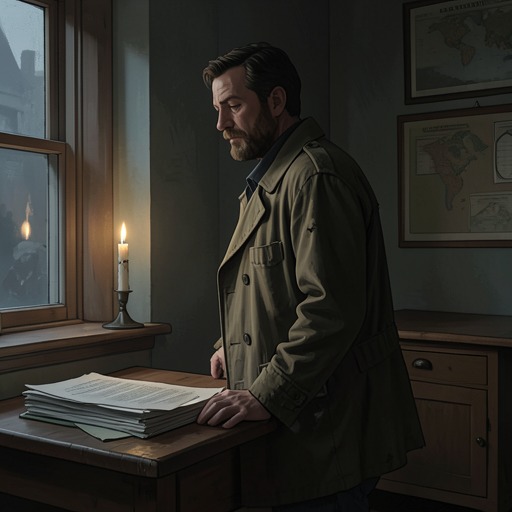
Doctor South
Of Human BondageDoctor South is the veteran general practitioner in Farnley who offers Philip Carey a partnership and a settled career, but cannot persuade him to give up his desire to travel. Initially presented as a sardonic, medically conservative employer, South gradually recognizes Philip’s competence and character; his proposal makes their brief association a turning point in Philip’s professional life and a quiet study in the difference between security and freedom.
Identity and Practice
Philip encounters South through a temporary appointment arranged by St. Luke’s Hospital. South’s assistant has developed mumps, so the hospital secretary offers Philip a month’s work at three guineas a week, with board and lodging, in Farnley, Dorsetshire. Philip agrees and travels there that same day. The first meeting is wary: South has kept dinner back for him but remains at his desk, staring rather than rising to greet him. The posting will prove more than a stopgap, however, because South is looking for an assistant who can understand the character of his practice and work without the professional hauteur he associates with younger hospital doctors.
South’s patients are chiefly fishermen and their families, as well as people served by the Union and the Seamen’s Hospital. He explains that a doctor established on the cliff receives the well-to-do visitors drawn by the town’s development as a fashionable seaside resort; his own practice is largely made up of people unable to pay a doctor at all. That distinction places South’s work among patients whose poverty is not incidental to their medical needs. It also helps explain why he distrusts treatments that make a poor patient’s bill needlessly expensive.
Methods and Conflict with Hospital Medicine
South resists the medical fashions of recent decades. He distrusts successive waves of celebrated remedies and continues to use mixtures he has relied on since his own student days. His skepticism extends to asepsis: although Philip follows the precautions emphasized at the hospital, South treats them with disdainful tolerance. He dismisses the succession of antiseptics and asepsis as “Bunkum!” His outlook is not simply a preference for old habits; it belongs to a wider contempt for young doctors who have absorbed hospital practice without learning how ordinary patients live or what everyday general practice demands.
In South’s view, the hospital-trained assistants arrive knowing how to manage obscure diseases but helpless with a common cold. Their theoretical knowledge, he believes, is matched by unjustified self-assurance. He reproaches them for prescribing costly combinations of drugs to fishermen with stomach-aches, and complains that their reading, handwriting, and spelling are inadequate. South’s judgments can be severe and his manner deliberately intimidating, but his criticism is grounded in the practical and economic circumstances of his patients.
Philip makes mistakes of his own. Having never seen measles before, he mistakes its rash for a rare skin disease; at other times his treatment differs from South’s. The first disagreement brings a display of savage irony. Philip answers with good-humoured repartee rather than fear or resentment, and South begins to suspect that the new assistant is teasing him. Accustomed to assistants who dislike and fear him, South finds Philip’s composure unexpected. He considers sending him away, then finds himself amused; the irritation becomes a shared, if unspoken, recognition that Philip will not be cowed by sarcasm.
Respect and Personal Recognition
South’s respect for Philip grows out of their daily work. Philip is pleased by the independence and responsibility of the post, and by the chance to observe patients over the course of treatment rather than at the intervals imposed by hospital work. His rounds take him into fishermen’s cottages where equipment and mementoes from distant journeys fill the rooms; he enjoys talking with sailors who discover he is not condescending. South’s rough practice gives Philip room to use both clinical judgment and the ability to put people at ease, while South can see how patients respond to him.
Their exchange about Philip’s club-foot brings that recognition into personal focus. South asks whether his earlier reference to Philip’s “game leg” had stung. Philip says that people bring up his disability, directly or indirectly, whenever they are angry with him. South observes that they must know it is a weak point. The exchange acknowledges a vulnerability that has repeatedly exposed Philip to insult, but it also marks a difference in South’s manner: the question is direct, and it leads not to mockery but to a serious offer. South asks why Philip should not stay and proposes to dismiss the assistant away with mumps.
The Partnership Offer and Refusal
South offers Philip a partnership in the practice. He says it brings in about seven hundred pounds a year; they can calculate the value of Philip’s share, which Philip may pay off gradually, and Philip can succeed him when he dies. To South, this is a practical alternative to years of hospital appointments and assistantships before Philip can afford to establish himself. The profession is crowded, and Philip understands that many doctors would welcome such a dependable beginning.
Philip refuses, not because he is weighing the financial terms, but because the proposal conflicts with the hope that has sustained him through years of difficulty. He has qualified in order to travel, and now feels an urgent desire to get away, even though he has no particular destination in mind. South recognizes the force of that longing as a sign of youth. He tells Philip that the offer will remain open if he changes his mind; Philip thanks him and leaves by train. The departure contrasts Philip’s excitement about seeing friends and spending a fortnight in the hop-field with South’s return to an empty house, where he feels old and lonely. South has offered security and belonging, but cannot make them answer Philip’s wish for movement.
Continuing Significance
South’s proposal remains available after Philip leaves. Later, when Philip is preparing to meet Sally at the National Gallery, he has written to South and carries a telegram from him: “Sacking the mumpish fool. When will you come?” The message confirms that South has dismissed the temporary assistant and still wants Philip to return. Its blunt familiarity makes clear that the partnership offer was not a passing courtesy: South continues to make room for him, even as Philip’s immediate attention is elsewhere.
South’s role brings together the practical and emotional stakes of Philip’s medical career. In Farnley, Philip finds work that gives him responsibility, contact with patients, and a degree of independence; South sees enough in him to offer a secure share in an established practice. Yet the offer cannot settle Philip’s future, because he values the possibility of travel over professional certainty. South, meanwhile, is left alone with the life he has built. Their separation is therefore neither a simple rejection of South nor a repudiation of medicine: it is the moment when Philip’s desire for freedom outweighs a rare offer of stability, while South’s willingness to renew the offer preserves the possibility of a different future.