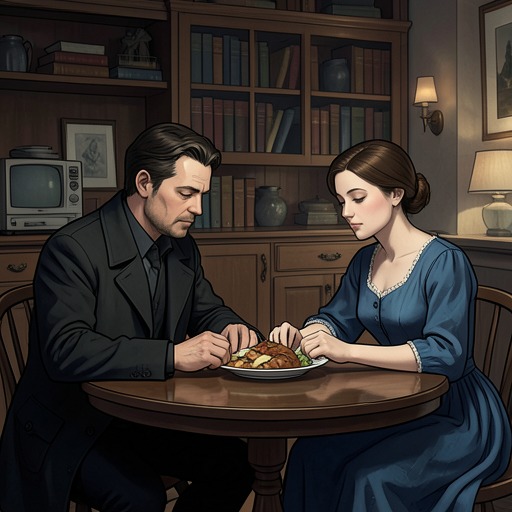
Mrs. Foster
Of Human BondageMrs. Foster, the longtime housekeeper at the Blackstable Vicarage, becomes the principal caregiver to the dying William Carey. Her steady attendance through his illness—washing, dressing, feeding, and answering him through the night—reveals an attachment built from years of shared domestic life, even though she is not his relation. In the final vigil, her exhausted tenderness stands alongside Philip Carey’s return to the household, making care itself one of the last bonds around William as his life ebbs away.
Identity and Place in the Household
Mrs. Foster belongs to the working life of the Blackstable Vicarage: she is its housekeeper and has served there for many years. The text gives her no independent family history, but her place in the household is made clear through what she does and through her own uncertainty about the future. She tells Philip that she does not know what she will do when William dies, a remark that joins her personal attachment to the material insecurity of losing the position around which her life has been organized.
Her care is not presented as a formal medical role. Instead, she provides the continuous, ordinary labor that illness requires: washing and dressing William, bringing him food, and sleeping in the adjoining room so she can respond whenever his small bell summons her. The narrative emphasizes the unbroken repetition of these tasks, making her domestic service a form of sustained intimacy rather than a background convenience.
Caring for William Carey
When Philip returns to the vicarage at Christmas, Mrs. Foster warns him that his uncle has changed and asks him to pretend not to notice. Her concern shows how vulnerable William has become and how carefully she manages the dignity he still wants to preserve. The request also makes her an interpreter of the household: she knows both the physical changes Philip will see and William’s nervousness about being seen in that condition.
As William’s illness continues, Philip recognizes that Mrs. Foster has had little peace for months. She nevertheless describes the old man as dependent and troublesome while admitting that he is hard not to like. Her affection is not sentimentalized as effortless devotion. It exists alongside fatigue and the demands of constant attendance, and Philip sees that she has been carrying this burden largely by herself.
The extent of her service is concrete. William may die at any moment or live for months; Mrs. Foster washes and dresses him, gives him his food, and rises repeatedly during the night. She sleeps in the next room, and when he wakes he rings his little bell until she comes. The bell turns his dependence into a recurring domestic summons, while her response makes clear how thoroughly his survival and comfort have come to rely on her presence.
The Final Illness and Philip’s Return
When William’s condition becomes more demanding, Philip and Mrs. Foster nurse him together. William’s appetite fails, neuritis torments him, and the shaking of his palsied limbs gradually exhausts him. Dr. Wigram uses opiates to still the pain, but when their effects wear off William grows restless and keeps Philip busy. The illness thus places care in a cycle of brief relief and renewed need, with Mrs. Foster’s long months of work visible in Philip’s decision to take a turn at the bedside.
Philip insists on sitting up so that Mrs. Foster can have a night’s rest. He remains in an armchair, careful not to sleep deeply, and reads The Thousand and One Nights by shaded candlelight, a book he had not opened since childhood. The scene gives her exhaustion a direct consequence: Philip’s watch is not merely an expression of filial duty but an effort to provide the respite that her months of service have denied her. While he keeps vigil, she remains part of the shared work of nursing rather than being displaced from William’s care.
As William approaches death, Philip sends Mrs. Foster to summon the gardener with a message and then returns to the bedroom. After he briefly leaves the house, she is still seated beside the bed when he comes back; she tells him William is just as he was when he left. Her place beside him persists through the final interval, while Philip watches the old man’s unconscious body struggle and then die. The narrative’s attention moves to Philip’s perception of death, but Mrs. Foster’s presence at the bedside marks the practical continuity of care until the end.
Attachment, Labor, and Significance
Mrs. Foster’s relationship with William is defined by an asymmetry of dependence, but it is not reduced to duty. She calls him a poor old gentleman, acknowledges that he can be troublesome, and still says that one cannot help liking him. Philip sees that she is genuinely fond of him. The mixture of affection and labor matters: she gives care to a man who is not family, yet the years of service have made his impending death a loss she cannot regard as merely professional.
Her situation also exposes the vulnerability beneath long service. Mrs. Foster has devoted herself to the household for years, but William’s death threatens to leave her without a clear future. Her statement that she does not know what she will do when he is gone is both an expression of grief in advance and a practical fear. The narrative does not resolve what becomes of her after his death; her concern remains unanswered, as do the material consequences of losing the person she has cared for and the household in which she has worked.
In the closing illness, Mrs. Foster represents the largely unseen labor that surrounds death: the repeated lifting, feeding, washing, watching, and answering of a bell. Her quiet constancy contrasts with the finality of William’s decline. Philip can take a night’s watch and witness the last moments, but her months of attention have sustained the daily life that precedes them. Through her, the vicarage’s final days are rendered not only as a family bereavement but as a story of care, dependence, attachment, and the precarious position of the person who provides that care.