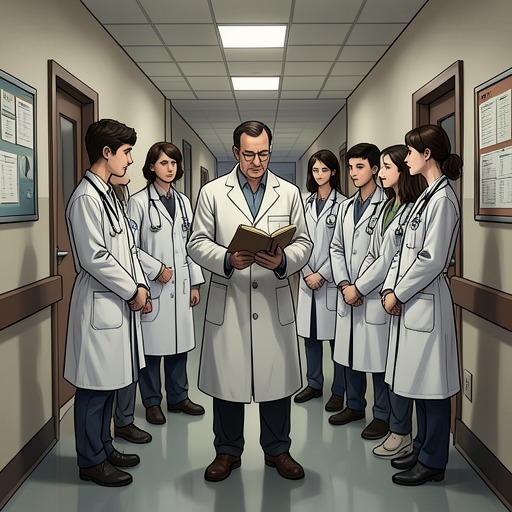
Royal College of Surgeons
Of Human BondageThe Royal College of Surgeons appears at a decisive threshold in Philip Carey’s medical career: he leaves its building carrying the diploma that qualifies him to practise. The institution’s narrative significance lies in this tangible culmination of seven years of study, set against the clinical work and encounters with poverty through which he has learned what medicine means beyond examinations.
Place in Philip’s Medical Training
Philip’s route to qualification has included the dissecting-room, where he first confronts the acrid smell of the work, and the crowded outpatient department at St. Luke’s Hospital, where students observe cases and record patients’ details. His training is not confined to formal instruction: as a clerk, he works through long afternoons among patients whose illnesses reflect alcohol use and inadequate nourishment. These hospital experiences supply the practical world behind the credential he eventually receives.
The Qualification Scene
At the beginning of August, Philip passes his surgery, his last examination, and receives his diploma. Seven years have passed since he entered St. Luke’s Hospital, and he is nearly thirty. He walks down the stairs of the Royal College of Surgeons with the roll in his hand, his heart beating with satisfaction; he thinks that he is really going to begin life. The scene makes professional qualification both a literal document and a threshold into a new stage of independence.
Clinical Work Beyond the Credential
Before qualifying, Philip has found absorbing interest in the patients themselves. In the outpatient rooms, he watches how people describe illness, learns how to frame questions so they will be understood, and recognizes that patients may conceal information until approached carefully. He feels able to put them at ease and senses that a patient entrusted to his inquiry gives himself into his hands. The work shifts his attention from the abstract pursuit of beauty that occupied him in Paris to direct contact with men and women.
That education continues in the hospital district. Philip attends an average of three confinements a day, often summoned at night and walking through deserted streets to homes where families live in cramped, airless rooms. He earns confidence through kindness, gentle hands, patience, and an ease with the people who offer him tea and bread and dripping while they wait. His diploma therefore follows not only years of study but also an apprenticeship in the circumstances surrounding illness, childbirth, and want.
Limits and Significance
The text does not describe the Royal College’s governance or wider institutional structure; it presents the College through the precise moment when Philip receives the qualification that permits him to practise. That moment joins achievement to responsibility. Immediately afterward, he seeks a hospital appointment, turning the satisfaction of passing into a practical next step. The College stands at the boundary between training and professional life, while the scenes that precede that boundary show the human realities his medical work will require him to face.