St. Luke's
Of Human BondageSt. Luke’s is the London hospital and medical school at the center of Philip Carey’s long, interrupted medical education. Chosen because his father had studied there, it becomes more than a professional institution: its dissecting rooms and crowded clinics bring him into sustained contact with bodies, illness, and social deprivation, changing how he understands both medicine and the people it serves.
Medical School and Early Training
Philip enters St. Luke’s after the examination he passed before beginning his accountancy apprenticeship proves sufficient for medical study. He chooses the hospital for its connection to his father and, before the summer session ends, visits its secretary to arrange his admission and find lodgings within a two-minute walk. The secretary tells him he will need a part to dissect and recommends starting with a leg. The practical instruction marks the beginning of an education in which the body is first an object of study and then, increasingly, a human life to be understood.
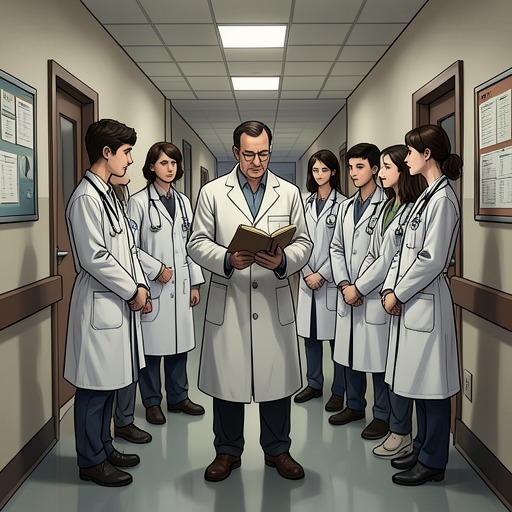
On his first day Philip arrives early, trying to appear at ease among students who drift through the school’s entrance hall and reading-room. He wanders into the pathological museum, where an eighteen-year-old student speaks to him and later accompanies him to the anatomy theatre. There, about sixty students gather, most younger than Philip; the table holds a pelvis and two thigh-bones, and Mr. Cameron begins the lecture by calling the roll and recommending books and a skeleton. Cameron presents anatomy as essential to surgery and as a source of appreciation for art, a conjunction that catches Philip’s attention. His own range of experience includes lecturing at the Royal Academy and years at the University of Tokyo, and he takes evident pleasure in the beautiful as well as the scientific.
After the lecture, Philip follows his fellow student to the dissecting-room. The acrid smell he noticed in the passage becomes unmistakable, and he lights a pipe; an attendant laughs and tells him he will soon grow used to it. This first encounter gives medical training a material reality distinct from the ordered lecture: learning requires proximity to the dead body and accommodation to the conditions of the room.
The Out-Patients’ Department
At the beginning of the winter session Philip becomes an out-patients’ clerk and puts his name down to work with Dr. Tyrell. The department consists of three adjoining rooms and a large, dark waiting-room with massive pillars and long benches. Patients wait there after receiving their letters, carrying bottles and gallipots; some are tattered and dirty, others respectably dressed. Salmon-colored walls with maroon dadoes, disinfectant, and the accumulating stench of crowded humanity make the clinic a physical record of illness and unequal living conditions.
The daily procedure is organized around sorting and throughput as well as diagnosis. At half past one the house-physician rings for old patients, many of whom have chronic bronchitis. Those judged to be improving receive the notation “Rep 14” and return to the dispensary for another fourteen days’ medicine. Some hold back in the hope of seeing Dr. Tyrell, but only a few whose condition seems to require his attention are retained. The large daybook records each patient’s name, age, sex, profession, and diagnosis, reducing the encounter to entries even as the stream of individual lives passes before the clerks.
Tyrell’s brisk, joking manner gives the consultation a theatrical ease, but his authority also enforces a boundary around charity. He suspects better-dressed patients of disguising their means and sometimes refuses to see those he believes can afford private attendance. His scrutiny of women’s worn clothes and the rings they have neglected to remove makes poverty something patients must visibly prove. The hospital is a charitable institution, but access to it is not automatic: the physician’s judgments determine who counts as entitled to its care.
The illnesses Philip sees are tied repeatedly to material circumstances. Men commonly suffer from the effects of excessive alcohol use, while women’s ailments more often reflect inadequate nourishment. Tyrell tells the students that a woman’s brother and sister died within three months of their first symptoms and expects her to follow; if the family were rich, he says, something might be done, but they cannot be sent to St. Moritz. In another case, a strong working man’s persistent pain leads to a verdict of death. Complete rest is his only chance, yet he cannot obtain it: when told to find lighter work, he answers that his trade has no light jobs. The clinic can recognize the medical danger, but it cannot readily undo the economic conditions that perpetuate it.
Philip’s Clinical Outlook
For Philip, the out-patients’ department becomes absorbing work rather than merely a set of duties. He spends hours standing in bad air, listening closely to patients and trying to establish what has brought them to the hospital. Their faces, voices, gait, and manner reveal differences that a diagnostic label alone cannot contain; Philip learns to ask questions in forms they understand, to notice the subjects on which they tend to lie, and to discover how further questions can elicit what they withhold. He observes that people receive the prospect of dangerous illness in sharply different ways, from laughter and jokes to silent despair.
This attention alters his relationship to those who come for treatment. He feels at home with them, not exactly sympathetic in a way that would place him above them, and discovers that he can put them at ease. When given a case to investigate, he feels that the patient entrusts himself to him with a particular confidence. His earlier life in Paris, devoted to color, tone, and the production of beautiful things, now seems far removed from this direct contact. At the hospital, Philip experiences a different kind of power: not artistic control over an image, but the responsibility and excitement of attending to people whose histories emerge through conversation and examination.
That clinical position also sharpens his perception of social distance. The patients are not simply medical examples: their occupations, incomes, domestic arrangements, and choices shape what can be done for them. Later, during obstetric work in poor neighborhoods, Philip sees how the hospital’s minimum ten-day period in bed after childbirth clashes with household necessity. No one may care for the children without payment, and the husband may come home tired and angry if his tea is not ready. Women explain that they cannot afford help, while the people around them treat the middle classes as remote and soft-handed. Philip learns these conditions not from abstract instruction but by listening in the rooms where patients live.
Return, Qualification, and Significance
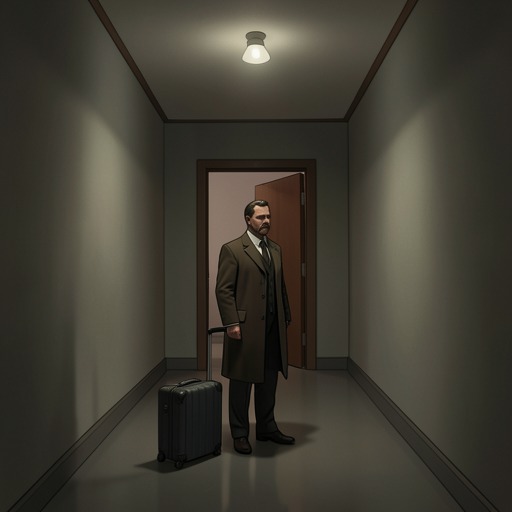
After a two-year break from the hospital, Philip returns to St. Luke’s to finish his training. He gives the secretary a deliberately vague account of private affairs and says he wants to qualify as soon as possible. Because the first available examination is in midwifery and diseases of women, he signs up as a clerk in the ward devoted to those conditions and arranges to serve during the last week of August and the first two weeks of September. His return is not a simple resumption: experience has made him more self-possessed, and he regards the renewed course as the chance to begin again.
In the district work attached to his training, he attends an average of three confinements a day. Messengers, often little girls, bring the hospital card to his lodging, sometimes at night; he walks through deserted streets to the patient’s home and waits for hours in stuffy rooms with the woman, her mother, and the midwife. His patients value his gentleness, his patience, and his willingness to share their tea and bread and dripping. Some homes are filthy courts without air or light; others, though dilapidated and densely occupied, retain carved oak balusters and paneling. The contrast makes the poverty more, not less, concrete: signs of an older domestic grandeur persist amid vermin, leaking roofs, crowded rooms, and hand-to-mouth survival.
The limits of institutional medicine become particularly stark when Philip and Chandler attend a woman whose life cannot be saved. As dawn approaches, she dies in a cheap iron bed while her young husband stands at its foot, bewildered and silent. Outside, Philip thinks first of the life poverty might have imposed on her: labor, deprivation, and dependence in old age. Yet pity seems inadequate to what he has witnessed. The hospital can send trained attendants into the room, but it cannot separate an individual illness from the larger conditions shaping an entire life.
Philip spends the remaining weeks before winter in the out-patients’ department, then settles into regular work in October. The two years away have, he thinks, left his mind refreshed; he is able to work energetically among a changed group of students. At the beginning of August he passes his final examination and receives his diploma, seven years after first entering St. Luke’s. Nearly thirty, he leaves the Royal College of Surgeons with the qualification to practise and the satisfaction of having completed a course repeatedly interrupted by his life outside the hospital.
St. Luke’s therefore frames a decisive change in Philip’s way of seeing. Anatomy begins with bones and the discipline of dissection; clinical work teaches him to attend to speech, behavior, work, diet, housing, and family pressures. The hospital’s procedures can classify, prescribe, and sometimes recognize a grave prognosis, but its charitable reach and the physician’s knowledge remain bounded by poverty and labor. Through that tension, Philip’s medical education becomes an education in the human circumstances that diagnosis alone cannot cure.