Thorpe Athelny
Of Human BondageThorpe Athelny is a journalist Philip meets while training at St. Luke’s Hospital. A lively talker with a varied working life, he becomes a friend and a welcoming presence in Philip’s Sundays. Through Athelny, the novel joins hospital life to a noisy family household and gives Philip a relationship founded on conversation, hospitality, and shared attention to art and books.
Identity and Introduction
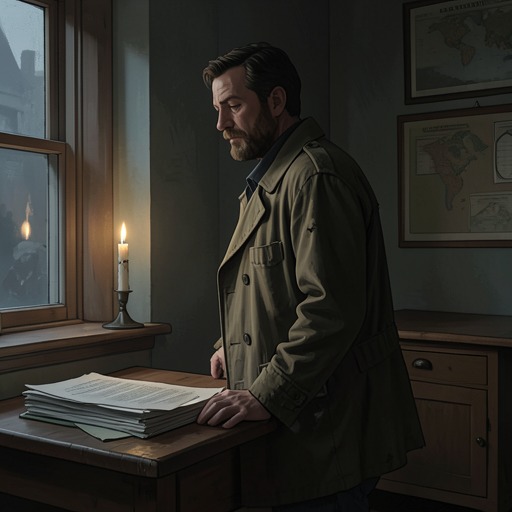
At forty-eight, Athelny is admitted to the hospital with a sharp attack of jaundice and symptoms that require observation. Philip first encounters him while taking down the particulars of his case. Athelny’s educated, pleasant manner and distinctive appearance stand out even in bed: he has small, delicate hands, blue eyes, a prominent nose, and a pointed gray beard. The contrast between his status as a patient receiving charity and the ease with which he carries himself becomes part of their early rapport.
Athelny does not regard using public provision as a source of shame. He explains to Philip that he makes use of the services society offers, including hospital treatment when ill and board-school education for his children. His matter-of-fact attitude differs from the embarrassment Philip fears he might cause by visiting. It also establishes Athelny as a man who meets social convention with practical independence and humor.
Friendship with Philip
The two men’s acquaintance grows through brief conversations during Philip’s hospital work. Athelny talks with an eager vividness that sets Philip’s imagination moving; although he is much older and more widely read, he balances their different positions with humor. His tales and ideas offer Philip a fresh imaginative world at a time when much of his own life is absorbed in routine and make-believe.
At their first meal together, Athelny praises simple pleasures such as English beer, roast beef, and rice pudding. He also speaks frankly about his experience of marriage and argues, from that experience, for a practical rather than intellectual ideal of domestic partnership. His views are his own, expressed with comic confidence, and the setting’s mixture of Spanish furnishings and English food delights Philip through its incongruity.
Athelney’s influence is especially apparent when he shows Philip a photograph of Toledo. Philip finds the image arresting and feels that it opens the way to a new discovery. Its visionary landscape challenges the strict realism he had pursued as a painter: the picture seems precise yet also to express a reality apprehended through the spirit. The encounter redirects Philip’s attention from the romantic passion consuming him toward the excitement of artistic and imaginative perception.
Family and Work
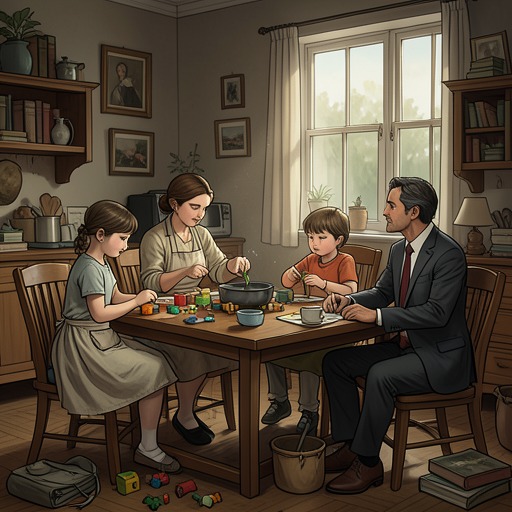
Philip soon accepts Athelny’s invitation to visit. Concerned that accepting dinner might burden the family, he initially proposes coming only for tea and brings a large plum cake. The children welcome him enthusiastically, compete to sit beside him, and call him Uncle Philip. Philip becomes a regular Sunday visitor, valued for his unaffected manner and evident affection for them. The family’s welcome gives him a dependable place in a social world otherwise marked by isolation.
Athelny recounts a succession of occupations: he has worked on a tea plantation in Ceylon, travelled in America selling Italian wines, served as a journalist and police-court reporter, and held editorial posts in the Midlands and on the Riviera. His longest employment was as secretary to a water company in Toledo. These changes supply him with anecdotes and a stock of unusual knowledge, which he shares with evident pleasure. He has also worked as a press representative for a large drapery firm, a job he considers beneath his abilities; poverty and his family’s needs, however, have kept him at it.
Character and Narrative Significance
Athelney’s self-assurance is accompanied by a practical dependence on work and family obligations. He may rate his abilities highly and find some employment unworthy of them, yet he remains in that employment because his household needs the income. This tension gives substance to his comic, expansive manner: his talk celebrates books, travel, and pleasure, while his life includes economic constraint and the effort of supporting a family.
As a friend and host, Athelny changes the texture of Philip’s life without turning their relationship into a formal mentorship. Their conversations broaden Philip’s imaginative horizons, while the Sunday visits give him affection and belonging. Athelny’s household and his photograph of Toledo thus matter both as human refuge and as occasions for Philip to encounter new forms of experience and artistic vision.