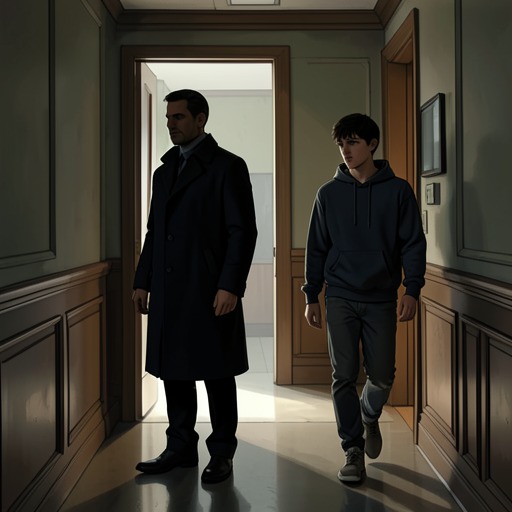
Jack is disciplined by the school and forced to leave for harassing Tom
Off CampusJack’s discipline and forced departure from Carlisle are the consequence of his harassment of Tom, but the episode also exposes the grievance Jack uses to excuse his actions: he treats Tom and Tom’s father as responsible for the losses that have reshaped his own future. Sent back to the small Iowa town he had hoped to leave behind, Jack has to confront both the practical cost of his conduct and the gulf between his resentment and the harm he caused.
Causes and Background
Jack’s anger is rooted in a family financial loss that he connects to Tom’s father. In Jack’s account, the father’s wrongdoing cost his parents their money for college, while Tom’s position at Carlisle made Tom the person against whom Jack could direct that anger. Jack reduces the relationship between father and son to an accusation of inherited guilt, even though it is Jack’s own behavior that leads the school to discipline him.
The contrast between Jack’s sense of injustice and the facts of his conduct is central to the episode. The narrative identifies him as having taken his anger out on Carlisle’s “golden boy” and makes clear that he is facing possible expulsion for doing so. Jack’s resentment may explain the grievance that fuels his actions, but it does not erase his responsibility for harassing Tom.
Discipline and Departure
The consequences become immediate when Jack loses his place at Carlisle. He had imagined spending his junior year studying somewhere like Paris or Rome; instead, his return to Iowa marks the collapse of that plan. He comes back to a town he thought he had escaped after having boasted about his admission to a prestigious school, making the reversal a public as well as a personal humiliation.
Jack’s arrival is not a planned homecoming. In the early hours of the morning, he walks through Colchester Falls without knowing what day it is and tries to work out where he can spend the time before it is acceptable to go home. His parents expect him a month later and do not know he is coming, because he has been unable to tell them what happened. He recognizes that being removed from school for harassing someone cannot be made to sound respectable by changing the wording. The sudden return leaves him facing the consequences before he has found a way to explain them to his family.
Tom and the Conflict
The episode belongs to a wider conflict shaped by the distance between Tom’s public image and private circumstances. His father’s arrest in a major federal price-fixing case made the Worthington name headline news, and reporters followed Tom after the school asked him to leave campus temporarily. Jack’s anger treats Tom as an extension of his father, but Tom is also living under the public exposure and isolation brought on by that scandal.
Tom’s reluctance to seek help reflects that experience. After a year and a half in which he felt he had received hostility rather than assistance, he doubts that campus institutions will protect him. That wariness makes the prospect of harassment consequential beyond a personal feud: Jack’s actions land in a context where Tom already expects to be made vulnerable by other people’s attention and by his family name.
The novel also sets Jack’s departure against Tom’s efforts to establish boundaries and control over what others know about him. Tom identifies as bisexual and considers a distinction between being known privately in his relationship and having his personal life exposed to a broad campus audience. Later, he explains that the scale and reach of public attention, rather than any one person knowing about his boyfriend, is what frightened him. These distinctions complicate the conflict: Tom is not simply avoiding recognition of his relationship, and Jack’s grievance does not grant him a right to make Tom a target.
Consequences and Significance
Being sent home forces Jack to return to the very place he had treated as a past he had outgrown. His interrupted college plans and his failure to tell his parents turn the disciplinary action into a period of isolation and reckoning, rather than a clean break from the conflict. The narrative does not present the setback as a misunderstanding: Jack acknowledges that the situation has rapidly worsened and that he has been expelled for harassment.
For the larger story, the episode makes the cost of Jack’s displaced anger visible while connecting it to Tom’s continuing struggle with exposure and trust. Jack interprets the losses in his family as a reason to blame Tom; the school’s action instead establishes that Jack remains accountable for what he chose to do. His forced return closes off the future he had planned at Carlisle and begins a new phase in which he must face the consequences at home.