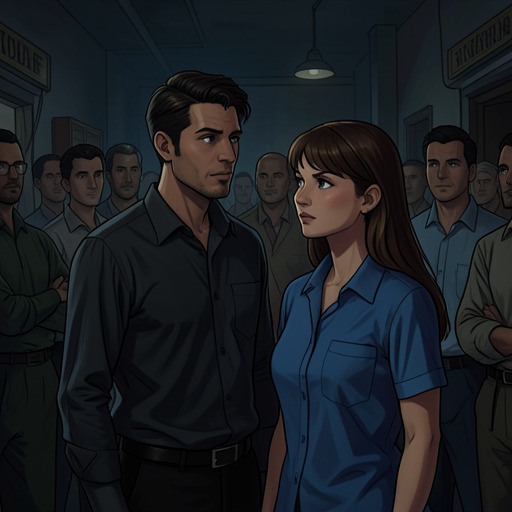
Tom and Reese reconcile on the campus green
Off CampusTom and Reese reconcile on the campus green after a separation rooted in Tom’s fear that public knowledge of his relationship would strip him of control over his private life. The meeting does not erase the hurt between them; it gives Tom a place to acknowledge the harm, describe concrete changes, and ask whether they can imagine a future together again.
Background: Privacy and Public Identity
Tom’s hesitation about being with Reese publicly is bound up with more than uncertainty about his sexuality. He tells Reese that anything people learn about him may become gossip, and that he does not want others to know anything about him. When Reese suggests that Tom fears being known on campus as gay, Tom corrects him: he is bisexual. The correction exposes how the language of identity and the experience of disclosure are themselves contested between them, even as Tom recognizes that insisting on the distinction can feel like denying Reese.
Earlier, Tom had tried to imagine a compromise: being out in one limited setting rather than everywhere. He was still working out what such a boundary could mean. Later, he articulates the underlying distinction more clearly: the difficulty is not simply coming out, but the scale and reach of contemporary exposure. He had been comfortable with an individual knowing about his boyfriend; the prospect of many people knowing and discussing his private life frightened him. The campus-green conversation follows that admission and tests whether he can act on it without pretending the fear has already vanished.
The Meeting on the Green
A week after trying to make new connections, Tom calls Reese and leaves a message asking to meet on the Green. The campus lawn is crowded with students resting on blankets and towels; an attempted Ultimate Frisbee game draws complaints from people being stepped on. Tom sits in the sun with his eyes closed, trying to imagine that he has come only to relax. When Reese arrives and says he got the message, Tom admits that he had not known whether Reese would come. For him, the meeting feels at once like coming home and like the most frightening thing he has done.
Reese sits across from Tom, hugging his knees and watching the game. He tells Tom that he does not hate him and misses him, but that missing him is not enough to resolve what happened. Tom accepts the limit rather than treating reunion as automatic. He says he understands and is working on it, then makes clear that he has prepared specific steps rather than relying on a declaration alone.
Repair Through Specific Actions
One of Tom’s first steps was to call Paul the previous month and tell him to run Reese’s article without editing Tom out. The action directly addresses the conflict over visibility: Tom is no longer asking that his connection to Reese be removed from public view. It is a particular, consequential choice, but the meeting does not present it as a complete solution or demand that Reese immediately trust him again.
Tom also tells Reese that he has attended a meeting, and that he has been spending time with Cash and Steph. He says that their meals have apparently been staggered so that the two men will not run into each other, and admits that being apart from Reese is not the same. When he says he misses him, Reese takes his hands and squeezes them. Their contact accompanies the conversation rather than replacing it: Tom continues to explain himself, while Reese’s response gives him room to breathe and keep speaking.
Tom also acknowledges that, for him, the relationship continued to matter during their separation. Seeing Reese with another person had made him jealous, but he believed he had no right to make demands. Instead of turning that feeling into an accusation, he tells Reese that they still were together, at least from his own perspective. The statement makes his attachment plain while leaving Reese’s experience and choice intact.
A Possible Future
The conversation gradually shifts from accounting for past behavior to considering what might come next. Reese asks what would happen if Tom stayed for another year. Tom explains that he would again be eligible for housing at Perkins and could seek a double on campus, even if he received an unfavorable lottery number. He presents these possibilities without assuming that Reese has agreed to live with him.
Reese mentions doubles in a new dorm near the Science building, where the rooms have bay windows and private bathrooms. His suggestion is indirect, but it opens a shared future for discussion. When Tom asks whether Reese is proposing it because he wants them to have sex in the shower, Reese answers with a playful qualification rather than withdrawing the idea. Tom understands the exchange as a sign that reconciliation remains possible, not as proof that every problem has been settled.
Significance
The scene turns on a distinction between private commitment and public visibility. Tom does not suddenly become unafraid of exposure; instead, he begins to make choices that resist the isolation his fear has supported, including advocating for Reese’s article to appear without removing him from it. His account of fear at a later student meeting clarifies the stakes: the imagined audience and the spread of information, rather than one trusted person’s knowledge, are what make disclosure feel threatening.
The Green therefore serves as the setting for a cautious repair rather than a simple reunion. Tom must show change through actions, Reese can acknowledge that he misses him without claiming that this is enough, and their tentative housing discussion gives the relationship a possible next step. The movement from separation toward renewed closeness remains conditional, built from candor and negotiation rather than a single declaration.