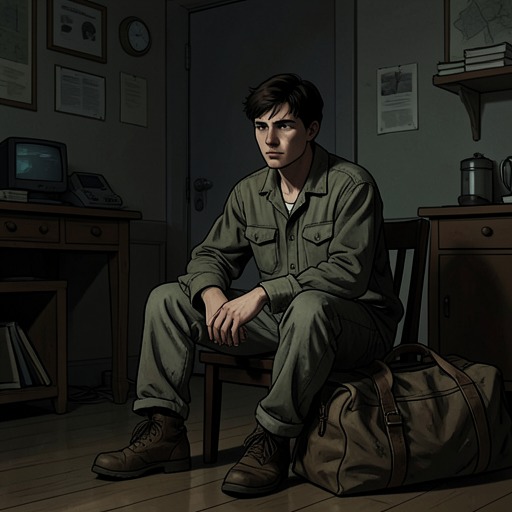
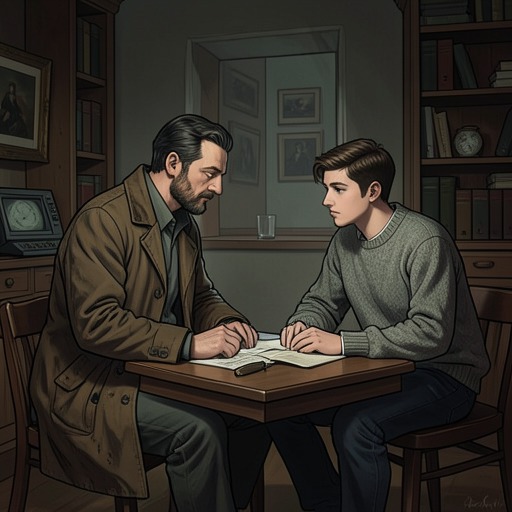
Tom spends Christmas at the Anders home
Off CampusTom spends Christmas at the Anders home at a point when the domestic welcome he has long lacked meets the financial desperation he has kept from Reese. A battered laptop with a red bow exposes how little Reese understands the scale of Tom’s losses; a conversation over tuition forces Tom to name the crisis; and, among pancakes and an old movie, he begins to accept the family’s care. The visit’s decisive change is modest but consequential: Tom does not merely stay under the Anders’ roof, but takes Reese’s hand and agrees to let him lead the way into a shared holiday.
An Invitation Competing with Shame
Reese’s Christmas wish is pointedly ordinary: a meal with Tom and his father, an occasional overnight stay, old movies on the couch, and pancakes for breakfast. He calls them pannkaker, then explains that the word is Swedish for pancakes. The request imagines Tom not as a guest passing through but as someone who might share the rhythms of family life. Tom, however, feels an immediate resistance. Christmas has lost its nostalgic appeal; memories of the wealth he once had, and of everything he wasted or discarded, make the holiday painful. He wants to work through the break rather than revisit a past built around privilege and careless excess.
That refusal is bound up with a financial truth Tom has barely spoken aloud. His old acquaintances have not understood why he cannot join spontaneous trips to Vermont or go clubbing in Manhattan, and he has stopped asking for help. He has told only his father’s lawyer and the bankers that the family’s assets are frozen and may be lost when judgment and civil suits follow. Reese has no way to know this when he gives Tom a battered laptop, its red bow stuck crookedly on the lid, on Christmas morning. Tom’s face drains of color: the gift arrives as kindness, but also confronts him with a deprivation he has kept secret.
The Cost of Staying
Tom had come to the Anders home before midnight on Christmas Eve after three consecutive days of driving. He parked outside and texted Reese to wake him in the morning, reluctant to disturb Reese’s father and confident that the weather was not yet cold enough to make sleeping in his car unsafe. Reese came to the car almost immediately, banging on the window and hopping barefoot on the frozen ground. His fierce smile and alarmed demand that Tom get inside make visible the gap between Tom’s plan to remain alone and Reese’s instinct to bring him in.
The strain of trying to balance work with Reese’s wishes comes into focus when Tom admits he has missed the deadline for second-semester tuition. The dean will still accept his check before classes begin at the end of January and hold the places in his registered courses, but Tom is short by enough that the check would bounce. Reese initially blames himself for asking Tom not to leave for so long. Tom rejects that explanation: the shortfall is his responsibility, caused in part by careless hours, but also by his reluctance to go. His admission links the financial emergency to the emotional choice the holiday has demanded. Staying has mattered to him, even as it has cost him time he needed to earn money.
A Seat at the Table
In the morning, the smell of pancakes and the sound of conversation tell Tom that Reese’s father is already up. Tom enters the sunny kitchen braced for an intimidating encounter, shoulders hunched and hands in his pockets. Instead, Mr. Anders greets him with expansive pleasure, takes him by the arm, and guides him to a seat at the small butcher-block table opposite the stove. He offers pannkaker, jokes that the family is fooling itself with the Swedish name, and repeatedly squeezes Tom’s shoulder or arm as if reassuring himself that Tom is still there. Tom is overwhelmed by the unguarded attention, answering the offer of milk or orange juice by asking for coffee.
The warmth of the kitchen does not make disclosure easy. Tom tells Mr. Anders that he is not always comfortable with people knowing things about him. Mr. Anders says Reese has told him a little, acknowledges that he understands Tom’s discomfort, and makes clear that Tom need not discuss the subject or pretend it is not true. When Tom can manage only that it is hard, Mr. Anders responds by speaking of his own longing for his late wife, Jeannie: if she were there, he would want to curl up with her and hold on tightly. The exchange offers Tom a model of family intimacy without pressure to explain himself. Tom tears up, hears his own father’s imagined rebuke against making a scene, and nevertheless agrees that he can try.
From Guest to Participant
That night, Tom sits beside Reese on the couch rather than taking the opposite corner. Mr. Anders puts on The French Connection, a film Tom has never seen; father and son insist that its famous car chase is a gap he must immediately repair. Tom does not quite press his thigh against Reese’s, but sits close enough for his heartbeat to quicken at the thought that Mr. Anders might notice. The anxiety is unnecessary: Reese’s father already knows they are together and is glad Tom is there. Reese, by contrast, stares at Tom as if stunned by the change in their distance. The scene makes acceptance tangible through a small rearrangement of bodies in a shared room.
The visit culminates when Reese stands silhouetted in the doorway. Tom recognizes that there is no real question to answer, takes Reese’s hand, and holds on tightly. His words confirm that he is there and asks Reese to show him the way. This is not a resolution of the tuition problem or of Tom’s shame about his former life. It is a change in how he responds to care: instead of preserving distance, he lets Reese guide him toward the holiday he had resisted. During the January-term break that follows, Tom continues driving long hours, but he also catches a few hours of sleep with Reese after the bars close on almost every night. Christmas thus marks a beginning rather than a cure, making room for closeness within the ongoing pressure of work and financial insecurity.