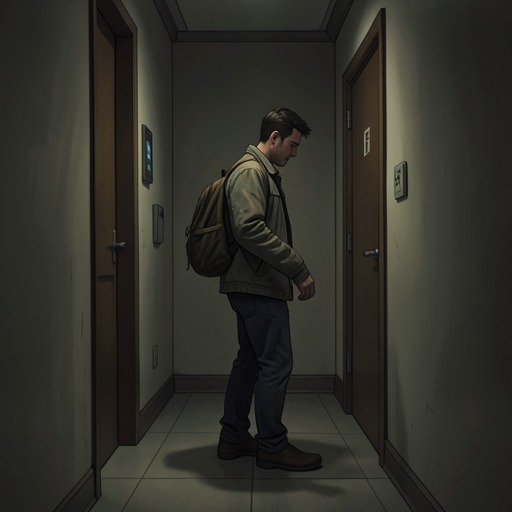
Tom’s financial precarity
Off CampusTom’s financial precarity is the material crisis that turns his return to Carlisle College into a daily calculation of tuition, work, sleep, and shelter. After his father’s Ponzi scheme freezes the family’s assets, Tom loses the security he had taken for granted and tries to earn his way back to college alone. His improvised survival—driving an unlicensed taxi, sleeping in his car, and refusing assistance associated with his father’s imprisonment—both sustains his education and deepens his isolation. The eventual aid he accepts does not erase that struggle: it comes only after others make him name his homelessness and let them help.
The Collapse of Security
Tom’s crisis follows the freezing of the assets tied to his father’s Ponzi scheme. His family home is sold at auction to repay only a fraction of his father’s debts, and the family’s former ease gives way to a precarious existence in which even the prospect of finishing college seems impossible without Tom’s own earnings. He has to reckon not just with lost money but with the loss of belongings and a future he had assumed were secure.
Returning to Carlisle requires fifteen months of effort. Tom comes back with a specific plan: retake classes from the middle of his previous semester without penalty, excel academically, and graduate after three more semesters. He believes a strong record is his route to a job and to a life no longer shaped by his father’s resources. That plan makes time and money feel inseparable. Coursework competes with paid driving, while exhaustion threatens the concentration on which his hoped-for future depends.
His financial hardship is also a problem of housing. Tom has spent months sleeping in his car or on other people’s couches, and he arrives after driving for forty-eight hours straight with a hot shower and a real bed as his immediate reward. Even after moving into student housing, he expects to spend weekends away from his room: he drives a cab in Boston, takes brief naps in the car, and saves the cost of a motel. The back seat becomes both emergency shelter and a practical way to protect his tuition fund.
Work, Secrecy, and Self-Reliance
Tom treats the weekend work as a private survival system. He drives from Friday into Sunday, sleeps only when fatigue makes it impossible to continue, and returns to campus with reading to do and late-night fares to manage. He hopes that nearly seventy-two hours away will also give Reese room to adjust to having a roommate: during the week Tom tries to return only to sleep, and he frames his absence as a way to avoid crowding Reese rather than disclose how little stability he has.
This arrangement gives Tom cash but leaves his actual circumstances concealed. Reese understands that the cab work provides spending money or perhaps covers room and board; Tom does not tell him that the car is where he sleeps on many weekend nights. He also withholds the scale of the tuition gap. When he starts spending less time driving in order to be with Reese, the effect is visible in his savings balance. By Thanksgiving he is ten thousand dollars short of what he needs for the second semester, and he calculates that holiday work, January-term driving, and pushing his hours to the limits of good sense might let him write a tuition check by the end of January. He fears that Reese will be furious if he learns Tom may not be able to return for the spring.
Tom’s habit of managing alone has a history in the sudden loss of his safety net. He recalls learning that a parent’s imprisonment could leave a student stranded with a senior-year tuition bill and no ordinary financial aid, because his father’s last reported annual income was seven million dollars. He responds by turning self-reliance into a rule: endure the problem and devise a way through it. The rule is functional—he learns to work, budget, and navigate unfamiliar procedures—but it also makes asking for help feel like a moral failure.
Refusing the Available Aid
When Tom first considers returning to Carlisle, his initial call is to the financial-aid office. The conversation makes clear that his father’s imprisonment could qualify him for an exception. Tom understands that he could use that route, and that he badly wants the money, but he resists because he wants help on the grounds that he himself has asked for it—not because his father is in prison. The distinction is emotionally decisive to him, even though it does not make the cost of college any less real.
The ordinary process for declaring financial independence seems both humiliating and uncertain. Tom fears that his father’s tax filings, which may themselves have been fraudulent, will complicate his application, and that untangling them could take years. The special exception feels like an unearned advantage purchased with other people’s losses: accepting it would mean using his father’s crimes to secure one last benefit for himself. He imagines students whose parents squandered their college funds or withheld tuition for personal reasons, and resents that the system offers him a route denied to them. His refusal is therefore not simple pride. It is an attempt to separate his own choices from the wrongdoing attached to his family name.
When the relevant forms and documentation lists arrive, Tom throws them away, registers for fall classes, and goes to work. He makes refusing the advantage a guiding principle because he needs to believe he can leave his collapsing home by his own effort and become nothing like his father. The hard-won pride in returning to campus is real, but it does not free him from stigma. At a party he cannot ignore the whispers, and he is unsure that he deserves to ignore them.
His self-denial becomes harder to sustain as his money dwindles. For a while, Tom tries to preserve the appearance of his former life among old friends, but their assumptions make his situation difficult to explain. Friends suggest easy comforts, such as staying in a pool house until lawyers sort out the family’s affairs; Tom knows that the money, properties, and casual freedom they imagine are already gone. He has spoken the words “I have nothing” only to his father’s lawyer and the bankers who explain that everything is frozen and likely to be lost. His silence leaves Reese unable to understand why a Christmas gift—a battered laptop with a red bow—makes Tom go pale.
The Crisis Becomes Visible
The concealment finally breaks when Reese recognizes that Tom has nowhere to go when Perkins is closed and asks whether there is enough money for school. Tom answers that there is no money. The disclosure overturns Reese’s understanding of the weekend driving and forces Tom’s private calculations into the open. By then Tom’s work has become physically dangerous: after seven days of driving, his vision blurs and his reflexes deteriorate, and Reese refuses to let him leave the house until he has slept for eight hours.
Reese and his father try to persuade Tom to accept a loan. Tom refuses to take money from either his boyfriend or his boyfriend’s father, believing the Anders family cannot spare it and that any loan would come from funds needed for Reese’s own education. The refusal repeats Tom’s preference for bearing the loss himself, but this time Reese gets him to contact people who can offer institutional rather than personal support. Tom emails the dean, the economics department head, and a professor he trusts, explaining the seriousness of his circumstances. The act is humiliating: he has to make his private life an open book, but it turns an unspoken emergency into a situation others can address.
The dean cannot extend the tuition deadline, but she arranges a campus work-study job that covers meals and directs Tom back to financial aid. This time he explains himself more clearly, and the financial-aid officer listens. The process still requires extensive documentation and regular appointments with a social worker. Tom can receive a homelessness exemption, minimal institutional aid, and access to services for homeless students, though the exemption will not make him eligible for federal aid until the following year. Naming his vulnerability remains painful; Reese has to help him accept that, despite having temporary shelter and a fifty-thousand-dollar car, Tom qualifies as someone who needs those resources.
The social worker finds a program that pays for Tom’s books for the semester. The department head offers him better-paid hours as a teaching assistant for an introductory survey course. Then Quillian identifies an unclaimed grant whose sponsoring foundation had rejected the other applicants. Tom spends twenty-four hours writing and revising an essay, while Quillian persuades several of his professors to write recommendations. With fewer than seven days remaining, Tom receives a grant covering full tuition, conditional on working for a nonprofit for two years after graduation. The foundation can sponsor only half a year at first, and asks him to apply again the following year, so the award is substantial without making his longer-term finances effortless.
What Help Changes—and What It Does Not
The grant transforms the immediate arithmetic. With tuition covered, Perkins room fees become Tom’s main expense; his savings can cover those fees and leave enough for an apartment over the summer. He expects to become eligible for aid to complete his final semester the following year, or, if he chooses to spend an additional semester at Carlisle, to finish a double major. He no longer needs to drive for the rest of January term. The change is concrete: time once divided between desperate earning and study can be spent on classes and campus work.
It does not instantly undo the habits built during his months of homelessness. Tom takes pride in learning how to manage paperwork, employment, and regulations despite once not knowing where his Social Security card was or how to complete a W-4. He has controlled what he can, but the public shame remains. Even as he and Reese grow closer, Tom fears that his financial vulnerability and his father’s notoriety will make him a public spectacle. He tells Reese that he is trying to stay off everyone’s radar and believes the dean’s written warning means the college could remove him if his presence causes a press circus. In reality, the dean later explains that he has misread her letter: she had been advising him how to protect himself, not threatening him on the college’s behalf.
Tom’s financial precarity thus reaches beyond a shortage of cash. It shapes where he sleeps, how he schedules his weekends, what he tells Reese, and whether he can imagine accepting care without compromising his moral independence. The shift from solitary driving to work-study, teaching, a social worker’s help, and a grant marks a change in how he survives: he remains determined to earn his future, but begins to accept that seeking support is not the same as exploiting his father’s crimes or taking advantage of others.