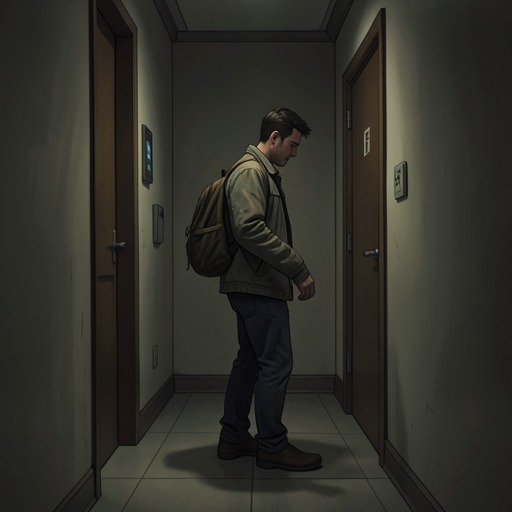
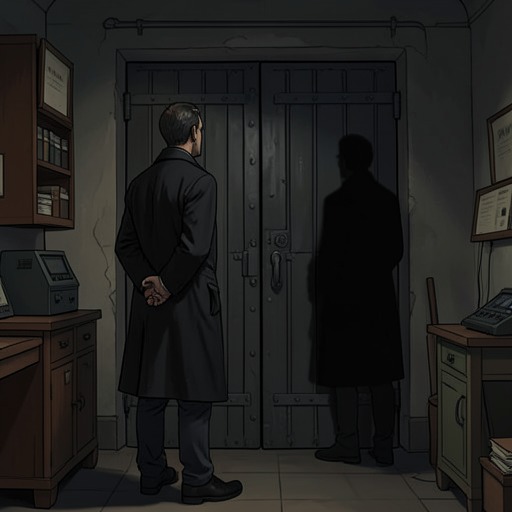
Tom’s guilt and self-punishment
Off CampusTom’s guilt and self-punishment are not simply regret over his father’s crimes; they become a private test of whether Tom can be different from the man whose name and wealth once protected him. He rejects assistance that might ease his financial crisis, reads public attention as a threat, and confines himself to a life of work and isolation. The discipline initially feels like moral independence, but Reese Anders and the people at Carlisle College gradually reveal its cost: Tom is punishing himself for someone else’s wrongdoing and mistaking help for corruption.
Guilt and the refusal of advantage
When Tom learns that his father’s imprisonment could make him eligible for special financial aid, the possibility feels like an unjust shortcut. The exception would let him move ahead of students whose parents had squandered college funds or threatened to withdraw tuition, even though Tom had never lacked for anything before the previous year. His father’s crimes had devastated other people’s lives; to Tom, using those crimes to gain help would reverse the moral order and make him a beneficiary of the harm.
Tom refuses. He throws away the forms and the requested documentation, registers for fall classes, and goes to work instead. He cannot fully explain the decision, but he is certain that refusing to take advantage of the system is the only way he can leave the home he is about to lose. As his father’s namesake, he expects to carry the shame; he can at least choose not to resemble him. That choice gives him a measure of pride: his own labor gets him back to campus for three more semesters. Yet the same resolve does not restore his confidence. At a party downstairs, he cannot ignore the whispers or feel that he deserves to disregard them.
The contradiction is central to his self-punishment. Tom can regard hard work as evidence that he has earned his place, but he cannot extend that judgment to the possibility that he might deserve ordinary institutional assistance. His standard of independence is therefore more severe than simple self-reliance: he treats need itself as morally suspect when the means of meeting it are connected to his father’s wrongdoing.
Shame, scrutiny, and the imagined verdict
The fear of being watched shapes Tom’s conduct even when no immediate confrontation is taking place. After returning to school, he understands his presence at Perkins House as part of what the college promised his father in exchange for allowing Tom to come back and not going to the press. The arrangement leaves him conscious of scandal and exposure. Later, he says that he is trying to stay off everyone’s radar and believes that the dean’s letter makes his continued enrollment conditional on avoiding a press circus. He imagines a photograph of himself with a boyfriend becoming a headline, and treats public visibility as a danger that could undo his place at school.
That expectation turns into self-confinement. Reese tells him that avoiding the world is a bad plan and that Tom does not have to shut himself up in a prison. Tom recognizes that withdrawal is his plan, but does not yet abandon it. When Reese suggests that he may think he deserves punishment, Tom answers that perhaps he does. He connects that feeling to the person he once was: someone who believed he walked on water, expected admiration, and assumed there was nothing he could not do. He admits he had been a jerk, though he distinguishes that past arrogance from the violence Reese endured.
Tom’s own imagined public verdict is harsher than the support actually available to him. In a later crisis, he remembers the dean’s words as a condemnation of his fitness to be a student, but the scene reveals that he has misread her letter. Sitting beside him, she explains it point by point: she had been advising him how to protect himself and enjoy the school year, not threatening to expel him or asking him to shield the college from unwanted attention. She also challenges him not to project his fears onto other people’s actions and to ask for clarification when he believes he has been treated unfairly. The correction matters because Tom has been living under an imagined institutional judgment that the dean herself rejects.
Reese as witness and counterweight
Tom’s guilt develops alongside his growing recognition that Reese’s guardedness has its own history. When Reese explains that the school had to offer him housing at Perkins House to secure his father’s permission for him to return and to prevent his father from going to the press, Tom listens rather than pressing him with questions. Reese then recounts how his previous roommate, an athlete, joined his friends in homophobic humiliation, and how the roommate and other men held Reese down and assaulted him while he was asleep. Reese was intoxicated after a party and cannot identify everyone who was present, except for the roommate; he did not report the assault immediately. Tom asks what the school did after Reese told them, but the disclosure also makes clear that the full history and its consequences are not something Reese can be made to recount on demand.
Tom recognizes the moment as an invitation to show care, and part of him wants to know Reese and be known in return. Yet his instinct is to retreat into self-containment, even while he longs for someone who might care about the strain of money and uncertainty pressing on him. That hesitation echoes his refusal of aid: he wants connection, but has difficulty allowing himself to need it.
Their intimacy makes this conflict more explicit. After a sexual encounter, Tom tells Reese that what they have done cannot be all they do. He is trying not to be an asshole and asks Reese to let him take part, but the request also exposes Tom’s need for agency and his fear of being reduced to a role he cannot accept. He thinks of himself as having been broken and reassembled from the wreck of his former life, and insists that he cannot be made into a person he is not. The scene does not resolve his guilt; it shows how the effort to control his conduct and be decent can become another pressure he places on himself.
Accepting help without becoming his father
The sharpest challenge to Tom’s code comes when his circumstances grow harder to manage. During January term, he drives a cab or uses his own car for pirate taxi work for as much as twenty hours a day during the first week. After seven days, his vision blurs and his reflexes deteriorate. Reese refuses to let him leave until he has slept eight solid hours, then sits him down with Reese’s father to discuss taking a loan. Tom refuses money from either of them, concerned that the Anders family cannot comfortably spare it and that the funds may be needed for Reese’s education.
He does, however, agree to contact the dean, the head of the economics department, and his favorite economics professor to explain how difficult his situation has become. The disclosures feel humiliating, as if he has been made an open book, but the replies offer assistance. The dean cannot extend the tuition deadline, yet arranges a campus work-study job that will cover meals. A second conversation with the financial-aid officer goes better: with more complicated documentation and regular check-ins with a social worker, Tom can receive an exemption based on homelessness and qualify for minimal school aid and services for homeless students. A social worker also identifies a program that will cover his books for the semester.
Accepting this support remains difficult even though it is close to what he had hoped for. Tom wants to distinguish himself from people in need, pointing to the fact that he has somewhere to stay for the moment and a fifty-thousand-dollar car. Reese makes him confront that those circumstances do not erase his homelessness or his need for assistance. He makes Tom repeat that asking for help is not wrong and that receiving it is not taking advantage of anyone. Tom resents being pushed to that recognition for two days, but ultimately speaks with the social worker and accepts the practical help.
The change is not a sudden release from shame; it is a revision of what moral independence can mean. Earlier, Tom believed refusal was the clearest proof that he would not repeat his father’s conduct. By telling the college the truth and accepting limited, relevant aid, he begins to separate legitimate support from exploitation. His work ethic remains, but it no longer has to be the only permissible answer to need.
A continuing struggle, not a clean absolution
Tom’s self-punishment also appears in how he responds when he believes he has hurt Reese. After Reese ends their relationship over the question of keeping it secret, Tom is in bed when Cash arrives, worried because Reese has called to say he may need someone to keep an eye on Tom. Cash makes clear that Tom’s farewell over the phone sounded alarming, even though Tom insists he is not suicidal. Cash’s intervention shows that Tom’s distress has become visible to a friend and that Reese has reached beyond the relationship to make sure he is not left alone with it.
Tom’s account of his own past remains divided between real accountability and excessive condemnation. He acknowledges his arrogance and the harm in having expected others to admire him, but Reese’s presence helps him hear the dean’s defense of his right to attend Carlisle without harassment. The dean investigates Jack’s conduct and states that students are entitled to go to school without being harassed; Tom, however, had been ready to say that Jack’s actions were justified. Reese’s influence is audible in the dean’s words, and Tom finds himself almost laughing or crying as he recognizes it. That response underlines the gap between the punishment Tom believes he deserves and the protections other people insist he is entitled to receive.
Tom’s guilt therefore remains a recurring pressure rather than a problem settled by one conversation or one aid decision. It begins in his refusal to profit from his father’s crimes, expands into fear of scrutiny and withdrawal, and is challenged through relationships that require him to be seen and to accept care. His gradual movement toward help does not erase his responsibility for his former behavior; it limits the reach of that responsibility, preventing his father’s crimes and his own past arrogance from becoming a permanent sentence of isolation.