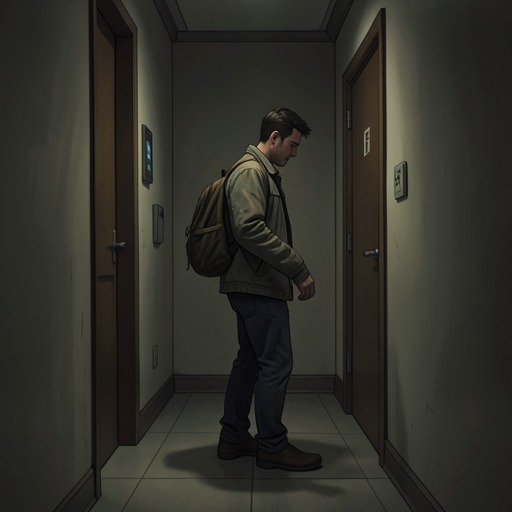
Tom's homelessness
Off CampusTom’s homelessness is not simply the absence of a place to sleep: it is the hidden material crisis beneath his return to Carlisle, shaped by the freezing and sale of family assets, an aid system keyed to an earlier picture of wealth, and his reluctance to disclose need. For a time, Reese’s room provides a roof without resolving the question of where Tom can go—or how he can afford to remain in school. His path toward stability begins when private coping gives way to other people and institutions recognizing the problem and helping him meet it.
Causes and Conditions
Tom’s housing insecurity follows his father’s arrest and the financial collapse that dismantles the life Tom had assumed belonged to him. By the time he considers returning to Carlisle, there is no prospect of a last-minute rescue: the family home is being foreclosed on, and possessions Tom thought of as his are being sold as estate assets. The financial aid calculation compounds the shock. His father’s previous-year income was seven million dollars, leaving Tom without ordinary access to need-based support at the point when that income and the property associated with it were no longer available to him.
The contradiction between apparent wealth and present precarity makes it harder for Tom to explain his position. His name remains publicly associated with his father’s scandal, while the resources that once made the association seem like a guarantee have disappeared. He had to explain his circumstances to a financial aid officer after working up the nerve to call; the conversation felt humiliating, and his physical discomfort made the disclosure still harder. Though the officer told him she could help, Tom’s longer struggle shows that being heard once did not immediately undo his expectation that he had to manage the consequences by himself.
A Room That Does Not Resolve the Crisis
At first, Tom’s immediate housing need is obscured by his stay in Reese’s room at Perkins House. The arrangement is not secure: Tom knows Reese has not yet been assigned an official roommate for the next semester, and he eventually tells Reese that he has nowhere to go when they are not at Perkins. Reese has been leaving apples on his desk because he notices Tom eating as though food is scarce; Tom’s admission makes clear that this private kindness has been responding to a need he had not named.
The uncertainty is not limited to what happens after the current arrangement ends. Three weeks into the semester, the strain of sharing a room leads Tom back to the Residential Life office, where he is prepared to consider a move even if that means living elsewhere on campus amid gossip. He first encounters the office as a place where he argues over the lack of open singles in Perkins House. On his return, a staff member asks whether he is on the wait list, explaining that available rooms go to students who have joined it. The exchange places Tom’s personal emergency inside an ordinary administrative queue: the system has a procedure, but knowing that he needs help does not by itself secure him a room.
Tom’s response to that procedure is colored by more than frustration. Outside the office, he reflects that after a year and a half of being met with hostility rather than a helping hand, he has little faith in the promise that colleges will take care of their students. He sees help as something available to students without the conspicuous burden of his family’s disgrace. The backpack, carry-on, and traveling trunk of notoriety he associates with himself stand in sharp contrast to the uncomplicated support he had expected institutions to offer. That distrust helps explain why he delays asking for assistance even as his housing and finances become increasingly difficult to sustain.
From Concealment to Material Support
Tom initially tries to contain the crisis rather than disclose its full scale. When Reese confronts the signs that he has no place to stay, Tom has been washing himself in bathroom sinks with wet paper towels. He also connects his immediate housing problem to a larger one: he is not managing financially, and he does not yet have a confirmed place to live for the next semester. The disclosure is especially difficult because Reese has already been helping in small ways, leaving Tom to face the shame of realizing that care has reached him before he was willing to ask for it.
The financial aid rules offer a potential route, but not a simple one. Tom recognizes that his father’s imprisonment might support an exception to the ordinary aid calculation, yet he cannot bring himself to explain why he does not want to use it. He is anxious about having to justify that refusal to Reese. Accepting an exemption for homelessness also means naming his vulnerability and submitting to a process that requires documentation and regular check-ins with a social worker. Tom’s resistance is therefore not evidence that he has no need; it is part of the difficulty of acknowledging that his actual circumstances qualify him for support.
The change comes through several people and distinct forms of assistance, rather than through an instant solution to housing. After Tom has gone seven days without adequate sleep, Reese refuses to let him leave the house until he has slept for eight solid hours, then sits him down with Reese’s father to discuss a loan. Tom refuses to borrow from his boyfriend or his boyfriend’s father, worried that the Anders family cannot readily spare money for him. He does, however, accept pressure to contact the dean, the economics department head, and a professor he trusts. Those conversations help him move from private endurance toward a formal account of his situation.
The dean cannot extend the tuition deadline, but arranges a campus work-study job that covers meals and directs Tom back to the financial aid officer. The officer listens, and the school can offer minimal aid through an exemption for homelessness, alongside access to services for homeless students; the exemption will not make Tom eligible for federal aid until the following year. A social worker identifies a program that will pay for all of his books for the semester. The economics department head offers him paid work as a teaching assistant for a first-year survey course. These measures address different pressures—food, immediate aid, books, and wages—without pretending that one conversation has restored the security he lost.
Stability, Dependence, and the Meaning of Home
The decisive educational relief arrives close to the tuition deadline. Quillian knows of a grant whose sponsoring foundation had decided not to give it to any of that year’s applicants. Tom spends twenty-four hours writing and polishing an essay, while Quillian persuades several of his professors to write recommendations. With fewer than seven days remaining, Tom receives a grant for full tuition, conditional on working for a nonprofit organization for two years after graduation. It does not erase his homelessness or the experience of having had to expose his private circumstances to obtain assistance, but it makes continuing at Carlisle financially possible.
Even after accepting help, Tom’s housing remains dependent on relationships and temporary arrangements. He stays with Reese, and later turns to Cash when he needs somewhere to sleep; Cash lets him stay without asking questions. After six weeks of sleeping on Cash’s floor, Tom describes Cash as his temporary roommate, though he is uncertain how temporary that arrangement has become. The details distinguish shelter from security: friends can make a place for him, but his dependence on their space persists long enough to acquire its own uneasy duration.
The homelessness plot thus tests Tom’s self-reliance against the practical limits of what he can endure alone. His father’s wealth had shaped the assumptions used to assess his eligibility, while the loss of that wealth left him in need of food, a place to sleep, books, and tuition support. His slow acceptance of help does not simplify those contradictions. Instead, the movement from hidden need to specific resources—an exemption, meals, books, paid work, and a full-tuition grant—shows how survival at Carlisle depends both on personal relationships and on institutions being made to respond to circumstances their ordinary categories initially obscure.