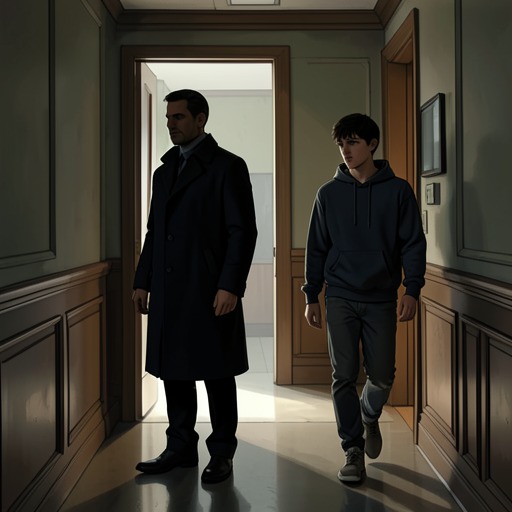
Worthington Financial Fraud Case and Freezing of Tom’s Family Assets
Off CampusThe Worthington Financial Fraud Case and Freezing of Tom’s Family Assets are the material and public crisis that recast Tom’s life after his father’s financial crimes. The loss extends beyond money: frozen property leaves Tom unable to rely on the ease and options that once defined his world, while the press turns the family’s disgrace into an enduring threat. Its consequences shape his isolation, his understanding of institutional protection, and his conflict with Reese over whether their relationship can be visible.
The fraud and the loss of security
Tom’s reckoning with the case is expressed through a stark account of what has vanished: the family’s money, properties, and the casual ease with which he once moved through the world. The scale of the loss was difficult for him to absorb even months later. He remembers that he did not say aloud that he had nothing to anyone except his father’s lawyer and the bankers who explained that everything was frozen and would most likely be lost when the final judgment was made and civil suits began. The freezing of assets is therefore not merely a financial fact; it leaves Tom confronting an uncertain future without the language or confidence to make that condition understood.
That loss also changes the terms of ordinary friendship. Tom had once spent time with his old social circle in the hope of preserving some human connection, but their expectations still included last-minute weekends skiing in Vermont and clubbing in Manhattan. He could no longer afford those plans and repeatedly backed out; his friends read the cancellations as melodrama and grew irritated. Rather than disclose the scale of his precarity, Tom stopped expecting others to understand and stopped asking for help. The scandal thus isolates him not only through public notoriety but through a widening gap between his actual means and the life his friends still assumed he could lead.
Public exposure and enforced isolation
The financial case makes Tom’s family circumstances a public story that resurfaces instead of remaining safely in the past. As his father’s first parole hearing approaches, articles rehashing the sting operation and trial appear in the Globe and USA Today. At school, the room’s landline rings repeatedly with hang-up calls; Tom suspects journalists disconnect when Reese answers. He flinches when nearby phones click as people take photographs, even though he knows those pictures are likely to be taken silently from a distance. Reese sees Tom as paranoid and inclined to overestimate public interest in the son of a white-collar criminal; Tom’s vigilance, however, is rooted in experiences Reese has not shared.
Tom recalls weeks when he felt imprisoned in his own home, afraid to leave because reporters and photographers waited at every exit. The press presence also cut off a mundane lifeline: after someone keyed a delivery car, the local grocery refused to deliver. Once the pantry was nearly empty, Tom opened can after can of red kidney beans. The detail makes the consequences of the scandal concrete: the family’s wealth has been frozen, but its public visibility remains active, restricting even the ordinary work of getting food.
The intrusion reached into the household’s private aftermath as well. In the days before and during the trial, Tom was alone in the large, empty house while his father was on suicide watch at jail. News crews camped on the sidewalk around the clock. Although they were not supposed to enter the property or block access, Tom believed the Boston police had little sympathy for the family because his father had defrauded middle-class workers. After Tom drank heavily on reading about an investor who had shot himself rather than tell his family he had lost everything, he discovered that reporters were going through the household trash.
The next day, local news published a photograph of a ripped-open garbage bag filled with empty beer bottles under the headline “Worthington Home Full of Booze, Drugs?” Tom could not be sure the image had not been staged, but it resembled the trash he had taken out for curbside pickup early that morning, his head pounding beneath a pulled-down hoodie. The episode joins personal distress to public spectacle: even the evidence of a private night could be selected, framed, and circulated as another insinuation about the family. For Tom, relief came when a month passed without a new online item about him or his father.
The case’s effects on relationships and choices
The same history informs Tom’s difficulty explaining himself to Reese. When Reese says that he cannot have another secret in his life, Tom answers that he is trying to stay off everyone’s radar because the dean had told him he would be gone if his presence caused a press circus. Tom says he has the warning in writing and imagines the sensational headlines that would follow a public photograph of him with a boyfriend. His fear of being exposed as the son of a convicted financier and of having his sexuality turned into a story presses the relationship toward secrecy, even as Reese wants an intimacy that does not require another hidden part of their lives.
Tom’s account of those fears is incomplete. He hopes Reese will trust him without asking for the history behind his caution, but later recognizes that withholding it was a mistake. He had not told Reese about the reporters outside his childhood home, the intrusion into the trash, or the extent of the humiliation and isolation. He wanted, for once, to have his difficulties taken on faith; instead, the silence leaves Reese without the context needed to understand why public attention feels dangerous to Tom. Their disagreement is therefore not simply over affection in public. It is also a conflict between Reese’s reading of Tom as evasive and Tom’s conviction, formed through past exposure, that visibility carries risks he cannot afford.
Tom’s efforts to protect his place at Carlisle are likewise colored by the scandal. He believes that he must keep a low profile to stay enrolled and treats the dean’s letter as a warning that any disruption could cost him his education. He regards college as his last foothold in a life he can build for himself: he does not expect to match his father’s success, but wants to finish school with a good record and stop living under the weight of the past. The stakes make him reluctant to challenge the restrictions he thinks the institution has imposed, even when that restraint costs him closeness with Reese.
Misread warnings and the case’s continuing legacy
Tom’s understanding of the dean’s letter eventually proves to have been shaped by fear rather than by its actual meaning. After the dean asks him to meet, she brings up a copy on her laptop and walks through it point by point. She explains that she had not threatened him with expulsion over circumstances beyond his control. The letter advised him how to protect himself and make the most of his year at Carlisle; it did not make him responsible for shielding the school from unwanted publicity. Her intervention exposes the distance between the protection Tom believed he had been denied and the support the letter actually offered. It also shows how the scandal’s earlier betrayals and exposure have trained him to anticipate punishment, even when an authority figure is trying to help.
That misunderstanding has a cost in his relationship with Reese. Tom had avoided rereading the letter and had told Reese he could not find it, partly because he did not want the argument and partly because he feared Reese might be right. He recognizes that there may be nothing stopping him from telling Jack to leave him alone and being affectionate with Reese at a campus movie night. Yet the possibility of losing his education, the memory of journalists surrounding his home, and the habit of keeping his difficulties to himself all reinforce the choice to hold back. The case remains present not as a single courtroom episode but as a structure of expectation: exposure seems imminent, privacy seems fragile, and asking for help feels like another risk.
The fraud also reverberates through people beyond Tom’s family. Jack tells Tom that this is his last semester at Carlisle because of him. Tom does not deny the grievance: he recognizes that Jack, or more likely Jack’s parents, has been hurt by the disappearance of a college fund in the Ponzi scheme. He understands that Jack sees him as the living representative of the person who wrecked that future, even though Tom is himself suffering the consequences of the frozen family assets. The confrontation does not make Tom responsible for his father’s crime, but it prevents him from treating the scandal as a private misfortune detached from its victims.
In retrospect, the case’s decisive effect is the way it makes money, reputation, safety, and intimacy collide. Tom has lost the means that once made spontaneous plans effortless, yet he remains visible as the heir to a scandal he did not commit. He responds by shrinking his life—avoiding attention, withholding the details of his fear, and treating public affection as a threat to his place at school. His gradual recognition that the dean’s letter was protective rather than punitive begins to loosen one assumption, but the history of frozen assets and public intrusion continues to shape what he thinks he can risk.