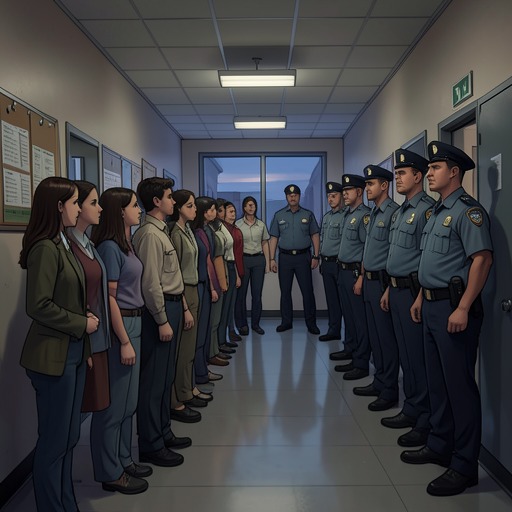
Brianna is restrained and searched by security at Midtown
On the Come UpBrianna is restrained and searched by security at Midtown after she passes through a metal detector without setting it off. The confrontation turns an uneventful screening into a physical restraint and a disciplinary case: Long treats Brianna’s refusal to hand over her backpack as grounds for force, while the school acknowledges excessive force but also suspends her for selling candy. The incident becomes a defining example of how suspicion, school security, and punishment converge around her.
The Search at the Metal Detector
Curtis, Shana, Deon, three sophomores, Zane, Sonny, and Malik pass through the detector ahead of Brianna without incident. The detector does not beep when she follows. Long nevertheless blocks her and orders her to go through again; Tate backs him up, and Long says he does not care that the alarm has not sounded. Brianna complies, and the detector remains silent. The sequence matters: the search does not begin with an alarm or a reported discovery, but with the guards deciding that she should be examined anyway.
Long then demands Brianna’s backpack. She knows that it contains candy she has been selling at school and fears that its discovery could lead to another suspension or even expulsion, given her previous disciplinary history. She refuses to hand it over. When Long reaches for the backpack strap, she pulls it away; he grabs her arm and demands the bag again. Brianna tells him to take his hands off her, but he seizes her arm once more, restrains her, and removes the backpack while Tate assists. Long wraps plastic around Brianna’s wrists and accuses her of bringing something into the school, calling her a hoodlum. His accusation is not based on anything the detector has revealed: the concrete issue is the concealed candy, while his language casts her as a wider threat.
Malik has taken out his camera and is filming. Tate orders him to put it away, but Malik insists that he can record. Sonny and Malik protest as Long restrains Brianna. The camera makes the confrontation not only an encounter between a student and guards but also a witnessed event that can be documented. Brianna is left unable to answer Long in the moment, and the narration stresses that he is not a police officer, distinguishing the school guard’s authority from the police power the scene evokes.
The School’s Response and the Suspension
At the meeting with Brianna’s mother, Jayda Jackson, and Dr. Rhodes, the principal admits that the guards used excessive force and put Brianna on the floor. Brianna corrects the account: they threw her down. Jay’s response makes the wording consequential rather than incidental; she asks the school to acknowledge what happened instead of softening it into a less forceful description. Dr. Rhodes assures Jay that there will be an investigation and that disciplinary action against the guards may follow if the administration sees fit.
The school’s response also turns toward Brianna’s conduct. Dr. Rhodes asks whether she has been selling candy on campus, and Jay tells her to answer. The principal later imposes a three-day suspension for selling banned items on school property without permission. The decision establishes a sharp distinction between the school’s stated response to the guards and the penalty it actually assigns Brianna: an investigation is promised for the excessive force, while the student receives a definite suspension. The backpack is returned to her after Dr. Rhodes zips it up.
Jay challenges the school’s larger claim that the guards treat all students alike. She tells Dr. Rhodes that her son said the guards picked on certain students when he attended Midtown and that she does not believe her children are inventing their experience. Dr. Rhodes repeats that an investigation will take place but maintains that the guards treat everyone the same. Jay’s pointed reply—that the guards must throw all the students to the floor, then—exposes the distance between the administration’s general assurance and the specific treatment her daughter describes.
Public Attention and the Lasting Label
Brianna leaves the meeting just as the bell rings for second period. As classroom doors open and students fill the hallway, she notices second glances, stares, and whispers she had not received before. The suspension makes her visible, but not on terms she welcomes: she feels that being noticed has displaced the relative safety of being overlooked. The incident thus has a social consequence beyond exclusion from school for three days; the encounter becomes part of how other students perceive her.
Later, that perception hardens into the false drug-dealer label. Brianna recalls people’s pity and surprise, and hears someone disguise the accusation by coughing as she passes. The suggestion that she is a dealer is not evidence about what was in her backpack; the incident involved candy. Yet the label reshapes how she is read, making a school security encounter appear to confirm a more serious suspicion. That reputational shift gives the search a continuing life outside the original meeting and suspension.
Security, Race, Gender, and the Meaning of Threat
The incident becomes part of a wider argument over Midtown’s security practices. Jay recalls that she and Brianna’s father, Law Jackson, had sworn their children would never attend Garden Heights High, where actual police serve as security and the school is treated like a prison. Jay argues that Midtown still gives Brianna a better chance, while warning that she will face many more people like Long and Tate. Her counsel is not to let their actions determine what she does. The comparison places Brianna’s treatment within a broader continuum of school discipline and policing, without making the two institutions identical.
When security guards later return to Midtown, students fear that the school may move toward the Garden Heights model of using armed police at the doors. Shana predicts that possibility, and Malik connects the guards’ return to parents accepting the drug-dealer narrative about Brianna and consequently treating the students as threats. These are characters’ fears and interpretations, not confirmation that armed officers are installed. They show how the original search feeds a climate in which surveillance and suspicion seem likely to expand.
The incident also resonates with the expectations placed on Brianna as a young Black girl and rapper. Earlier, when a man mocks her as too young to rap, she answers with a sharp comeback and wins over some of the men in the room; Aunt Pooh had warned her that she would have to work twice as hard for half the respect and survive in a field that expects her to behave like one of the guys. Later, radio host Hype objects to the violent content of her lyrics, but Brianna identifies the gendered double standard: the same material did not surprise him when her father rapped it at sixteen. James Irving’s praise of her as a “sassy black girl” likewise exposes the stereotype through which her confidence is filtered. These later moments do not change what happened at the detector, but they clarify a recurring pattern: Brianna’s actions are interpreted through race, gender, age, and suspicion, while the institution’s account of its own conduct remains framed as neutral procedure.
From School Discipline to Public Controversy
The school search is distinct from the later student protest and violence, but the novel places Brianna’s treatment within the climate that precedes them. When television coverage links her song “On the Come Up” to a school uprising, the report emphasizes lyrics described as violent and says students were arrested while security guards were hospitalized and expected to recover. The reporting focuses attention on Brianna’s words and the incident’s aftermath, while Brianna’s mother turns off the television and asks whether the song was hers. Later, Hype also challenges Brianna about lyrics he reads as threatening toward police. Together, these developments show how the label first attached to Brianna at school can travel into public debate, where her art is treated as evidence about her character.
The confrontation’s central reversal is therefore not simply that a student is searched and suspended. Brianna enters the detector lane without triggering it, but the guards’ suspicion overrides what the machine shows; the school then recognizes excessive force while issuing her a concrete punishment. From the hallway stares to the later drug-dealer accusation and security fears, the episode supplies the personal and institutional context for a larger question in the novel: who gets presumed dangerous, and whose account of harm is believed.