Brianna’s false reputation as a drug dealer
On the Come UpBrianna’s false reputation as a drug dealer is a stigma built from a distorted video and repeated rumor, not from evidence that she sells drugs. It follows the school security guards’ assault on her into classrooms, hallways, and public coverage, turning her into a supposed threat and giving others a ready-made excuse to discount what happened to her. The label’s power lies in that reversal: a student subjected to force is recast as someone who must have deserved it.
Origin in the security incident
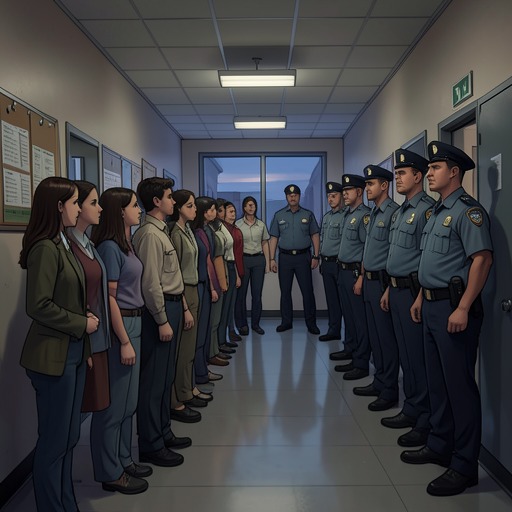
At Midtown, Officer Long and Officer Tate restrain Brianna and remove her backpack. Long accuses her of bringing something into school, then wraps plastic around her wrists and calls her a hoodlum. She is unable to speak in the moment. The accusation supplies no proof of dealing, but it makes the guards’ suspicion sound like an explanation for their treatment of her.
The video later uploaded by someone at school deepens the distortion. It shows Long and Tate pinning Brianna to the ground, but does not show them throwing her down or what happened before the restraint. Its uploader titles it “Drug dealer caught at MSOA,” converting a partial record of a security encounter into an apparent statement about her identity. Brianna notes that the clip has few views and is relieved that it is not attracting more attention, even as its framing gives the false claim a foothold.
How the rumor spreads
The label does not remain attached only to the video. Curtis tells Brianna that students are saying she sells drugs and that this is why Long and Tate went after her. He describes how a story about her slipping candy to people in the hall has turned into a story about her slipping them weed. The change is not a discovery of new evidence; it is rumor altering an ordinary detail until it can support the accusation already circulating.
At school, the reputation becomes visible in how people look at her. Brianna encounters pity, surprise, whispered comments, and a student muttering “drug dealer” as she passes. In poetry class, her classmates fall silent when she enters. She wishes she could become invisible again, a sharp reversal from her earlier sense that she had been overlooked: attention has arrived, but in a form that makes her feel exposed and misread.
The rumor also affects how the security incident is judged. Shana tells Brianna that some parents support bringing Long and Tate back because they have heard she was a drug dealer. Their belief treats the accusation as a reason to excuse the guards and makes the burden fall on Brianna to disprove a story created around her. The video’s incomplete view and the rumor’s repetition work together: the missing context is not filled with questions about the guards’ conduct, but with suspicion about the student they restrained.
A public identity imposed on Brianna
The word “hoodlum” and the phrase “drug dealer” perform related work. Long’s insult reduces Brianna to a type, and she privately turns the word over, listing its synonyms before refusing it. The later drug-dealer claim is more specific, but it likewise replaces her account of herself with a label that others can circulate. What begins as an accusation at school becomes a social identity imposed from outside.
That imposed identity collides with Brianna’s efforts to be recognized as a rapper. When a man at a gathering mocks her as a girl likely to perform nursery rhymes, she answers him sharply and wins laughter and respect from some of the men present. The scene recalls Aunt Pooh’s warning that a girl in rap would have to work twice as hard for half the respect, remain cutthroat, and avoid showing weakness. Brianna’s public image is therefore shaped by more than the false accusation: her age and gender also affect whether others hear her as an artist or dismiss her before she performs.
The contradiction becomes especially charged when the song “On the Come Up” attracts attention. Blackout places Brianna on its front page under a headline identifying her as the murdered underground rap legend Lawless’s daughter rather than using her name. Elsewhere, television coverage calls her track violent, highlights lyrics in fragments, and presents the song as a hit among young listeners. The coverage does not itself establish that Brianna sells drugs, but it shows how public accounts can reduce her to a provocative image instead of letting her define her work and experience.
Consequences and continuing conflict
The false reputation helps shape the response to the Midtown security incident: some parents accept the rumor as justification for the guards, while classmates repeat it in Brianna’s presence. It also changes the terms on which she is heard. In a radio interview, Hype focuses on lyrics about weapons and suggests they imply violence against police. Brianna challenges the unequal standard behind that reading by asking whether her father’s rap at the same age had unsettled him; Hype admits that it had not. The exchange does not prove that every criticism of her music comes from the drug-dealer rumor, but it reveals a parallel pattern: Brianna’s words are interpreted through assumptions about who she is, rather than simply as artistic expression.
The stakes extend beyond school gossip because the rumor can be used to recast both the person and the event. A video that omits the lead-up, a whisper transformed from candy to weed, and parents’ willingness to welcome the guards back all move in the same direction: away from scrutiny of the restraint and toward suspicion of Brianna. Her refusal to accept Long’s label, and her insistence on challenging Hype’s assumptions, mark efforts to reclaim the right to name herself. The book leaves the reputation as a force she must contend with, not as a truth about her.