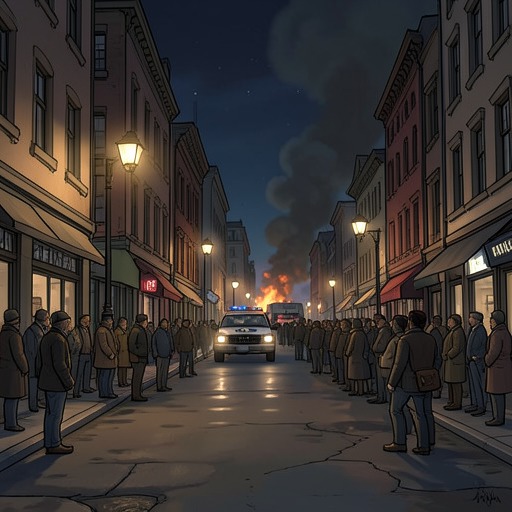
Garden Heights riots and protests
On the Come UpThe Garden Heights riots and protests begin after a police officer kills an unarmed boy near Brianna’s grandparents’ home and a grand jury declines to charge the officer. The demonstrations and unrest last for weeks; their effects outlive the street clashes, altering the neighborhood’s businesses, schools, and daily sense of safety while remaining an intimate source of fear and grief for Brianna and her family.
Causes and Course
The immediate cause is the killing of an unarmed boy by a police officer. The grand jury’s decision not to charge the officer is followed by weeks of protests and riots in Garden Heights. The narrative identifies the unrest as a response to the shooting and the failure of legal accountability, rather than presenting it as an isolated episode of disorder.
The conflict also changes how police presence is experienced in the neighborhood. Officers repeatedly drive through the area, a routine Brianna describes as the new normal. Their patrols may be presented as reassuring, but to her they instead convey surveillance and suspicion directed at Black residents. The contrast between the stated promise of safety and the sense of being watched captures a broader mistrust that the shooting and its aftermath have intensified.
Neighborhood Damage
The unrest leaves substantial damage behind. About half the businesses in Garden Heights are either deliberately burned by rioters or caught in the destruction. Club Envy, previously the usual Thursday-night destination, is among the businesses lost. In the months that follow, people gather outside Jimmy’s after the weekly Ring battles, turning its parking lot into a party spot. The gathering is not simply a replacement venue: it takes place in a neighborhood whose ordinary social spaces have been diminished by the violence and its consequences.
The damage reaches beyond commercial life. The daycare at Christ Temple is damaged during the riots, and the insurance company refuses to cover the repairs. The church’s pastor and elders adjust the budget to pay for them, and Jay loses her job as a result. The sequence connects neighborhood-wide destruction to the Jackson family’s financial insecurity: the riots’ aftermath contributes directly to a lost income at a time when the household is already struggling to cover basic expenses.
Effects on Brianna and Her Family
The shooting becomes a continuing personal reference point for Brianna. She connects the boy’s death with the possibility that she might have suffered the same fate, and that sense of proximity remains when she encounters police. The memory also shapes her response to school security. When guards at Midtown block and restrain her despite the metal detector not sounding, she cannot speak; the possibility of being mistaken for a threat is entangled with the remembered killing and the treatment she fears from authorities.
Brianna’s fear recurs as a bodily response, not just a stated opinion. Later, approaching the place where the guards pinned her down, she remembers the incident and struggles to breathe. The book links this school experience to the wider atmosphere left by the shooting: everyday scrutiny can revive the fear that a Black young person may be treated as dangerous, regardless of what they have done.
The shooting and the family’s earlier experiences also shape arguments about schooling. Jay refuses to send Brianna and Trey to Garden Heights High, explaining that she and their father had promised the children would never attend a school staffed by actual police and treated like a prison. She sees Midtown, despite its guards, as offering a better chance. Her reasoning makes the consequences of the neighborhood’s violence and policing part of a parent’s calculation about where her children might have a future.
Institutional Aftermath and Significance
The unrest’s legacy is visible in the measures institutions adopt and in the stories told about the community. After security guards are hospitalized in a later school confrontation, students are arrested and sent home while officials determine what to do next. Within the school community, Shana anticipates that Garden Heights High-style armed police may be introduced at Midtown. Malik argues that the guards’ return is tied to parents accepting the false narrative that Brianna is a drug dealer, which has encouraged the belief that students are threats. The protests and their aftermath thus form part of a continuing cycle in which public fear becomes increased surveillance and enforcement.
The event’s significance lies in its extended reach. The riots follow a specific failure of accountability, but their consequences appear in lost businesses, reduced community resources, school security, family hardship, and Brianna’s lasting fear. By showing these effects alongside the neighborhood’s gatherings and routines, the narrative presents the unrest not as a closed chapter but as a force that continues to shape daily life in Garden Heights.