I’m somebody’s daughter, sister, hope, and mirror
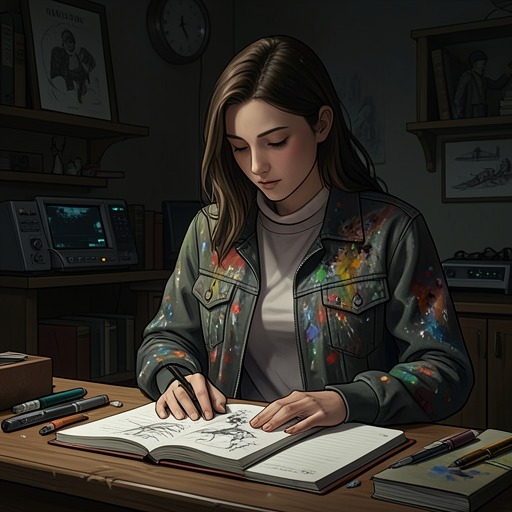
On the Come Up“I’m somebody’s daughter, sister, hope, and mirror” is the defining turn in Brianna Jackson’s freestyle at The Ring, where she refuses to let other people’s assumptions, commercial demands, or misreadings of her lyrics determine who she is. The phrase joins family identity to artistic responsibility: Brianna speaks as herself, while acknowledging that her words may become a reflection for her younger brother, Jojo.
Meaning and Context
The line takes shape amid competing attempts to define Brianna. People have treated her as a copy of her father, Law, while Supreme’s management advice threatens to turn her into a performer built for someone else’s expectations. Supreme tells her to play the role that others assign and explains that he urged Law to adopt a street image and associate with the GDs to appear authentic. He warns Brianna to play the role without becoming it, but she sees that he also regards her as a second chance to remake her father’s career.
That pressure is not confined to the music business. At a radio interview, Hype challenges the violent lyrics of “On the Come Up” and treats them as evidence about Brianna herself. Brianna objects that the criticism overlooks the students’ reasons for protesting and singles out her as a sixteen-year-old girl in a way it did not her father. Her song has also been presented on television as a hit among young listeners and linked to attacks on law enforcement. Across these encounters, a performance or lyric is repeatedly taken as a complete account of the person who made it.
From Labels to Self-Definition
The expression’s immediate emotional ground is Brianna’s resistance to being reduced to a replica or puppet. She thinks of how long people have called her her father’s clone and how Supreme appears to treat her as someone he can direct. Against those imposed identities, she recalls her brother calling her a gift and her mother calling her a miracle. She understands herself, more firmly, as her mother’s daughter and Trey’s sister.
The refrain’s final word opens the family declaration outward. Brianna considers that she may be a mirror for Jojo, but not a neutral one: he has distorted her meaning, as have Emily and the Crowns. The possibility of influence therefore comes with a risk. Jojo may take her words as encouragement to join a set, just as other listeners mistake her lyrics for an endorsement of the violence they describe. Brianna’s response is not to withdraw her voice, but to make its meaning clearer.
The Freestyle at The Ring
Brianna’s realization comes after she refuses to record a song written for her by Dee-Nice. Supreme argues that the music business is about making money, points to the commercial opportunity in the studio, and invokes the family’s poverty and need for food drives. He also offers to make the image of her song seem more authentic by surrounding her with people he calls goons. Brianna rejects the track because it does not represent her and because accepting a ghostwritten song would contradict her own authorship.
At The Ring, she turns that refusal into a performance of her own. She says she will not be a puppet or a clone, and declares herself someone’s daughter, sister, hope, and mirror. The freestyle also rejects being called either a sellout or a thug and challenges the assumptions that make listeners treat rap as proof of a violent identity. Its family-centered refrain is thus part of a wider argument about representation: Brianna can speak about what she sees without claiming that those words define her as a person.
Audience and Significance
The declaration addresses Jojo in particular, but it also answers the adults, media figures, and listeners who have tried to turn Brianna into a predetermined role. Her words distinguish influence from imitation: she recognizes that her brother may look to her, yet refuses to become a model that endorses gang affiliation or a marketable stereotype. The mirror is not an image she simply accepts from others; it is a responsibility she names for herself.
The crowd answers the freestyle with an explosion of cheers. That response marks the moment when Brianna’s refusal of the ghostwritten song becomes an affirmative statement of artistic identity. The phrase holds together the relationships she claims and the public consequences of being heard: she is not only someone’s daughter and sister, but a voice whose meaning she insists on defining.