Jackson family’s financial hardship
On the Come UpJackson family’s financial hardship is not a passing backdrop but a force that reaches into the family’s meals, housing, work, and decisions about Brianna’s future. When Jay loses her church job after riot damage leaves Christ Temple unable to pay for repairs, the household’s existing strain becomes harder to contain; later, hunger, unpaid bills, and the loss of electricity make the cost of that insecurity unmistakable.
Income, rent, and a lost job
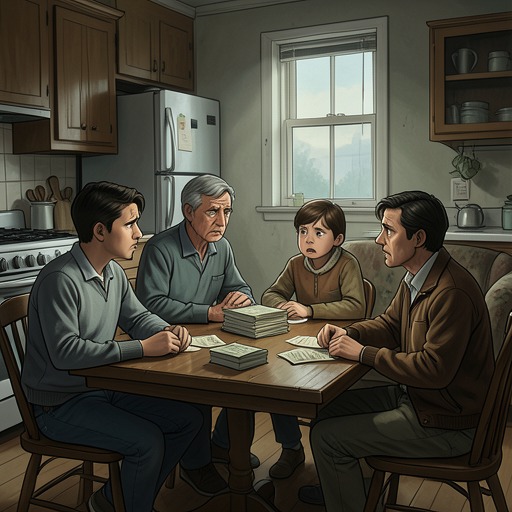
The crisis becomes explicit when Jay explains that the church daycare was damaged during the riots and the insurance company would not cover the repairs. The pastor and elders adjusted the budget to pay for the work, and Jay was let go. Brianna understands the consequences before any new income is in view: the family already has no gas, and the previous month it received an eviction notice. Jay used most of her paycheck to cover the rent, leaving the household to eat sandwiches until payday. Without the next paycheck, even that fragile arrangement has no clear continuation.
The numbers and routines behind the crisis matter. A paycheck is already divided between keeping a roof overhead and meeting immediate needs; losing Jay’s position threatens both at once. The family’s insecurity is therefore not simply a shortage of spending money. It is exposure to cascading setbacks, where a damaged workplace becomes unemployment, unemployment threatens rent and food, and there is little reserve to absorb the next bill.
Food, utilities, and everyday survival
During the second day of winter break, Brianna inventories the refrigerator: eighteen items in total, including eight eggs, four apples, butter, milk, juice, bread, and jars of jelly and peanut butter. The freezer holds a ten-pound bag of chicken, peas, and corn. She can account for dinner that night and the next, but not what will follow; Christmas itself feels uncertain. Trey reaches into the refrigerator for an egg and bread, reducing the count as the family’s food supply is being measured in meals rather than abundance.
The scarcity also appears in the household’s compromises. The family has already given up cable to preserve Jay and Trey’s phones, which they need for possible jobs. Later, Brianna tells Malik that the family went without lights for a while, and that her shoes fell apart while he stood in Jordans. The contrast is not offered as a simple accusation: Brianna acknowledges that Malik’s mother works hard and that his family is not rich, while insisting that he cannot know the daily urgency of her situation unless he tries to understand it.
Food assistance brings the shortage into public view. Jay drives Brianna to a community center on Ash before eight in the morning; the parking lot is already full, an eighteen-wheeler is loaded with boxes, and a line stretches out the door. A news van is there as well, making the relief effort visible to the media. Brianna protests that she does not want to be on the news. The scene places practical help beside the exposure and embarrassment that can accompany needing it.
Money, family obligations, and difficult choices
The hardship shapes Brianna’s understanding of money as immediate protection. After Law’s chain is taken, she explains to Malik that she wanted it back because it was the family’s safety net, something they could pawn if conditions worsened. Her insistence is rooted in concrete deprivation: bills, missing lights, days with barely enough food, and worn-out shoes. Malik’s reminder that money is not everything meets a different lived reality; Brianna asks not that he share her hardship, but that he try to understand why financial security occupies her attention.
Jay’s confrontation with Aunt Pooh makes the family’s limited resources a boundary as well as a need. When Aunt Pooh asks whether Jay will bail her out, Jay demands to know where the money would come from and points to her own bills. Aunt Pooh proposes that Jay take out a loan to cover bail and hire a better attorney, promising repayment. Jay rejects the plan because she believes it would lead Aunt Pooh back to the behavior that landed her in custody. Her refusal comes amid her distress and her acknowledgment that she has cried over her sister; financial help cannot be separated from the risk of enabling a cycle Jay fears will continue.
Work, opportunity, and the cost of a way forward
Music offers a possible route to income, but it also exposes Brianna to pressure over how that income should be made. Supreme tells her that the Ring brought her father and Dee-Nice attention, while music and the right song secured opportunity; he offers to make calls and generate buzz after the holidays if Brianna uploads her song. Dee-Nice describes a more concrete result: Supreme helped him build a plan, and he can now take care of his family. These examples make the prospect of a music career more than a dream, especially in a household that has little financial cushion.
Yet the business opportunity comes with its own demands. At the studio, Supreme argues that Brianna should record a song Dee-Nice wrote, stressing that the music business is about money and invoking food drives and poverty as reasons to accept the deal. Brianna resists because she has already been mocked as a ghostwriter and does not want to perform a song that feels false to her. The scene sets the promise of income against creative ownership: poverty raises the stakes of saying no, but it does not erase Brianna’s concern that a commercially useful role could compromise her identity.
Housing and the family’s next arrangement
Eventually, Jay proposes that the family move in with Brianna’s grandparents. She says she will help with household expenses, but sharing the home would reduce the number of bills the family has to carry. They have been trying to catch up on rent for so long that catching up has become nearly impossible. The move is presented as practical relief, not an effortless resolution: it eases the immediate pressure while Jay hopes to return to school, finish her education, and save for a place of her own once she has a job. Trey, who has been trying to keep the family afloat, learns about the plan at the same time as Brianna.
Across these episodes, hardship narrows the family’s choices without making its members passive. Jay works, cuts costs, and considers education and employment as routes toward stability; Brianna tracks food, protects the chain’s value as a reserve, and weighs music-industry opportunity against artistic independence. The family’s circumstances give those decisions their stakes: the question is not only what they want, but what they can risk when rent, food, utilities, and the next paycheck remain uncertain.