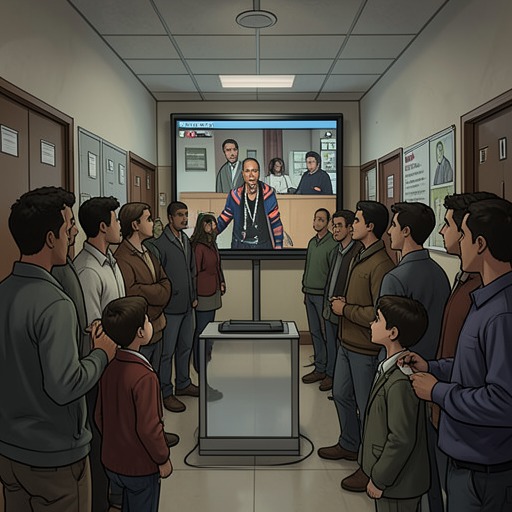
Jay and Brianna make and release a music video for the song
On the Come UpJay and Brianna make and release a music video for “On the Come Up” as a response to the public controversy over Brianna’s song and to the school incident the controversy obscures. Built with Malik’s documentary footage, the video connects lyrics that have been quoted as evidence against Brianna to images of the experiences behind them. Its method is both artistic and explanatory: rather than accept other people’s framing of the song, Brianna and her collaborators use the song to show what they say it means.
Background and Purpose
The idea begins with Malik asking whether the video of Long and Tate’s treatment of Brianna could be released on her own terms. He suggests using the song to show viewers what happened, matching its lines with documentary footage. When Brianna identifies the possibility of showing the recording as she raps about being pinned down, the proposal becomes a way to explain the lyrics through the incident they evoke.
This proposal follows an argument between Brianna and Malik about how to respond to the security incident. Malik recognizes that Brianna has already addressed what Long and Tate did in the song, and accepts that she spoke up for the students even if others fail to understand her. His change of position matters: the video is not simply an attempt to defend Brianna from criticism, but a collaboration in which Malik uses his documentary material to help make her intended meaning visible.
Making the Video
Brianna, Malik, and Sonny spend several hours assembling the video from material Malik recorded for his documentary. The sequence links particular lyrics to particular images rather than treating the song as a general statement. When Brianna raps about a squad carrying weapons, the video shows guns at the waists of Garden Disciples members; Malik blurs their faces. The images retain their evidentiary function while withholding the group members’ identities.
Another lyric, about being blamed for murder despite not committing it, is paired with news clips from the previous year’s killing of a boy. The edit shifts attention from the accusation in isolation to the wider setting of the song’s claim: news footage supplies the event to which the line refers. The video therefore does not erase the song’s confrontational language; it places that language beside images of the conditions and public narratives informing it.
The makers also include Malik’s secret footage of a clerk following Brianna and her companions around a comic shop in Midtown. It accompanies Brianna’s line about being watched as a threat. This connection extends the video’s argument beyond the school incident: its montage also recalls an earlier encounter in which Brianna experienced suspicion in a public setting.
The sequence culminates in footage of the incident with Long and Tate. As Brianna raps about being pinned to the ground, Malik inserts the recording of what happened at school. The pairing fulfills the original concept directly, making the video’s central claim legible through the correspondence between words and image. The project is a response to the security incident, but it also makes the act of documenting and releasing that incident part of Brianna’s public artistic expression.
Public Controversy and Framing
The need for a counter-reading is established by media coverage that identifies Brianna as a local rapper and presents “On the Come Up” as violent and popular with young listeners. A television report plays only selected passages, with profanity removed, and characterizes the song as containing attacks on law enforcement. That presentation separates provocative fragments from the circumstances and experiences the video later assembles around them.
The controversy continues through a petition to remove the song from Dat Cloud. During an interview with Hype, Brianna is asked to answer claims that the song is anti-police and contributed to a school riot. Hype also challenges her lyrics about being armed and suggests that they imply killing police officers. Brianna rejects that interpretation and objects that the song’s critics treat the lyrics as the cause of student protest without asking why students were protesting. The video’s use of the school footage gives this objection a concrete form: it places the event beside the line used to characterize her, rather than allowing the line alone to stand for the event.
The coverage and the video use different editing logics. Television extracts pieces of the song to make a case about its alleged danger; Brianna and her collaborators build correspondences between each selected lyric and footage meant to clarify its reference. The video cannot guarantee that viewers will accept that explanation. Brianna doubts it will change the minds of people unwilling to understand someone like her, even as she hopes it will unsettle them. Its significance lies partly in that limitation: the work claims the right to speak and show, but cannot compel its audience to listen fairly.
Artistic Agency and Significance
The project also belongs to Brianna’s struggle over artistic identity and authenticity. Earlier, Supreme advised her to play the role others expected of her and explained how the music business could turn stereotypes about Black artists into a commercial advantage. Later, he urges her to record a song written by Dee-Nice, arguing that the business is about making money and invoking the poverty Brianna’s family faces. Brianna resists because the song is not hers and accepting it would make her feel phony. Against that pressure to perform a marketable identity, the video is made from her own lyrics and from footage connected to what she has experienced.
That insistence on authorship resonates with Brianna’s later freestyle, in which she refuses to be a puppet or a clone and declares that she will not be called a sellout. The music video and the freestyle are distinct acts, but both place control over her voice at the center of her public work. In the video, agency is not expressed by separating art from reality: Brianna joins her writing to documentary images, while Malik’s contribution lets the song show what its critics’ excerpts leave out.
The video thus changes the terms of the dispute without promising to settle it. It gives Brianna a means of presenting her account of the school incident alongside the lyrics that have been used to condemn her, and it makes the process of interpretation visible: viewers must decide whether to treat the song as a threat detached from context or as expression grounded in experiences the images document. Even if that choice does not persuade every critic, the release is an act of self-representation shaped by collaboration, evidence, and the demand to be understood on Brianna’s own terms.