Jayda Jackson
On the Come UpJayda Jackson, known to her children as Jay, is Brianna and Trey’s mother, a recovering addict, and a woman trying to rebuild a stable family life under persistent financial strain. Her story is defined by a painful contrast: she once could not care for her children while also managing her drug habit, but later works, studies, and parents with a deliberate awareness of the harm her absence caused. Her recovery offers neither an erasure of the past nor an easy resolution; it becomes the difficult basis for renewed responsibility.
Identity and Background
Jay’s addiction led her to leave Brianna and Trey in the care of their grandparents when she could not manage both her children and her drug habit. Brianna recalls this separation as more than a past change of household: in a nightmare that is also a memory, she understands that people who die can sometimes take the living with them. The thought connects her mother’s addiction and departure to the fear and grief Brianna associates with loss, giving Jay’s return to family life a history that cannot be treated as simple reconciliation.
Recovery is part of Jay’s visible life as well as her private history. When Supreme sees her, he compliments her in recognition of her having gotten clean, not as flirtation. Brianna describes Jay’s stories about her father as variable: sometimes Jay shares them to fill gaps in Brianna’s memories, while on other days his name is treated as something the family should not say. This changing openness places Jay between preserving family memory and managing subjects that remain difficult to discuss.
Work, Study, and Financial Strain
Jay works as a church secretary and adopts a formal “Church Jay” appearance for the role: a ponytail, a knee-length skirt, and a long-sleeved blouse that covers her tattoos and scars from her addiction. The clothes are part of the position’s expectations, but they also make visible the distance between the composed public role and the past she carries beneath it.
She attends college part-time, taking evening classes several nights a week as she pursues a social work degree. Her stated purpose is to help people who need the kind of assistance she did not receive while using drugs. The schedule leaves little margin: on a Thursday, she has time either to eat or change before class, and chooses to eat. Her education therefore appears not as an abstract ambition but as work undertaken alongside employment and parenting, with her past informing the kind of help she hopes to provide.
The family’s hardship is concrete. After repeated extensions, the gas company cuts service when overdue bills accumulate. The house has no gas heat; an electric heater in the hallway only partly eases the cold, hot bathwater must be heated in pots on the electric stove, and the family sleeps under extra covers. Jay and Trey have both been caught up in the bills, and Jay’s effort to keep the household going takes place within this limited set of resources rather than beyond it.
Her church job is also insecure. The church daycare is damaged during the riots, and the insurance company refuses to cover the damage. The pastor and elders adjust the budget to pay for repairs and let Jay go. The loss follows from institutional financial decisions and riot-related damage, not from a stated failure in her work; it further narrows the family’s already strained means.
Parenting and Relationships
Jay’s relationship with Brianna is shaped by care and the memory of separation. At home, she serves herself and Brianna plates of food while Trey is away, a small domestic scene that sits against the larger history of her inability to care for both children during addiction. Later, when the family is at the house where she left Brianna and Trey, Jay taps the steering wheel and says she still hears Brianna’s screams from that day. Her recollection confirms that the separation remains present for her, not only for the daughter who remembers being left.
Jay also brings the experience of recovery into her support for others. Speaking to Pat, who is trying to regain access to their children, Jay urges patience and continued work to earn trust. She understands the frustration because, after rehab, her own in-laws made regaining access to her babies difficult. The advice is grounded in both sides of that history: she can acknowledge the pain of being kept from one’s children while recognizing why trust has to be rebuilt.
Her account of Brianna’s father is not consistent from day to day. Jay sometimes offers stories that compensate for Brianna’s limited memories; at other times, she treats his name as forbidden. The variation shows that family history is something Jay both mediates and withholds, and that her attempt to help Brianna remember coexists with her own difficulty speaking about him.
Public Conflict and the Cost of Poverty
Jay speaks up when Brianna is questioned by school authorities after a security incident. When the principal asks whether Brianna has been selling candy on campus, Jay warns her daughter and then challenges the principal’s implication that the children may be inventing their account of the guards’ behavior. She recalls that her son reported guards picking on some students more than others when he attended the school. Her response is measured but firm: she asks the administration not to dismiss the children’s account simply because it is being made by her family.
The incident unfolds within a school environment where metal detectors, searches, and armed police have become points of concern for parents. At a public meeting, another parent questions why children should be subjected to such measures in a school. Jay’s intervention is part of a wider dispute over security and unequal treatment, and it shows her acting not only as Brianna’s protector but as a parent insisting that institutional authority answer for how students are treated.
Poverty also shapes how Jay’s family is judged. In a school confrontation, Brianna protests that her worst failing is being poor. The statement gives voice to a condition that the family’s unpaid bills and cut-off gas have already made tangible. Jay’s circumstances place her children’s daily needs alongside the risk that economic hardship will be treated as a personal fault rather than as a constraint on their lives.
Change and Continuing Responsibility
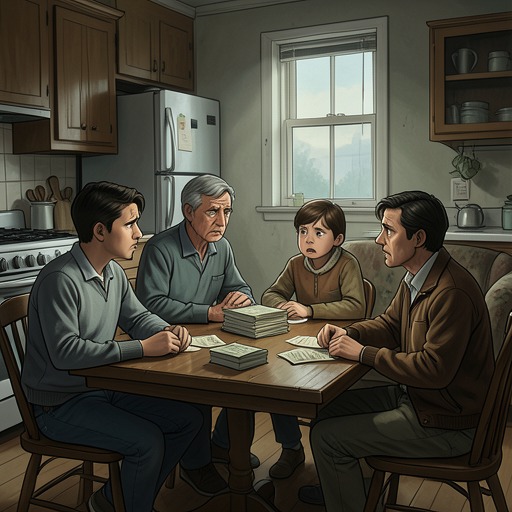
The family’s circumstances eventually lead to a practical change in where they live. Jay tells Trey that his grandparents have offered for all three of them to stay in their home until they can get back on their feet, and that she has accepted. The decision is a response to financial instability, not a claim that every difficulty has been resolved. It brings the household closer to the grandparents whose home once provided care for Brianna and Trey during Jay’s addiction, giving that place a changed role in the family’s life.
Jay’s trajectory is therefore neither a simple redemption story nor a return to an untouched past. She has completed rehab and remained clean, pursued education so she can help others, supported her children, and spoken up when she believes their accounts are being discounted. At the same time, poverty interrupts work and basic utilities, and Brianna’s memory of being left remains sharply alive. The force of Jay’s characterization lies in that coexistence: recovery makes renewed care possible, but responsibility includes facing the separation and material insecurity that recovery alone cannot undo.