Jimmy’s Boxing Ring
On the Come UpJimmy’s Boxing Ring is a Thursday-night freestyle venue and one of the most consequential public stages in Garden Heights. More than a place to compete, it is where Brianna Jackson moves from rapping privately to risking judgment in front of her community, and where the difference between performing a role and being defined by one becomes central to her artistic life.
Setting and Place in Garden Heights
Brianna describes the Ring, formally Jimmy’s Boxing Ring and often called Jimmy’s, as one of Garden Heights’ most sacred places, second only to Christ Temple. In local terms, a rapper has not fully proved themself until they have battled there. The venue therefore carries more weight than an ordinary entertainment space: it is a recognized proving ground where skill can become reputation.
The Ring hosts freestyle battles every Thursday. Around the contests, Jimmy’s parking lot has also become a gathering place. The outdoor party, known as the let out, begins after the final battle, with people showing off their cars and socializing outside. The lot’s popularity recalls the role Magnolia Avenue plays on Friday nights, extending the Ring’s influence beyond the gym and into the neighborhood’s public life.
That gathering place has a history shaped by violence and loss. A year before Brianna’s first battle, an unarmed boy was killed by a police officer a few streets from her grandparents’ house; a grand jury declined to charge the officer, and protests and riots followed for weeks. Businesses throughout the Garden were burned or caught up in the conflict, including Club Envy, the usual Thursday-night destination. Jimmy’s became part of the changed landscape: a replacement gathering spot, but one operating amid ongoing police surveillance and a new sense of normality formed by the unrest.
Battles and Brianna’s Debut
Before entering the Ring, Brianna has been rapping since she was ten, but has rarely put herself forward. Her family and friends know about her ability, yet she does not regard their encouragement as proof that she can succeed before an audience. The Rookie Royale offers a decisive first public test. She has submitted her name for a chance to battle and sees a win as a way to earn a place in the Ring’s lineup, which could lead to further battles and a name of her own.
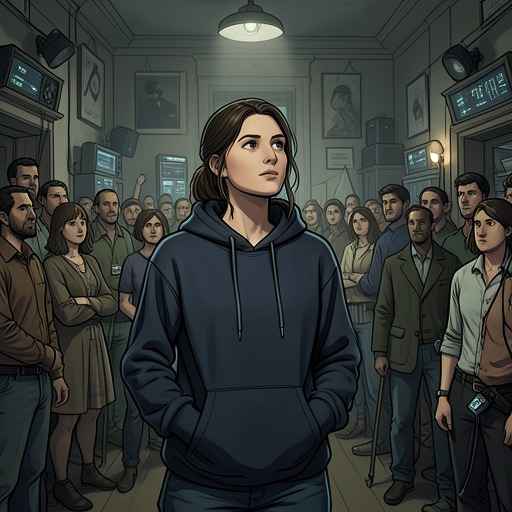
The event is staged with the language and ceremony of a boxing match. The music fades, the lights dim, a spotlight falls on DJ Hype, and he introduces the first competitors by corner. That theatrical framing makes the Ring’s contest legible as both competition and show: performers step into a marked space, while the crowd’s reaction helps determine who leaves with public recognition.
Brianna wins the Rookie Royale. Hype raises her arm and announces her as the winner to thunderous cheers. The result answers her uncertainty about whether she can hold her own in the Ring, and it converts a private ambition into a visible achievement. Her victory is also part of the history later used to introduce her to radio listeners: Hype tells them to look up the battle online and recalls that she had been expected to return to the Ring before a later mishap interrupted that plan.
Audience, Reputation, and Public Exposure
The Ring’s audience does not simply witness Brianna’s performance; it helps carry it outward. In a later parking-lot confrontation connected to the venue, Supreme points out that phones were aimed at the people involved and anticipates that the resulting coverage will reduce the incident to a sensational story about a rapper having a supposedly “ghetto” encounter. The Ring’s surroundings thus become another stage, where a moment of public conflict can be recorded and reframed for audiences beyond Garden Heights.
That tension between performance and interpretation returns when Brianna appears on Hot 105. Hype praises her battle and says listeners should watch it, but then turns to controversy over “On the Come Up,” including a petition to remove the song from Dat Cloud and claims that it contributed to a riot at a local school. The Ring is not the source of that dispute, but Brianna’s achievement there becomes part of the public story used to frame her music and her identity.
Inherited Identity and Artistic Choice
The Ring is also bound to Brianna’s relationship with her father, Law. Before her debut, Mrs. Murray recognizes that battling there means following her father’s footsteps. Later, at the venue, a Crown recognizes Brianna as Lawless’s daughter by the chain she wears. That recognition turns an object associated with her father into a public sign of family history, linking her presence at the Ring to the danger and expectations attached to his name.
The venue’s legacy also carries a warning about the making of a rap persona. Supreme tells Brianna that he urged Law, who had been working ordinary jobs and singing in a church choir, to rap street material and associate with the GDs so he would appear authentic. Law took that role seriously. Supreme presents Brianna with the same commercial logic—play the role others expect, but do not become it—and sees her as a chance to accomplish what he and Law did not. His account makes the Ring’s demand for performance part of a larger conflict over whether a rapper can use a public image without being trapped by it.
Brianna’s answer is not to withdraw from performance, but to claim authorship of it. In a later freestyle, she rejects being treated as a puppet, a clone, a sellout, or a thug, and describes herself through her relationships and responsibilities as a daughter, sister, source of hope, and mirror. The crowd responds with cheers. The Ring therefore stands not only as the place where she wins recognition, but as a recurring measure of what recognition costs—and as a stage on which she insists that her words and identity remain her own.