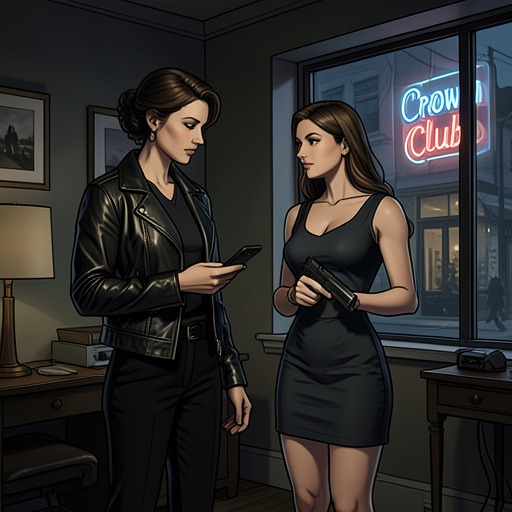
Lawless (Junior Jackson) is killed
On the Come UpLawless (Junior Jackson) is killed in a shooting outside his family’s former home as he and Jay leave for a date night. Though he was not a gang member, his closeness to the Garden Disciples drew him into their conflict with the Crowns; his death leaves Brianna with a loss that continues to surface in memory, family life, and her responses to violence.
Circumstances of the Killing
The shooting takes place in front of the family’s old house. Jay and Lawless are heading out for date night, while Aunt Pooh has agreed to watch Brianna and Trey, who are still children. The ordinary family arrangement is interrupted by the killing, making the loss inseparable from Brianna’s recollection of the home and the evening her parents left together.
The account identifies the Crowns as the suspected perpetrators: Brianna has heard that a Crown pulled the trigger. The Crowns are described as the largest King Lord set on the east side, so large that they may as well be their own gang. Lawless was not a gangbanger, but his close ties to many Garden Disciples placed him near the conflict. The narrative thus distinguishes his own identity from the gang violence that killed him while showing how association could expose him to its consequences.
Brianna’s Memory of Her Father
Lawless’s death remains vivid in Brianna’s recollection. She can still hear the gunshots that took him from the family, and she remembers seeing him in the coffin, cold and stiff. These details return as fragments of a loss that is not confined to the past: her account links the shooting to the lasting presence of bereavement in her life.
The novel also connects this early loss to a later rupture in care. In a nightmare that is also a memory, Brianna recalls that Jay left her and Trey at their grandparents’ house because she could not manage both the children and her drug habit. Brianna understands this abandonment through the earlier death, reflecting that people who die can sometimes take the living with them. The thought conveys how Lawless’s absence shapes her experience of subsequent separation without suggesting that the two events are the same.
Aftermath and Continuing Effects
The death also belongs to a wider pattern of violence that informs Brianna’s life and artistic expression. Years later, when a news report describes her song “On the Come Up” as violent and popular among young listeners, the song is publicly associated with attacks on law enforcement. In an interview, Hype challenges lyrics about being armed and killing police. Brianna counters the gendered framing by asking whether the same material would have surprised listeners if her father had rapped about it at sixteen. Her response makes Lawless’s own history part of the context through which she contests the scrutiny placed on a young girl who raps about violence.
That scrutiny unfolds alongside Brianna’s awareness that a girl in rap must work harder for less respect and is expected to be as ruthless as men without showing weakness. James Irving’s approving description of her as sassy and Black similarly reflects how others frame her performance through race and gender. These later encounters do not change the circumstances of Lawless’s death, but they show how the memory of her father and the violence surrounding his world remain connected to Brianna’s effort to claim space as an artist.
Narrative Significance
Lawless’s killing is presented through Brianna’s remembered experience rather than as an isolated account of gang conflict. The date-night departure, Aunt Pooh’s babysitting, and the old family house give the event a domestic setting; the reported connection to the Crowns and the Garden Disciples locates that private loss within neighborhood violence. The contrast underscores that Lawless’s lack of gang membership did not shield him from a conflict entangled with his relationships.
His death also becomes a reference point for understanding the novel’s recurring links among violence, grief, and family instability. Brianna’s memories of the shooting and the coffin coexist with the later memory of Jay’s departure, while her father’s teenage rapping informs her answer to criticism of her own lyrics. The killing therefore matters not only as the event that took Lawless from his family, but as a loss whose aftereffects continue to shape how Brianna interprets abandonment and speaks about violence.