Long and Tate
On the Come UpLong and Tate are security guards at Midtown School of the Arts whose use of school security turns suspicion into punishment. Their scrutiny of Black and brown students culminates in the restraint and search of Brianna Jackson, even though the metal detector does not beep; the encounter then circulates online under a false drug-dealer caption and becomes part of the larger dispute over how Brianna and her schoolmates are represented.
Identity and Role
Long and Tate work as a pair of school security guards. Brianna sees them keeping watch on Sonny and Malik in a hallway, describing the guards as persistently looking for trouble. The scene introduces their presence not as a neutral background service but as a source of pressure for students who are already conscious that race affects who is watched.
Long is himself Black, a detail that complicates rather than resolves Brianna’s observation that Black and brown students are more likely to attract the guards’ attention. The narrative presents the problem through the pattern of scrutiny and the authority the guards exercise, not through a claim that the guards share the same identity or motive. Tate appears alongside Long as the second guard, reinforcing the paired, institutional character of the encounters.
Repeated Security Practices
The guards’ conduct is not limited to Brianna’s later search. Sonny recalls that the previous week Long and Tate subjected Curtis to an additional screening even though the metal detector had not sounded. They said they wanted to be sure, a rationale that makes personal discretion—not an alarm or an identified violation—the basis for further examination. Malik objects that the way security is being conducted is not normal, while Sonny dismisses the guards as more talk than action.
That disagreement sets up the difference between how the students assess the guards and what happens next. Curtis passes through the detector without difficulty, as do Shana, Deon, the three sophomores, Zane, Sonny, and Malik. Brianna follows them; the detector again does not beep, but Long bars her from proceeding and orders her back. Tate’s response is that she must comply because Long has said so. The sequence makes the asymmetry concrete: the equipment registers no problem, yet the guards’ authority creates one.
Restraint and Search of Brianna
When Brianna pulls away and tells the guards to take their hands off her, Long grabs her arm again and pulls it behind her; Tate is also involved as the two take her down and remove her backpack. Long places a knee on her back, and Tate searches the bag. The guards’ actions escalate a disputed screening into a physical restraint and search, although the available account does not establish that they discover contraband.
Long frames the search as confirmation of his suspicion, asking whether Brianna brought something into school and accusing her of hiding it. He calls her a hoodlum and taunts her about having spoken up the previous day. Brianna cannot answer in the moment. Her immediate experience is therefore shaped not only by the restraint but by a label that turns an unverified suspicion into an asserted identity. She also notes that Long is not a police officer, underscoring the force of the guards’ conduct within a school setting.
From School Encounter to Public Stigma
The aftermath shows how the incident’s meaning is contested. When Jay acknowledges that the guards used excessive force and says they put Brianna on the floor, Brianna corrects the account: they threw her down. The distinction matters because even a sympathetic description can soften what happened. Brianna later reflects that she is no longer invisible, but wishes she were; Long’s use of hoodlum has become a word she turns over, testing its possible rhymes before rejecting it.
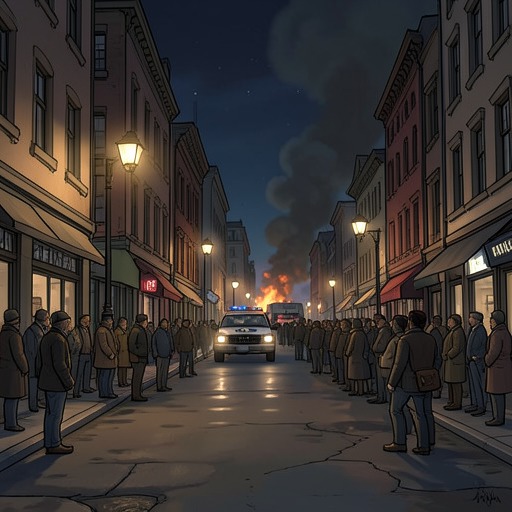
The incident also acquires a second, more damaging label online. A recording of Long and Tate pinning Brianna to the ground is uploaded without showing the preceding events, under the caption “Drug dealer caught at MSOA.” The video’s limited view omits the guards’ decision to stop Brianna despite the silent detector, while its caption presents an accusation as fact. Brianna’s own account of the encounter is thus competing with a fragment that makes her appear culpable.
Wider Consequences and Significance
As Brianna’s song “On the Come Up” becomes news, the conflict between student experience and official framing broadens. A television report calls the track a hit among young listeners and describes its lyrics as violent and directed against law enforcement; classmates chant one of its lines, which the report presents as evidence that the song encouraged students to act violently. The sequence links the guards’ treatment of Brianna to a wider cycle in which her words and image are detached from context and used to define her as a threat.
That framing is challenged in Brianna’s interview with Hype. When he questions the song’s references to weapons and police, Brianna points out the gendered difference in his reaction: he was not unsettled when her father rapped about such subjects at sixteen. Her objection recalls Aunt Pooh’s warning that a girl entering rap would have to work twice as hard for half the respect and could not show weakness. In this context, Long and Tate’s treatment of Brianna is part of a broader pattern of suspicion and unequal interpretation, intersecting with her identity as a Black teenage girl and rapper rather than reducible to a single incident.
The guards’ actions do not remain confined to the school encounter. Brianna’s classmates later repeat her lyrics, and a television account interprets their protest through the song; the connection does not make Long and Tate responsible for every later event, but it shows how the original encounter becomes one element in a public argument about security, student protest, and blame. Their decisive narrative role is to expose how discretionary school authority can produce both physical consequences and a lasting public label, while the missing context in the circulated video makes Brianna’s struggle to correct that label harder.