Louise Jackson
On the Come UpLouise Jackson, usually called Grandma, is Brianna Jackson’s grandmother and one of the adults who tries to keep the Jackson family safe through grief and financial hardship. Her care is tangible: she offers money, urges Brianna to sit with her at church, and eventually insists that Brianna come live with her. Yet the same protectiveness can become a contest with Jayda Jackson, whose different background and painful history Louise distrusts. Louise’s characterization rests in that tension between provision and possession: she wants to secure her grandchildren’s future, while grief makes letting them choose feel perilously close to letting go.
Identity and Family Background
Louise is the mother of Jayda and the grandmother of Brianna and Trey. The novel presents her as a churchgoing family member with an active place in the congregation: she sits near the front with the decorating committee, distinguished by the largest hat among the group. That public, communal setting also becomes a place where family tensions surface rather than disappear.
Her antagonism toward Jay is rooted in class and neighborhood divisions. Brianna describes Louise as stuck-up and says her principal objection is that Jay came from Maple Grove. Louise has repeatedly called Jay an “ol’ hood rat from the projects”; Jay, in turn, has called Louise “that ol’ bougie heffa.” Their mutual insults expose a long-running conflict in which neither woman’s judgment is one-sided. Louise’s suspicion is sharpened by Jay’s past addiction, while Jay resents being reduced to her origins and history.
Care, Church, and Family Conflict
Louise’s care for Brianna appears in repeated invitations to sit with her at church. Brianna and Jay have developed an informal Sunday arrangement: Brianna alternates between sitting with her mother and her grandparents, so neither side feels that she has chosen the other permanently. Brianna calls this “joint custody: church pew edition.” The routine gives her a way to manage the adults’ competing claims without resolving their underlying conflict.
At church, Louise also presses Brianna about the incident at school after Sister Daniels reports that security threw her to the ground. Brianna initially says nothing happened, hoping to avoid the questions that will follow. Louise’s concern is direct, but the moment also shows how quickly Brianna’s private experience becomes subject to family scrutiny in a community setting.
Louise’s wary attention extends to Jay’s use of money. When Jay receives money, Louise tells her not to waste it and says she hopes it will go toward her grandchildren rather than “some of the other mess” Jay may be involved in. Jay demands to know what Louise means; Granddaddy Jackson tries to quiet the exchange. Louise’s remarks frame her financial concern as protection of the children, but their accusatory edge makes clear that trust between mother and daughter remains fragile.
Grief and the Things Left Behind
The death of Brianna’s father, Law Jackson, shapes Louise’s attachment to the family. Jay explains that she hid some of Law’s belongings from Louise because Louise wanted everything that had belonged to him. Jay had also hidden the items from herself, recognizing that, during her addiction, she might have sold some of them. The objects therefore carry more than family history: they are vulnerable remnants of a loss that both women have tried, in different ways, to manage.
Granddaddy Jackson later gives a more explicit account of Louise’s grief. When Louise insists that Brianna and Trey move in with the grandparents, he says that she holds on to the children because doing so is like holding on to Law. His explanation does not erase her genuine concern for their welfare, but it reveals the emotional pressure beneath her intervention: caring for her grandchildren is also bound up with preserving a connection to her son.
The Move and Its Consequences
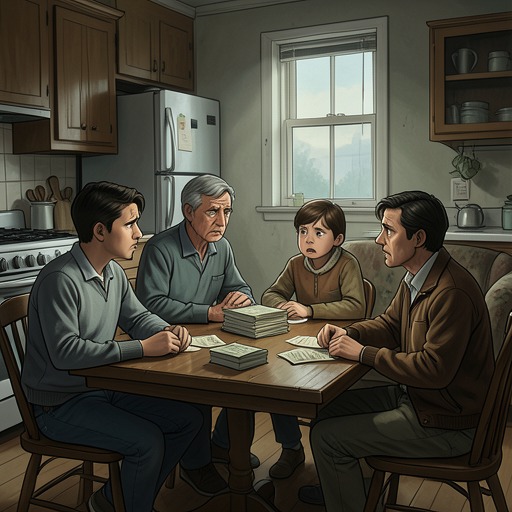
The immediate crisis is practical as well as emotional. Brianna and Trey’s household has no electricity, and Granddaddy points out that Trey cannot claim to have matters under control when they do not even have lights. Louise responds by announcing that Brianna and Trey are coming home with the grandparents. Trey protests that he is twenty-two and does not want to be the rope in the tug-of-war between Louise and Jay.
Louise refuses to apologize for fighting for her son’s children. She tells Trey that he may stay if he chooses, but declares that Brianna is coming with her. Granddaddy interrupts the decision to ask Brianna what she wants, recognizing that she is old enough to decide for herself. Her immediate answer is shaped by deprivation: she wants food, lights, and guarantees. The exchange places Louise’s offer of shelter alongside the family’s need for material security, while also exposing the danger of treating Brianna as the prize in an adult dispute.
Louise leaves after Jay refers to paying someone back, prompting her lips to tremble before she hurries out and shuts the door. Granddaddy interprets her reaction through grief and gives Jay money, asking her to call if she needs help. His response preserves a route to practical support even as the confrontation fractures the room. Louise’s protectiveness remains real, but the scene shows that it is inseparable from her sorrow and can drive her to make a decision for Brianna before Brianna has spoken.
Narrative Role and Significance
Louise is neither a simple source of rescue nor merely an obstacle. She can provide the concrete help the household lacks, and her determination to protect the children has an understandable basis in their insecurity. At the same time, her hostility toward Jay and her readiness to claim Brianna reproduce the family’s unresolved divisions. The novel lets those motives coexist: concern can be generous and controlling in the same act.
Her presence also gives the family’s grief a visible, recurring form. Louise’s desire to keep Law’s belongings and her insistence on keeping his children close both turn loss into an effort to hold on. Granddaddy’s intervention makes that pattern explicit, while Brianna’s alternating church visits and her answer about wanting food and lights register the costs of being caught between adults. Louise’s arc in the available scenes is therefore not a resolution of grief or conflict, but a sharp illustration of how love, material need, class judgment, and bereavement overlap in the Jackson family.