Midtown Black and Latinx Coalition
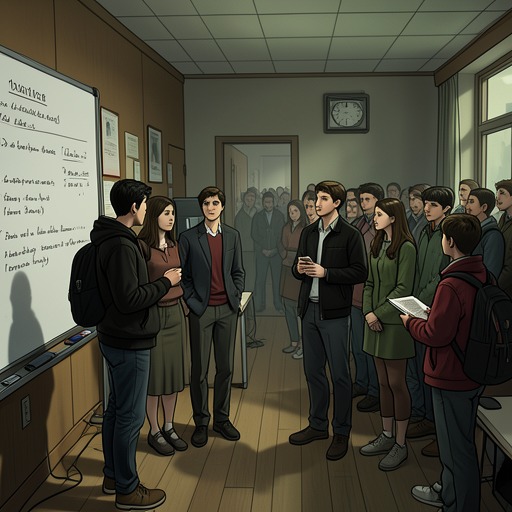
On the Come UpThe Midtown Black and Latinx Coalition gives students a collective voice in challenging the security regime at Midtown. Formed amid controversy over guards’ treatment of students and the arrival of armed police, it brings those grievances to school administrators and presses for changes to campus security rather than accepting the crisis as a series of isolated incidents.
Formation and Context
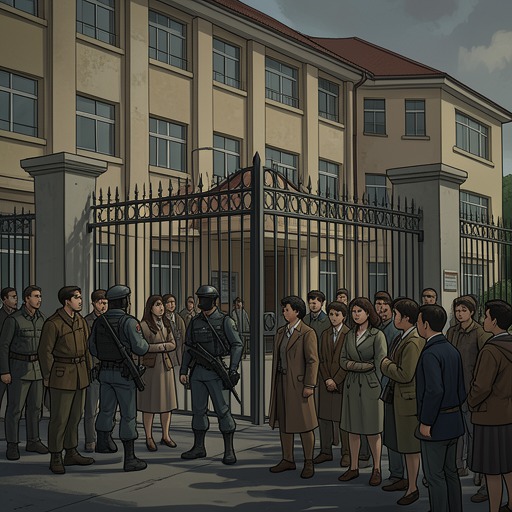
The coalition’s work grows out of an incident in which Brianna passes through a metal detector without setting it off, yet Officer Long blocks her and orders her to go back. When she resists being handled, Long forces her face down on the floor while Officer Tate removes her backpack. The contrast between Brianna’s uneventful passage through the detector and the guards’ subsequent treatment of her makes the security procedure itself part of the dispute.
At the meeting with the principal, Dr. Rhodes asks whether Brianna has been selling candy on campus and warns that she may face discipline. Jayda Jackson challenges the implication that Brianna’s conduct explains the guards’ actions, drawing on her son’s account that guards had singled out certain students in the past. Dr. Rhodes promises an investigation but maintains that the guards treat everyone the same. The exchange exposes the gap between students’ and families’ accounts of unequal treatment and the administration’s calm, institutionally framed assurances.
Security and Escalation
The dispute intensifies when students anticipate a shift from school guards to armed police. Shana notes that the district could follow Garden Heights High’s example, where actual police serve as security. Malik links that possibility to the public narrative portraying Brianna as a drug dealer: if parents accept that characterization, he argues, administrators may regard the students as threats. Brianna’s fear of seeing police is heightened by the recent killing of a boy; the prospect of armed officers at school makes that broader fear a daily concern.
The school’s security measures become a public issue at a district meeting. A parent questions metal detectors, random pat-downs, and armed officers, objecting that the school is not a prison. Superintendent Cook justifies heightened security by citing recent crime spikes in the area, but does not explain the presence of the police. The unanswered question leaves the district’s safety rationale in tension with the students’ experience of surveillance and coercive treatment.
Advocacy and Public Pressure
The coalition invites Brianna to meet Cook after school, explaining that he agreed to meet with its members and that he is meeting with them because of her. Cook has also seen Brianna’s music video, which, Shana says, gave him new insight into the incident with Long and Tate and is helping the coalition’s cause. The video thus becomes more than a personal expression: it helps carry the account of the security incident into the coalition’s negotiations with district leadership.
Shana also presents a petition asking Cook to remove the armed police officers from security. The coalition plans to bring it to the meeting and gather enough signatures to persuade him to listen. Its approach combines direct contact with the superintendent and organized public pressure, making the demand specific: the coalition is not merely objecting to an atmosphere of heightened security but seeking the removal of armed officers.
Institutional Response and Significance
The district’s response continues after the immediate controversy. Jayda Jackson begins working for the school district as Dr. Cook’s secretary. Among Cook’s first instructions to her is to schedule monthly meetings with the Midtown Black and Latinx Coalition so he can check that matters are going smoothly; he also asks her to look into a new security firm for the district. The recurring meetings give the coalition an ongoing channel to raise concerns, while the search for a new firm signals that security arrangements are under review.
The coalition’s significance lies in this movement from a student’s individual encounter with school security to sustained collective engagement with the institution. Its advocacy connects the guards’ actions, the armed police presence, the public story told about Brianna, and administrative decisions about safety. The resulting monthly meetings do not erase the earlier dispute, but they establish a continuing forum in which students’ concerns can be addressed.