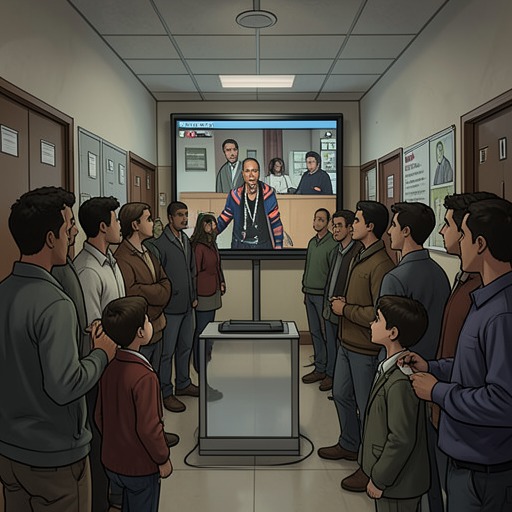
Midtown school district hearing
On the Come UpThe Midtown school district hearing is the public confrontation in which students and parents challenge the administration over racial profiling, armed security, and the assault on Brianna Jackson. What had been treated as a school discipline and security matter becomes a question of whose safety the institution recognizes: Shana Kincaid and Jayda Jackson place the treatment of Black and Latino students, and Brianna’s beating for selling candy, before Superintendent Cook and a packed auditorium. Jay’s testimony links the hearing’s broader claims to the specific harm done to her daughter, while her résumé in hand makes the encounter both an act of accountability and a bid for work.
Setting and immediate context
The hearing takes place in the Midtown auditorium at a parent-teacher association meeting with the superintendent. Brianna arrives with Jay, Sonny, and Aunt ’Chelle; Jay is still wearing the skirt and blouse she wore to a job interview and carries the small briefcase in which she keeps her résumés. Aunt ’Chelle has come straight from the courthouse in her security uniform, and Aunt Gina has left the beauty shop early. Their presence places the school’s controversy inside the ordinary demands on families’ time and livelihood, rather than separating institutional debate from daily life.
The auditorium is packed. Before the meeting begins, Brianna sees Dr. Rhodes speaking with a man in a suit and Mrs. Murray talking with teachers. Students from the coalition stand in the side aisles with posters asking the superintendent to see that Black or brown students should not be treated as suspicious and questioning whether grants matter more than students. The signs set out the tension that the hearing will test: Midtown presents itself as a successful, diverse school, yet many of the students whose presence contributes to that image say they do not feel welcome or safe there.
David Rodriguez, president of the Midtown School of the Arts Parent-Teacher Association, opens the meeting by acknowledging concerns about recent events and inviting Superintendent Cook to explain next steps and answer questions. Cook describes Midtown as a “beacon of light,” emphasizing its high performance, diversity, and graduation rates, then says the district is committed to safety and excellence. He invites comments, and parents and students line up at microphones on both sides of the room. The orderly public format gives those affected a route to speak, but Cook’s opening praise also establishes the distance between the school’s celebratory self-description and the experiences brought to the microphones.
Student testimony and institutional response
An early question asks how the incident happened. Cook says an ongoing investigation prevents him from sharing many details, though he will provide information when it can be shared. Another parent challenges the metal detectors, random pat-downs, and armed police, arguing that the school is not a prison and asking why children must undergo such measures. Cook answers that recent crime spikes in the area led the district to heighten security for students’ safety. He does not explain the presence of the police officers. The exchange exposes a familiar administrative pattern: a general appeal to safety justifies expanded security, while the concrete reasons for the measures—and their unequal effects—remain unanswered.
Shana Kincaid speaks next. After a pause, she identifies herself as a junior and tells Cook that Black and Latino students have been targeted by Officers Long and Tate more than other students. She names the practices involved: pat-downs, random locker checks, and secondary screenings. Several students, she says, have had physical altercations with the officers. Now that armed police have been brought onto campus, many fear for their lives, a fear they should not have to carry into school. Her account turns a broad claim about discrimination into a description of repeated procedures and their bodily consequences.
Shana also challenges the school’s reliance on students like her to qualify for grants while those students feel unwelcome. She asks whether they are treated as dollar signs or as human beings. Her testimony draws applause and cheers, especially from the coalition students; Brianna claps, as do most of the students. Shana then connects the previous week’s uprising to accumulated frustration: students had filed complaints against Long and Tate, and video showed the officers physically assaulting a Black student, yet they were allowed back on the job. When she asks Cook why, he agrees that racism and racial profiling are unacceptable but again declines to discuss the particular incident because the investigation is ongoing. The response recognizes the principle while withholding an answer about the documented case that prompted the question; the students’ boos and shouts register the gap.
Jay’s testimony and the question of safety
Jay reaches the front of the line after Shana. She begins by telling Cook she has left him voicemails for weeks without receiving a call back. Before he can explain that he is behind on his work, she identifies Brianna as the student physically assaulted by Long and Tate the previous month. Her explanation is blunt: Brianna sold candy, not drugs. In a single contrast, Jay counters the suspicion attached to her daughter with the ordinary act that preceded the assault.
Jay turns from Brianna’s case to the larger question of children’s safety. Some parents, she says, fear the effect songs may have on their children, but others are terrified that the people charged with protecting children will harm them. Young people are already afraid to move around the neighborhood because well-meaning people may misread them, and they may be endangered at home by people who do not mean well. Jay asks why they should have to face the same danger at school. Applause repeatedly interrupts her, and Aunt ’Chelle urges her on. Her testimony refuses to treat school safety as a question confined to campus: children move among neighborhood, home, and school, carrying the consequences of suspicion across all three.
Jay names the uprising on Friday as a response to what happened to Brianna. Long and Tate returned to work after assaulting her, she argues, as if their conduct had been acceptable. She asks whether the district intends to teach students that some children’s safety matters more than others’. If so, she concludes, it cannot claim to care about the safety of all students. Half the audience gives her a standing ovation, and Brianna claps harder than anyone. Cook waits for the applause to subside and apologizes that Jay feels the district has not been proactive, while repeating that an investigation is underway. His phrasing makes the disagreement plain: Jay is describing a failure and demanding a response; Cook frames the issue as her perception of the district’s performance and points again to process.
Private exchange and practical outcome
After the meeting, Jay pushes through the crowd and catches Cook as he reaches the hall. An officer beckons him onward, but Cook raises a hand, turns back, and gives the family a few minutes. Jay introduces herself again and presents Brianna as the student who was assaulted, asking for a conversation after his failure to return her calls. The brief exchange outside the public meeting extends the hearing’s demand beyond the microphone: Jay insists that Cook encounter the student behind the case and answer her directly.
In the conversation, Jay challenges the way Brianna has been disciplined at school. She notes that Brianna has been sent to the office for “aggressive behavior” simply for rolling her eyes and invites Cook to review her records, asking him to judge whether the incidents warranted the consequences. Jay describes the choice she faces as a mother: the neighborhood school does not set students up to succeed, while Midtown is beginning to feel as though it is setting Brianna up to fail. She asks both what she should do and what Cook will do as superintendent. The question binds the unequal options available to the family to the administrator’s responsibility for the institution.
Cook is quiet, then says he hopes to do much more than he has done and apologizes to Brianna for the ways the school has failed her. For Brianna, the apology carries weight precisely because of its simplicity: it is the acknowledgment she has been waiting to hear. It does not erase the assault or settle what the investigation will produce, but it marks a change in the conversation from procedural deferral to an explicit admission of failure.
Jay then makes the encounter unexpectedly practical. Knowing that the district has advertised a secretary opening, she takes papers from her briefcase and gives Cook her résumé and references, acknowledging that this is not the usual way to apply. She has several years of secretarial experience. Before Cook can ask about the gap in her employment, Jay explains that it resulted from her past drug addiction and says she has recently celebrated eight years of sobriety. Cook responds by recognizing her determination, shares that he is thirty years sober from alcoholism, and tells her she should be proud. He puts her application papers in his jacket pocket and promises to be in touch. Jay appears dazed as they shake hands.
Consequences and significance
The hearing makes the Midtown security controversy legible as more than a dispute about equipment or isolated misconduct. The detector screenings, searches, armed police, disciplinary records, and return of Long and Tate to work form a sequence in which ostensibly neutral claims about safety coexist with students’ accounts of disproportionate scrutiny and physical harm. Shana speaks for a coalition of students who have complained; Jay gives the issue a family history and a specific consequence in Brianna’s treatment. Their testimony does not simply ask the district to affirm that racism is wrong. It demands an account of how its routines have made some students less safe and what the administration will do in response.
The hearing also brings together two kinds of action without confusing them. In the auditorium, Jay and Shana make a public case, drawing support from students, parents, and relatives; afterward, Jay presses Cook privately and asks him to acknowledge Brianna’s treatment. Her résumé changes the terms once more: she seeks paid work from the same district she has just challenged, disclosing her recovery rather than concealing the employment gap. The superintendent’s apology and promise to follow up on her application are limited outcomes, not proof that the security practices or investigation have been resolved. Yet the scene ends with an administrator holding Jay’s papers, after having heard her name the costs of institutional inaction. The hearing’s force lies in that unresolved contrast between official process and lived harm—and in the insistence that the people most affected be heard as students, parents, and individuals, not as statistics or suspects.