Midtown student uprising and attack on security guards
On the Come UpMidtown student uprising and attack on security guards is the crisis in which an earlier act of school security violence becomes a mass student protest and then a physical assault. After Long and Tate return to work despite having thrown Brianna Jackson to the ground, her classmates take up her lyrics as their own. The chant gives a crowd a shared language of defiance, but the arrival of a bullhorn and a final warning precedes a punch, a group beating, arrests, and the guards’ hospitalization. The episode makes visible a punitive cycle: students are treated as threats, their anger becomes public, and the resulting violence is used to justify still more security.
Background: unequal treatment and no visible accountability
The confrontation has a history. At the metal detectors, Curtis, Shana, Deon, three sophomores, Zane, Sonny, and Malik pass through without trouble; when Brianna follows, the detector does not beep, yet Long blocks her and orders her back. The school’s security procedure thus turns on her without an alarm or an explained cause. When she protests, Long and Tate restrain her, force her face down on the cold floor, and remove her backpack. Malik points his camera at the scene as Sonny and Malik call for the guards to get off her.
At a later meeting, Principal Dr. Rhodes says there will be an investigation and possible disciplinary action, but also raises the possibility of discipline for Brianna, asking whether she has been selling candy on campus. Brianna refuses to answer, and Jay challenges the attempt to shift attention onto her. Jay tells Dr. Rhodes that her son had previously described guards singling out certain students and says she does not believe her children are inventing the pattern. Dr. Rhodes calmly maintains that the guards treat all students the same. The assurance of an investigation therefore sits beside the family’s testimony and the school’s readiness to scrutinize Brianna.
The injustice becomes tangible when Brianna sees Long ushering another student through the detectors as though he had never left, while Tate checks a backpack nearby. She recalls the promise that the incident would be investigated and that discipline might follow, but concludes that throwing her to the floor evidently did not meet the administration’s idea of misconduct. The guards’ return, not a public finding or resolution, is what the students can see. Jay had already warned Brianna that Garden Heights High was treated like a prison, with actual police, and argued that Midtown still offered her a better chance. The episode unfolds in a school environment where the language of safety is inseparable from coercive control.
From Brianna’s lyrics to a student call
The protest starts with a pause rather than an immediate confrontation. Half the school is outside, and many students are watching Brianna. Malik begins to shout, “Hell no, we won’t—” before Curtis cuts across him with Brianna’s words: “Pin me to the ground, boy, you fucked up.” Curtis repeats the line loudly, and another student joins in, then another. The words travel through the crowd until Brianna hears them from classmates, though not from Malik, who had begun a different chant.
That distinction matters to Brianna. The lyrics began as her thoughts and feelings, moved through her pencil onto a notepad, and now emerge from the mouths of her classmates. She recognizes that they are speaking for themselves, but also for her. That recognition brings her into the protest: she joins the crowd in shouting, “You can’t stop me, nope, nope!” Her private writing becomes a public form of solidarity, not because the crowd simply repeats a celebrity’s refrain, but because Brianna hears her own experience being carried by others.
The scene’s energy is not orderly or silent. Students rock to a beat that is not playing, jump and dance, and add calls of agreement. Brianna distinguishes this gathering from the earlier Ring parking-lot confrontation: that had been a mini-concert, while this feels like a call to war. The contrast captures both the protest’s force and its danger. The students have turned a song into a collective refusal, but its charged language is now being spoken in a crowd already facing the guards whose actions helped give it meaning.
The confrontation and the escape
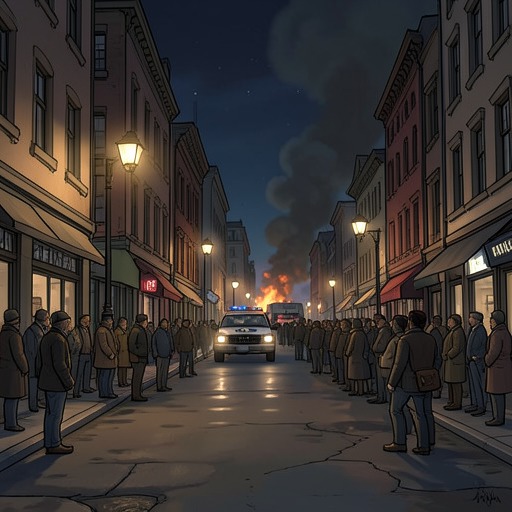
Long and Tate appear in the school doors, and Long uses a bullhorn to order every student to class, warning that they risk suspension if they do not comply. A student answers with another of Brianna’s lyrics, “Run up on me and get done up!” The line becomes a repeated chant as Long issues a final warning. The scene turns abruptly: a fist hits Long’s jaw and sends the bullhorn flying from his hand.
The punch acts as a trigger for a wider attack. A cluster of boys charges Long and Tate, bringing them to the ground; fists and kicks follow, and Curtis is among those attacking them. The crowd’s earlier movement and shared rhythm have become direct violence against the guards. Sonny calls for the group to leave, while Malik also urges them to go. Brianna shouts that the police are coming. Curtis stops kicking, turns toward her, and hurries over; Brianna escapes with Curtis, Sonny, Malik, and Shana as sirens sound nearby. Behind them, chants give way to screams and shouts. They run until they can no longer hear the disturbance, then stop to catch their breath. Sonny’s response is blunt: the situation is bad.
Arrests, public framing, and consequences
Within less than an hour, almost every Black and Latinx student from Midtown has gathered at Malik’s home for an emergency coalition meeting. Malik and Shana have contacted the coalition, and students arriving one after another report what happened after the group fled. At least ten police cars came to the school, a news van appeared, and boys who had attacked Long and Tate were arrested; Zane was among them. Long and Tate were taken away in ambulances. The students do not know how seriously either guard has been injured.
The consequences reach Brianna’s family through television reporting. A news report says several students were arrested, that the guards were hospitalized but expected to make a full recovery, and that students were sent home while school officials considered what to do next. Jay turns off the television and asks Brianna directly whether it was her. The report’s compressed account puts the arrests and the guards’ injuries before the surrounding history of the protest, leaving the song and Brianna’s role as the questions that demand attention at home.
The students also anticipate that the administration may respond by bringing armed police into the school. Shana predicts that Midtown may follow the example of Garden Heights High and use actual cops as security. Malik argues that the guards’ return is connected to parents having accepted the story that Brianna is a drug dealer: in his view, that narrative has made the students appear threatening and gives the school a reason to place armed officers at the doors. The episode does not present this prediction as an accomplished policy at that moment; it presents it as a fear sharpened by what the students have already seen. Brianna’s heart races at the sight of police because of a recent police killing of a boy, and she fears that the same danger could have fallen on her.
Later discussion of school security reinforces the institutional stakes. At a public meeting, a parent questions the metal detectors, random pat-downs, and armed police, insisting that the school is not a prison. Superintendent Cook answers that security was heightened because of recent crime spikes, but does not explain the presence of armed officers. The uprising has thus been absorbed into a public argument over security whose official justification is framed as safety, while the students’ experience includes being singled out, restrained, and treated as potential threats.
A protest caught in a punitive cycle
The episode refuses to make the crowd’s solidarity indistinguishable from the attack. Brianna is moved when classmates give voice to her lyrics, and she joins them; the students’ chant registers a grievance that the earlier administrative response had not resolved. But the punch and the group beating are consequential actions, not simply another form of protest. The boys are arrested, the guards are hospitalized, and police arrive in force. The uprising’s emotional and political meaning does not erase the injury or the risk of further punishment.
Nor does the aftermath settle the underlying dispute. Students have already seen Brianna searched and thrown down, heard an administrator insist that security treats everyone equally, and watched the guards return to work. The public account reports arrests and hospitalization, while the next school response remains undecided. In the later hearing, officials still explain heightened security as protection from crime, and the presence of armed police remains unexplained. The event’s lasting significance lies in this collision: a protest gives students a way to speak together, but the institutions around them answer dissent and violence through surveillance, discipline, arrest, and the prospect of greater force.