Midtown’s racialized security crisis
On the Come UpMidtown’s racialized security crisis turns a school’s promise of safety into a contest over who is treated as a threat and whose testimony counts. What begins with Officers Long and Tate singling out Brianna Jackson after she has passed through the metal detector expands into a dispute over racial profiling, school discipline, armed policing, and the administration’s responsibility for restoring trust. The conflict is not only about the force used against one student: it is also about the school’s response, the return of the officers, and the way a public account of Brianna’s music can make heightened security seem justified.
Unequal Treatment and Brianna’s Restraint
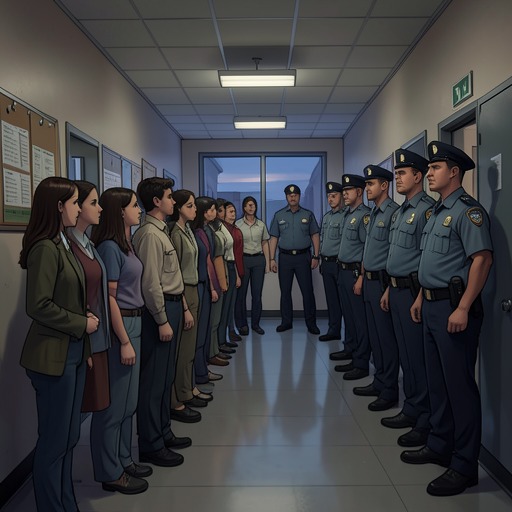
Students are screened as they enter Midtown. Curtis Brinkley, Shana Kincaid, Deon, three sophomores, Zane, Sonny Jackson Emmanuel Taylor, and Malik pass through the metal detector before Brianna. Her detector does not beep, but Long blocks her and orders her to go back. When Brianna asks why, Tate answers that it is because Long said so. The sequence makes the disparity concrete: the intervention is not prompted by an alarm, but by the officers’ decision to stop her.
The encounter escalates after Brianna pulls away and tells the guards to get their hands off her. Long takes her arm again and pulls it behind her; when she struggles to get free, his grip tightens. Long pins her down while Tate removes her backpack. Sonny shouts, and Malik points his camera at the scene and tells the guards to get off her. The recording later matters as evidence, but in the moment the students’ reactions also show that Brianna is not alone in recognizing the restraint as an abuse of authority.
At the subsequent meeting with school officials, the question of responsibility is already unsettled. Dr. Rhodes says Brianna was not cooperative at first, then promises that the incident will not happen again and that an investigation and possible disciplinary action will follow. She also asks Brianna whether she has been selling candy on campus, introducing the possibility of discipline for the student who was restrained. Brianna refuses to answer, unwilling to let the discussion turn the allegation back on her. Jayda Jackson presses the school to explain what happened rather than treating Brianna’s reaction as an adequate account of the event.
Jayda also tells Dr. Rhodes that her son had described the guards picking on certain students when he attended Midtown. She says she does not believe her children are making this up and challenges the implication that the family’s account is false. Dr. Rhodes maintains that the guards treat all students the same, even as Jayda points to the physical restraint as a contradiction of that assurance. The exchange establishes a recurring divide in the crisis: family testimony identifies a pattern, while the administration answers with a claim of equal treatment and an investigation still to come.
From Security Procedures to Armed Policing
The concern that the officers’ conduct reflects a broader pattern resurfaces when students discuss their return to Midtown. Shana predicts that the school may follow the approach at Garden High, where actual police serve as security. Malik argues that parents’ acceptance of the false drug-dealer narrative about Brianna has helped make students seem like threats and predicts armed police at the doors. His forecast is borne out: four armed police officers later serve as security, while students still pass through the usual metal detectors.
For Brianna, the new measures compound an already personal fear of police. Since a boy was killed, seeing an officer makes her heart race; she thinks that chance alone separated the boy from her. The sight of armed officers at school therefore does not register as an abstract policy change. It adds to the accumulation of threats and distress she is already carrying, alongside the gun pointed at her, the article about her, the guards’ restraint, the darkened home, and Aunt Pooh’s situation. The school grounds, where she should be able to attend class, instead feel like a prison.
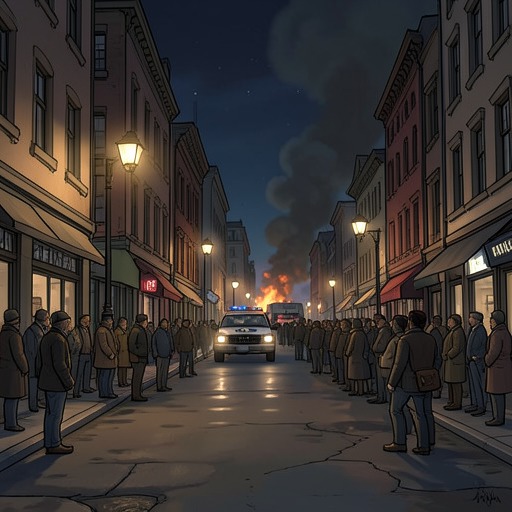
At a public school-district meeting, a parent asks why students must endure metal detectors, random pat-downs, and armed police, insisting that Midtown is not a prison. Superintendent Cook attributes heightened security to recent crime spikes in the area, but does not explain the presence of the armed officers. The official explanation invokes safety in general terms; it does not answer the students’ specific concern that security measures are being imposed unevenly or explain why the guards accused of targeting students have returned to work.
Student Testimony and Institutional Accountability
Shana gives the pattern a public account at the meeting. Introducing herself as a junior at Midtown, she says that she and students who look like her experience the school differently. She identifies Long and Tate as officers known to target Black and Latino students more often, who are more likely to face pat-downs, random locker checks, and secondary screenings. She also says several students have had physical altercations with the guards and that the arrival of armed police makes many fear for their lives. Her claim is not simply that individual students dislike security; it is that routine procedures and physical encounters fall differently on students by race.
Shana links that treatment to the institution’s incentives and obligations. Midtown needs students like her to receive grants, she says, yet students like her do not feel welcome. Her question—whether they are valued as people or only as sources of funding—makes the gap between inclusion on paper and safety in practice explicit. Students, including members of the Black and Latinx Student Coalition, respond with applause and cheers. Shana then connects the previous week’s uprising to frustration, noting that students had filed complaints against Long and Tate and that video showed the officers physically assaulting a Black student. She asks why they were allowed back on the job. Cook agrees that racism and racial profiling are unacceptable but says he cannot discuss the specific incident while the investigation is ongoing. The response recognizes the principle while withholding an answer to the accountability question that prompted the testimony.
Jayda supplies the family’s account of the same incident. She tells Cook that her daughter was physically assaulted by Long and Tate because she sold candy, not drugs. Turning to a parent concerned about the effect of songs on children, Jayda contrasts that worry with parents’ fear for children’s safety at the hands of people meant to protect them. She describes children who may feel unsafe both in the neighborhood and at home, then asks why they should have to face the same danger at school. Her intervention returns the discussion from a generalized debate about youth behavior to the specific circumstances of Brianna’s stop and the district’s choice to return the guards to work.
Jayda explicitly identifies the Friday uprising as a response to what happened to Brianna and to the officers’ return, which, in her view, suggests that their conduct was acceptable. She asks whether the district is telling students that some children’s safety matters more than others’. The room gives her a standing ovation, while Cook answers that he is sorry the district has not been proactive and again cites the ongoing investigation. The contrast is central to the crisis: the audience hears a causal account and a demand for equal protection; the superintendent offers regret without yet providing a substantive resolution.
The Crisis Beyond the School Gates
The security dispute intersects with Brianna’s growing public profile as a rapper. A television report identifies her song “On the Come Up” as a local hit among young listeners and presents selected lyrics as violent, including lines about weapons and law enforcement. The report frames the song as a threat; Brianna’s experience is that her words and identity are being used to construct a public case against her. The false drug-dealer narrative Malik identifies and the media’s account of her lyrics reinforce one another: both turn Brianna into a danger to be managed rather than a student whose treatment needs explanation.
That framing follows her into an interview with Hype. When he says some of her lyrics are too much and points to lines about being armed and killing police, Brianna rejects the claim that she threatened to kill officers. She argues that his alarm is not simply about the words but about a sixteen-year-old girl saying them, and compares his reaction with his lack of surprise when her father rapped about such subjects at sixteen. The exchange reveals how age and gender shape the reception of her music, even as the school’s security crisis is driven by the racialized suspicion attached to her and her peers.
The same gendered expectations surface in the music business. When a man at a studio mocks the idea that Brianna could rap and asks whether she will perform nursery rhymes, she recognizes the dismissal as the kind of response Aunt Pooh warned her to expect. Brianna understands that she will have to work twice as hard for half the respect, remain cutthroat, and avoid showing weakness in order to survive among male rappers. Her answer earns laughter and acceptance from the men present, but the moment also clarifies the pressure surrounding her public identity: she is expected to prove herself while being judged through assumptions about what a young girl can say or do.
At a later studio encounter, James Irving praises what he calls Brianna’s “sassy black-girl shit.” She objects to the description, which makes a stereotype out of the very confidence that has helped her resist dismissal. Though the encounter is not itself a school-security procedure, it echoes the larger crisis’s struggle over who gets to define Brianna. In the school, she is cast as a possible threat; in the media, her lyrics are treated as evidence of danger; in the music business, her assertiveness is reduced to a racialized and gendered label.
Meaning and Continuing Stakes
Midtown’s crisis develops through a chain of distinct but connected decisions: Long stops Brianna without a metal-detector alarm; the guards restrain her; officials raise her possible discipline while promising an investigation; the officers return; and armed police join the school’s security regime. Students and parents then carry their accounts into a public meeting, where they name unequal searches, prior complaints, the video of the assault, and the consequences of policing students as presumed threats. Security is repeatedly defended as protection, but the students’ evidence makes safety itself contested: the measures intended to secure the school deepen the fear of the people most exposed to them.
The conflict also shows how a story about one student can be expanded into a justification for surveillance. A candy-sale allegation becomes entangled with the false claim that Brianna is a drug dealer; selected lyrics become a news narrative about violence; and that public image helps turn all the Black and Latino students at Midtown into suspected threats. Against that compression, Shana and Jayda restore detail: who is searched, who is restrained, what students reported, why they protested, and what the district has not yet answered. Their testimony does not itself resolve the investigation, but it shifts the crisis from a question of Brianna’s supposed misconduct to a question of institutional accountability and whose safety Midtown is prepared to protect.