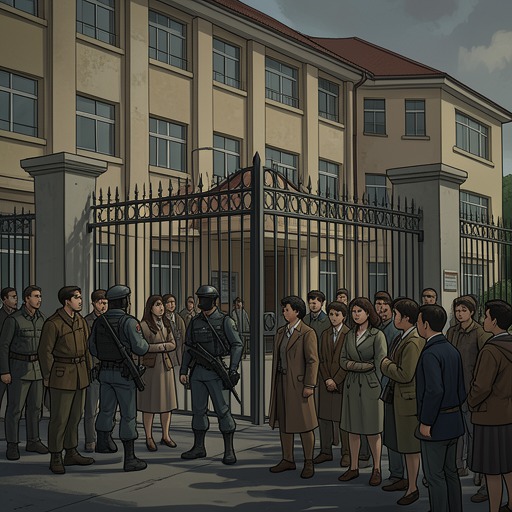
School protests and riots
On the Come UpSchool protests and riots become the contested backdrop to the public framing of Brianna Jackson’s song, “On the Come Up.” News coverage and a petition associate the track with violence at a local school, while Brianna insists that the song did not cause the protest and that blaming it lets observers evade the underlying problems. The dispute turns a school crisis into a fight over whose account is heard—and whether Brianna’s performance will be treated as art, evidence, or a stereotype.
Background and Public Framing
The controversy reaches a radio audience through a report by Megan Sullivan. She identifies “On the Come Up” as Bri’s song, describes it as violent and popular with young listeners, and plays selected, censored fragments rather than the complete track. The broadcast thus presents the song through curated excerpts and a news frame that connects it to a local school riot, inviting listeners to see its lyrics as a possible cause.
The framing is already consequential before Brianna is asked to respond: a petition seeks to have the song removed from Dat Cloud, and the report labels it an attack on law enforcement. Later, Hype tells her that people claim the song led to a riot at a local school. The available account establishes the public allegation and its reach, not that the song caused the students’ actions.
Brianna’s Rebuttal
In the interview, Brianna answers the demand for a defense with anger rather than a prepared explanation. She says the people criticizing her did not hesitate to come at her, then rejects the premise that lyrics made students act. In her view, the protesters were already responding to other problems, and the song offers a convenient target for people unwilling to ask what those problems were.
When Hype presses her about lyrics concerning being armed and seeming to threaten police, Brianna disputes his interpretation. She points out the gendered contrast in his concern: he admits that a sixteen-year-old girl rapping about weapons caught him off guard, but says the same material from Brianna’s father at sixteen did not. The interview therefore exposes more than disagreement about a lyric; it reveals how the speaker’s age, gender, and identity affect whether the same kind of performance is treated as alarming.
Security, Solidarity, and Aftermath
The school conflict also has consequences beyond the broadcast. Brianna’s music video gives Shana a new way to understand the situation involving Long and Tate, and Shana tells Brianna that it has helped their cause. She is collecting signatures for a petition asking the school district to remove armed police officers as security, with the hope that the district will listen if enough people sign.
The controversy does not end with a settled public account of the protests. Instead, Brianna’s song remains caught between competing uses: its lyrics are presented as evidence against her, while her own account and the petition direct attention toward student grievances and school security. In a later performance, she refuses to be a puppet or repeat words that are not her own, and rejects the idea that she should be made responsible for turning a child toward a gang. The cheers that follow mark a moment of public support for her insistence that speaking about what she sees is not the same as claiming that violence as her identity.