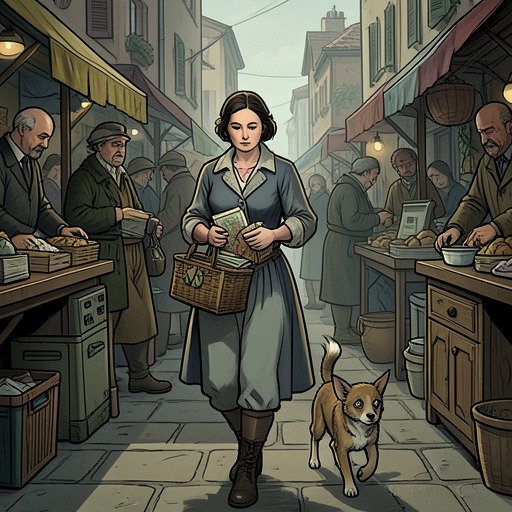
Imogene
One Thousand and One NightsImogene, usually called Tante Iezavel, is a witch who dispenses advice, reads minds, and turns the fearful reputation surrounding her into a practical advantage. She is at once an unnerving fixture of Claire’s household, a shrewd operator who understands how appearances attract customers, and a sister who can help bring Rumpelstiltskin’s disguise to an end.
Identity and Introduction
Imogene first emerges through the unease she leaves in her wake. After Tante Iezavel ejects a client from her house, she warns him about cracks and black cats before slamming the door; the man remains motionless, blinks at the orange wood, and departs without a word. Tad, who is present, is struck by the implication that the encounter has left the client altered. The episode establishes the witch’s theatrical, unsettling manner before Tad meets her properly.
When Imogene opens the door to Tad, she greets him as a “drabling,” welcomes him as if she had been expecting him, and then makes him wait because she has a customer. Her speech and behavior combine familiarity with command: she seems to know who has arrived, but does not rearrange her business around him. The household is not merely strange from Tad’s perspective; Imogene controls its rhythms and decides who receives her attention.
Her powers are not limited to a witch’s ominous reputation. When Tad questions what she does, Imogene says she gives counsel to those in need, then reveals that she also reads minds. She identifies Tad’s unspoken judgment that she is a charlatan, making his skepticism itself evidence of her ability. Claire calls her Imogene and objects to her behavior, while Imogene answers by calling Claire a nonbeliever and dismissing her faith in science. Their exchange sets up a recurring contrast between Claire’s rational outlook and Imogene’s supernatural authority, without making the witch’s own methods wholly solemn.
Counsel, Reputation, and Business
Imogene’s advice is presented as a service she offers to people in trouble, but the book also shows that her consultations can be abrupt and theatrical. She sends a woman away after declaring that the woman’s problem of choosing between two suitors has been solved, then turns to Tad and says she knows about his troubles too. Her confidence unsettles him: he wonders whether the town witch is simply selling old wives’ tales, while she insists that she can read his mind. The tension between apparent performance and demonstrable supernatural knowledge remains part of her character.
Her business depends partly on the image other people have of her. Imogene says she never cooks, explaining that Claire tells people Imogene made the food Claire gives away so that the townspeople might believe she can prepare a pork roast or stew and might regard her as normal. In practice, people refuse the food because they imagine it came from a cauldron. Imogene is not offended by the rumor; she says the rumors are good for business. The witch’s fearsome public image is therefore not only something imposed on her: she knows how it works and accepts its commercial value.
The arrangement with Claire is mutually useful. When Tad asks why Imogene keeps Claire around, the witch laughs and says Claire is good for business too. This answer recasts their household as a partnership rather than a simple landlord-and-tenant arrangement. Claire manages the charitable food-giving and the story attached to it; Imogene benefits from the resulting traffic and reputation. Their methods differ, but each contributes to the other’s practical position.
Family and the Rumpelstiltskin Case
Imogene’s wider family comes into view when Tad and Claire encounter a merchant challenging a crowd to guess his name in exchange for gold jewelry. Imogene appears with her sister Paribanou, who recognizes the disguised merchant as her brother and rebukes him for playing games with humans. She says he is offering what he spun on the wheel their father gave him while claiming it is gold, although humans cannot tell the difference. The scene connects Imogene’s family to the investigation into the creature who spun straw into gold for Della’s father.
Imogene identifies Paribanou to Claire and Tad, calling the latter a cursed drabling, and then identifies the merchant as their brother. She orders him to abandon his disguise. He covers his ears, protesting that he does not want to hear his name; Paribanou snaps her fingers, and the merchant’s appearance changes into that of a small, wrinkled being with golden eyes. She names him Rumpelstiltskin and threatens to ask their father to take away his wheel. Imogene’s presence places her within a family capable of exposing and disciplining the disguised trickster, even though Paribanou—not Imogene—performs the transformation and issues the direct threat.
The family confrontation clarifies the connection between the case’s scattered clues. Earlier, Tad had witnessed a small hooded figure celebrating that Della’s father could not calculate, and later the Magic globe showed Zaen and Della’s father opening a concealed treasure chamber with the words “Open sesame.” Tad’s library research had linked the case to a story about a creature who spins straw into gold, while the merchant’s challenge to guess his name echoed the name-guessing demand in that tale. Imogene’s appearance with Paribanou and Rumpelstiltskin turns those suggestive parallels into a family revelation: the apparent merchant is the same kind of creature implicated in the case, and the spinning wheel is not ordinary merchandise but a family object with a history.
Relationships and Narrative Role
Imogene’s relationship with Claire is marked by affectionate familiarity as well as conflict. Claire knows her well enough to interrupt her and call her by name, and Imogene calls Claire a nonbeliever when she rejects witchcraft. Yet Claire also helps maintain the public story around Imogene’s cooking, and Imogene openly recognizes Claire’s value to her business. Their friction does not cancel their practical interdependence.
Imogene’s connection to Paribanou and Rumpelstiltskin broadens her significance beyond the local role of witch and adviser. She belongs to the same family as the creature at the center of the investigation, and she stands beside Paribanou when the disguised brother is confronted. The evidence does not show Imogene herself revealing the name or changing Rumpelstiltskin’s form, so her role is distinct from her sister’s decisive intervention: she is present as a member of the family whose history and authority make the exposure possible.
Across these scenes, Imogene’s character is organized around the management of belief. The townspeople’s fear of cauldron cooking becomes useful publicity; Tad’s skepticism becomes something her mind-reading can expose; Claire’s rational resistance becomes a recurring joke between them; and the disguised merchant’s insistence that he is not Rumpelstiltskin collapses when Paribanou names him. Imogene operates in that same space between what people see and what is true—not by pretending to be ordinary, but by understanding how the extraordinary can be turned into counsel, reputation, and leverage.