Library of Love
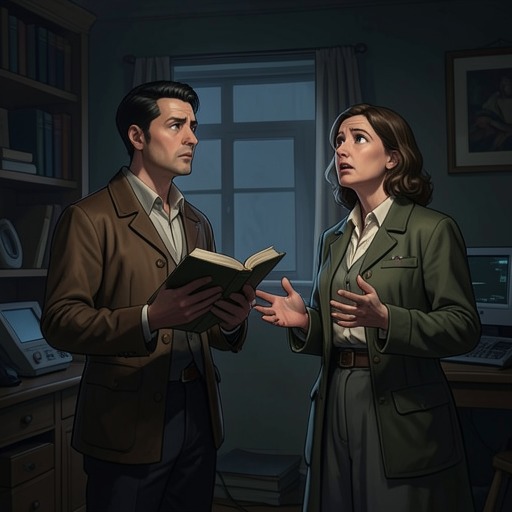
One Thousand and One NightsThe Library of Love is the shared investigative base from which Tad and Claire pursue the mystery of Della de Courville’s curse and Rumpelstiltskin’s claim. More than a backdrop, it is where remote observation, book learning, physical experiments, and argument meet: clues arrive through the Magic globe, are tested against objects and records, and eventually direct the agents back into the world where the danger is unfolding.
Investigative Headquarters
Tad’s work brings him to the Library of Love after he magics himself there to begin the case. The room gives him access to the Magic globe, through which he and Claire watch their client’s past and present. In one prolonged viewing, Tad spends three hours with Claire and the birds observing Della, including events from the preceding week and what seems to him nearly her entire life. The globe makes a distant subject available for scrutiny, but its abundance of recorded detail does not immediately produce useful evidence: Tad is left with impressions of Della’s routine, her friends, and her preference for gold jewelry, while the reason for her repeated refusals of Zaen remains hidden.
The library’s function depends on people as well as instruments. The birds are present during the surveillance, and their participation in the investigation appears uneven: Tad suspects that they take turns being helpful, with Sev serious about the agents’ duty to Lady Love and Nan having helped on an earlier case. Pip also belongs to the working company, though Tad imagines with apprehension what might happen if it were Pip’s turn to contribute. The room is thus both a workplace and a gathering point for a small, informal investigative team.
A Room for Competing Methods
The Library of Love becomes the setting for Tad and Claire’s wager over whether scientific method or romantic intuition will solve the case. Claire challenges Tad’s confidence in his own approach, calling his reliance on poetry scientifically unsound, and proposes that they test their competing methods on the same investigation. The disagreement gives the library’s work a second purpose: it is not only where clues are gathered but where the agents’ different habits of interpreting them are exposed to comparison.
That contrast is visible in the handling of Della’s gold necklace. Claire brings a wrapped necklace to a long table and tests its pendant with a liquid from a carefully unwrapped vial, applying a single drop and replacing the stopper with care. When Tad sees only a slight fizz, Claire treats the reaction as confirmation rather than failure. The experiment supplies a concrete basis for suspicion about the gold, turning an object associated with Della’s tastes into evidence that can be assessed rather than merely admired.
The investigation also shows why observation must be followed by inference. Claire reasons that a merchant would have little reason to exchange genuine gold jewelry for roughly equivalent gold coin unless the necklace were fake or had been acquired dishonestly. If it were stolen, she argues, the seller could not safely display it alongside legitimate goods and would need to sell it to foreigners. When Tad admits that the merchant produced the necklace only after looking him over, Claire concludes that the seller knowingly dealt in dishonestly obtained goods. Her explanation does not settle every detail of the theft, but it narrows the case and makes Tad’s own encounter with the merchant newly significant.
Books, Records, and the Hidden Chamber
When one clue slips from Tad’s attention, the library gives him a place to return to the investigation’s record and redirect the Magic globe. After realizing that he had forgotten to find where Zaen and Della’s father went after entering a storage room, he sits at Claire’s stool and commands the globe to show them. The resulting image reveals the men lighting candles, approaching a pile of straw, and opening a concealed staircase with the password “Open sesame.” Beneath the rug is a chamber crowded with treasure. The discovery links the library’s remote viewing to a physical hiding place and makes a spoken phrase, previously only a familiar expression, the key to a secret location.
Books offer another kind of access, though not an instant solution. After searching the library for more than an hour, Tad finds that jinns or genies are described as partly fairy and partly something else, mischievous and unpredictable, and capable of helping or harming according to their nature. He also finds a story about a miller’s daughter tricked by a creature that spins straw into gold, a possible parallel to the being who deceived Della’s father. Yet that tale contains no reference to a lamp. The library’s learning therefore supplies comparison and context without erasing the gaps between familiar folklore and the particular facts of the case.
Urgency and the Case’s Resolution
The knowledge assembled at the Library of Love clarifies the deadline. Della’s father explains that Rumpelstiltskin’s hold is already affecting her and that, when she turns twenty-one, she will become his unless the curse is broken; the claim is supported by his possession of her mother’s necklace and her father’s ring. He also recounts how his third wish sent the imp back into the lamp, after he had used his first wish to obtain knowledge of how to acquire wealth rather than wealth itself. These revelations make the library’s research more than an abstract contest between methods: the investigators are working against an approaching transfer of Della and her inheritance.
Once Rumpelstiltskin has been captured and the curse removed, the library remains the point from which Tad and Claire go to close the case. Claire insists on accompanying Tad to see the matter finished. They use the library to locate Zaen and then travel to the street where he is questioning locals. Claire tells him that the jinn has been captured and asks for the lamp; Zaen clutches the lump concealed in his shirt, and the exchange leaves Tad and Claire soberly aware that collecting the object is not a casual formality. The sequence shows the library’s reach and its limit: it can locate people and organize the inquiry, but its agents must still leave the room to confront the case’s consequences.
After the case, the Library of Love also becomes a place of shared relief. When Tad returns, the birds and Wigamus are gathered around Claire, picnicking at the table beside the ledger. Claire is thanking them for their help, and Nan answers in kind. The scene contrasts with the long stretches of fatigue, surveillance, and argument that preceded the resolution. The same room that held the agents’ competing theories and demanding research can hold their company once the urgent work is over, making the library both an instrument of investigation and the social center of their collaboration.