Magic globe
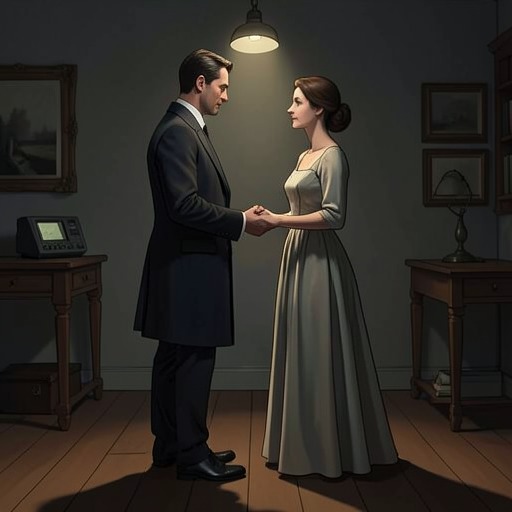
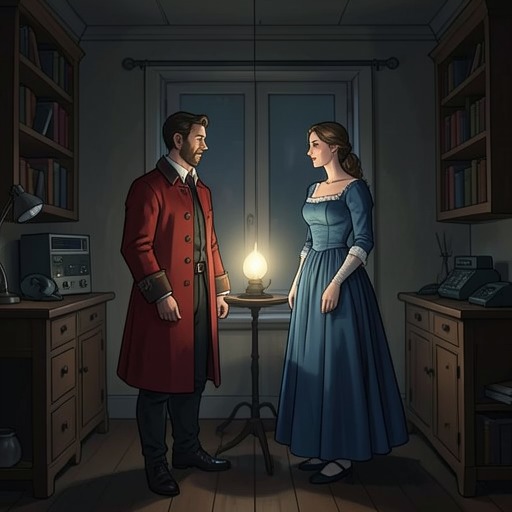
One Thousand and One NightsThe Magic globe is the central viewing instrument in Tad and Claire’s investigation: it lets them observe clients and past events from the Library of Love, then redirect their attention as new questions emerge. Its reach is extensive, but its images do not arrive with their meaning already settled. Tad can grow impatient with what it shows, Claire can notice evidence he overlooks, and even a decisive discovery requires the investigators to connect observation with reasoning. The globe therefore makes the case visible without making it self-explanatory.
Form and Investigative Use
In the Library of Love, Tad and Claire watch the globe together, using it to inspect the people whose case they are handling. When the globe shows Della de Courville’s life, the view extends beyond the events of the preceding week: Tad is made to watch what she had said and done throughout her life, a breadth of material that leaves him struggling to stay awake. Rather than a selective dossier, the globe offers a potentially overwhelming stream of observation; the investigators must find the useful details within it.
The globe also permits targeted inquiry. After realizing that an earlier lead distracted him from finding out where Zaen and Della’s father had gone, Tad sits down at Claire’s stool and commands it to show him their destination after he entered the storage room. The image reveals the men returning to the hidden chamber beneath the straw. By choosing a specific question, Tad turns the instrument from a general window onto Della’s life into a means of recovering a missed sequence of events.
Later, as the investigation grows urgent, Claire lets Tad make the next request because he had arrived first. Exhausted, he asks the globe to show where to find the jinn Zaen is trying to capture. It presents a merchant gesturing to a crowd gathered around his cart, but Tad cannot see the creature he had encountered in the woods among the figures. The result advances the search without instantly resolving it: the image supplies a scene, while the investigator still has to recognize what is relevant and decide what to do next.
Watching and Interpreting
The first extended viewing tests the difference between access to information and the ability to interpret it. Tad spends hours watching Della and her three friends. Their conversation seems uninformative to him, and he is particularly impatient with Claire’s close attention to their remarks. He concludes that he has gathered little beyond Della’s affection for gold jewelry, her friends’ names, and her attachment to Zaen. The globe has shown him abundant material; his frustration comes from not yet knowing which details matter.
Della’s account of Zaen’s weekly proposals complicates Tad’s dismissal of the conversation. She explains that the letters began when she was six and Zaen was seven, and that he has sent a love letter and marriage proposal on the first day of every week since. She also says that they are friendly acquaintances, while one of her companions sees their familiarity as evidence that he is her best friend. These details give the apparently routine viewing a bearing on the case: the relationship is shaped by a recurring pursuit and by Della’s repeated refusals, not simply by a single recent proposal.
The viewing also places Tad’s assumptions beside the limits of what can be inferred from appearance. Della seems healthy and ordinary to him, and her conspicuous jewelry supplies no visible explanation for the curse he suspects. Her own account of her bond with Zaen is similarly incomplete as an answer: she calls him friendly but rejects the idea that she should marry him. The globe records what people say and do, but the investigators must distinguish surface impressions from the hidden cause they are seeking.
Evidence, Method, and Revision
The instrument’s images become most useful when observation is paired with a test. Claire’s investigation of the gold necklace illustrates the difference between simply looking at an object and examining it as evidence. She takes a square metal-like object and moves it over the necklace, then applies a drop of liquid from a vial to its gold pendant. When Tad says that it has only fizzled, Claire replies that this is exactly what confirms her suspicion. The globe supplies the broader investigative setting, but the deduction depends on Claire’s deliberate examination and her interpretation of the result.
A separate chain of reasoning connects the necklace to a merchant who deals in stolen goods. Claire considers why someone would exchange a finely made item of genuine gold for roughly the same amount in gold coin. She reasons that the necklace must be fake unless the merchant had stolen it or acquired it cheaply while knowing it was stolen; if the merchant knowingly dealt in stolen property, he could not display it openly alongside legitimate goods and would have to sell to foreigners. She asks whether the necklace was hidden until the merchant had looked Tad over. Tad confirms that it was. The case thus advances through a question about the circumstances of an observed transaction, not through the globe’s images alone.
The globe also allows Tad to return to a scene when he recognizes that his earlier attention was misplaced. His renewed viewing of Zaen and Della’s father reveals a detail missed while Tad was occupied elsewhere: the father carries a strange contraption, lights the two small candles on the wall, and uses the words Open sesame. A rug lifts to disclose the stairway; after the men descend, it settles over the entrance again. What had seemed to be a storage room is connected to a concealed chamber full of treasure. This recovered sequence gives Tad new evidence, while also showing that access to a past scene is not the same as having understood it the first time.
Limits, Recurrence, and Narrative Role
When Tad searches the Library of Love for information about jinns, he finds that they may be helpful or harmful and that a story about a miller’s daughter and a creature that spun straw into gold may concern the same being that deceived Della’s father. The story, however, makes no reference to a lamp. This gap matters to the investigation: even a magical instrument that can show past events does not replace the work of comparing a case with incomplete knowledge. The globe can help locate scenes and people, but the available information may still leave a crucial connection unproved.
After Tad tells Zaen that Della’s curse has been lifted, he returns to the Library of Love and finds Claire watching Zaen in the globe. He waits for Della to appear, then watches the pair sit together beside a stone fountain. Zaen gives her a friendship bracelet and explains the meanings of its colored horsehair and beads; Della tells him that she had needed evidence that he understood who she was, rather than more poetry or a grand display of wealth. In this final use, the globe witnesses a change in the relationship as well as serving the investigation. It lets Tad and Claire observe the outcome, but the exchange’s meaning comes from what Zaen and Della say and do.
The globe recurs as the case’s viewing surface, a prompt for questions, and a record that can be revisited when a clue has been missed. Its scenes contribute to the contrast between Tad’s impatience and Claire’s attention, but do not simply declare one method sufficient: the necklace requires testing, the merchant’s conduct requires inference, and the hidden chamber comes into focus only when Tad asks to recover a neglected event. The final view of Zaen and Della completes that pattern in a different register. The instrument can show the moment; understanding what it means remains the work of the people watching.