Romance versus scientific method
One Thousand and One NightsRomance versus scientific method is the contest Tad and Claire use to frame their rival approaches to magical cases—and a conflict the story repeatedly complicates. Tad argues that love can explain what measurement misses; Claire demands observable evidence and testable explanations. Their wager over a case involving Della and Zaen turns that disagreement into a working partnership, while the investigation and its aftermath expose the limits of treating either method as sufficient by itself.
The dispute and the wager
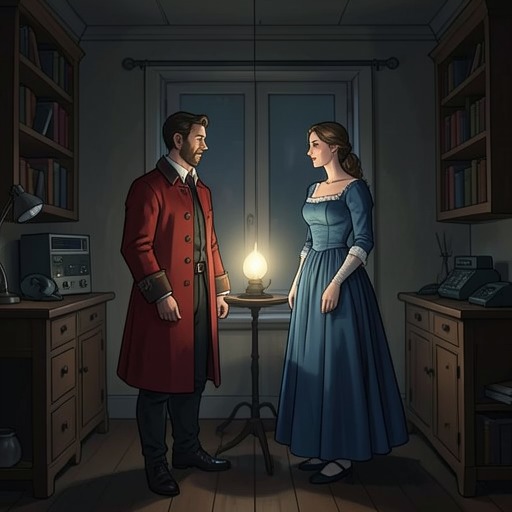
The rivalry begins in their assessment of one another’s competence. Claire mocks Tad’s reliance on a true-love kiss, impersonating his brooding manner and asking how often the tactic has worked for him; she counters with the case ledger, whose record, she says, shows that such kisses have received more credit than their actual statistical relevance warrants. She also points out that Tad is zero for three when using the tactic himself. Tad bristles at the criticism and insists that her scientific approach is no more qualified to settle the matter.
Their argument sharpens into a formal challenge when a new case seems to leave two people who should love one another inexplicably apart. Tad suggests magical mischief may be interfering, while Claire contends that his assumptions about obvious love are implausible. She accepts the challenge: on this case, they will determine whether science or romance is the better method. The wager gives their banter a practical test, but also reveals that both understand the investigation as a chance to prove the other wrong.
Neither uses the terms in a wholly neutral way. Claire associates scientific method with evidence, method, and disciplined inference, and treats Tad’s romantic reasoning as unsound. Tad, by contrast, claims that matters of the heart reach beyond physics. Their exchange is comic and combative, but its stakes are methodological: what counts as an explanation when the case involves enchantment, love, and clues that may support more than one account?
Testing, interpreting, and revising
The investigation gives Claire’s approach a concrete form. At the Library of Love, she unwraps a gold necklace with a rectangular pendant, moves a square metal-like object over the gold, and then applies a drop from a vial. The liquid fizzes slightly, which Tad initially dismisses as nothing happening. Claire treats the reaction as confirmation of her suspicion. Her procedure separates the physical observation from the conclusion drawn from it: the faint fizz is not, to her, a failed test but evidence that must be interpreted.
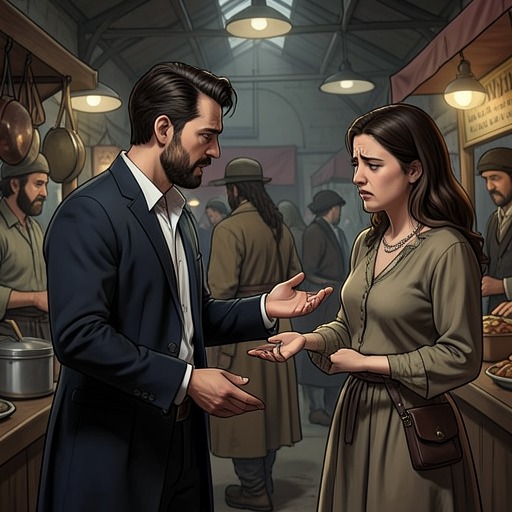
She later builds a larger inference from the necklace’s circumstances. A merchant would have little reason to sell genuine gold for roughly the same amount in gold coin, she argues, unless the item were fake or had been acquired under suspicious conditions. If it were stolen, the merchant could not openly display it beside legitimate goods and might offer it only to foreigners. Claire asks whether the necklace was concealed until the merchant had looked Tad over; Tad confirms that it was. She concludes that the merchant knowingly deals in dishonestly obtained goods, while distinguishing that finding from Tad’s further theory that a thief watched him buy the necklace and then picked his pocket. Her reasoning thus shows both the strength of a chain of clues and the difference between an inference supported by circumstances and an additional hypothesis not yet established.
Tad’s own contribution also depends on close observation. Using the Magic globe to revisit what happened after he entered a storage room, he sees Zaen shut the door while Della’s father lights candles, takes one, and says the password “Open sesame.” A rug lifts to reveal a staircase, and the men descend into a chamber filled with treasure. Zaen remarks that the thief did not take much. The vision provides specific evidence about the hidden room and the men’s access to it, rather than an answer supplied by romantic intuition alone.
Tad also researches the kind of creature involved. After more than an hour in the library, he learns that jinns or genies are half fairy and half something else, unpredictable and potentially helpful or harmful. A story about a miller’s daughter tricked by a creature that spins straw into gold may concern the same jinn who deceived Della’s father, although it contains no reference to a lamp. The discovery gives the investigation a possible folkloric parallel, not a complete identification; the absence of the lamp from that account remains a meaningful gap.
Romance as an interpretive method
Tad’s case for romance rests on the claim that magical problems can turn on what people feel and perceive, not just on their outward condition. Recalling Princess Arabella’s curse, he points to the Love goggles and Captain Avery’s kiss as part of its resolution. He argues that the curse was not simply a problem of Arabella’s siren form: what mattered was what she saw when she looked in the mirror. Claire admits that she does not understand why applying the goggles broke the curse, but rejects Tad’s claim to special knowledge, proposing instead that a chemical reaction with the magic may have been involved.
Tad concedes that Claire may be right, then insists that his explanation is more right because matters of the heart will always beat mere physics. Claire corrects him—biology, rather than physics—and he waves away the distinction. The exchange makes their difference vivid: she seeks a mechanism that can be described and tested, while he treats emotional meaning as an explanation in its own right. Yet the scene does not settle the question in Tad’s favor. His interpretation is suggestive, but his confidence exceeds what he can demonstrate, just as Claire’s proposed chemical explanation is tentative rather than proven.
The romance under examination also resists a simple formula. Della explains that Zaen’s repeated proposals do not, by themselves, persuade her that he understands her. She has regarded them as empty poetry and has hardened her heart because she does not expect him to love the real person beneath other people’s assumptions about her. The distinction between romantic language and enduring affection therefore becomes another test of interpretation: declarations may sound convincing yet fail to establish that the speaker truly sees the person addressed.
Della and Zaen as a test case
The history behind the case gives both methods something to examine. Della says that Zaen began courting her when she was six and he was seven, and that he has sent a love letter and marriage proposal every week since then. She answers because she believes a lady of rank must respond to her suitors, even though the unrelenting routine has tried her patience. Her friends see the constancy as romantic; Della calls them friendly acquaintances and insists she has never given him reason to think she loved him. The contrast between outward evidence and private interpretation makes the case harder than a simple tally of proposals.
The decisive change comes when Zaen gives Della a friendship bracelet rather than gold or jewels. He explains its components through particular memories: white horsehair recalls her first pony; red recalls the stallion that threw her and the moment he caught her, when she first smiled at him; black comes from the mare he chose for her. The beads represent the two of them, and he carved their initials himself. The gift draws its force from a record of shared experience, not from its monetary value or from the sheer number of proposals.
Della cries and admits that she did not believe Zaen really loved her. His poetry had not shown her an enduring love she could trust. What she wanted was someone willing to trust her with what he did not possess and to believe she could love him back; she resented being treated as a spoiled person interested only in gold and jewelry. She tells Zaen that his thousand proposals described how he saw her but did not show that he understood how she saw herself. The bracelet matters because it represents the person she wants to be to the man she marries: a friend to be treasured, not a prize won through valiant effort.
Zaen understands the distinction and asks whether she had taken his poetry for insincerity. Della confirms that she had; she had hardened her heart rather than risk turning the pleasure of their daily encounters into a romance built on a misunderstanding. When he says he has loved the real Della more with each passing day, he calls the thousand and first attempt the bargain that finally found her heart, then kneels and asks her to be his friend for life and marry him. Della accepts without gold or jewels, on the condition that he first and forever be her dearest friend. Their reconciliation makes the case’s emotional evidence visible: affection becomes credible not through repetition alone, but through an act that recognizes Della’s own account of what she values.
Partnership and significance
The wager does not end with either method declared the universal winner. Near the close of the case, Lady Love tells Tad and Claire that she ordered Pip, Sev, Nan, and Wigamus to leave them to their own devices, rather than taking sides or deciding which servant was more valuable. She says their ordeal has brought them back to the point where neither has been recognized as more important than the other: Claire cannot solve a case without Tad, and Tad cannot solve one without Claire. She then reveals that she has entwined their magic so they cannot work separately. Their independence was never the condition of the contest; their interdependence was built into it.
That revelation reframes the rivalry. Claire’s insistence on testing clues and Tad’s attention to love and perception are not interchangeable, but neither can claim to be sufficient in every case. The necklace investigation depends on physical testing and contextual inference; the hidden chamber emerges through a magical vision and attention to a spoken password; Della and Zaen’s reconciliation depends on understanding the meaning of a gift and the history it carries. The story’s resolution does not reduce romance to a scientific variable or science to a failure of feeling. Instead, it makes their methods answerable to one another: evidence can challenge romantic certainty, while emotional context can disclose what a purely physical account leaves unexplained.
The final balance is personal as well as intellectual. Lady Love’s binding makes collaboration unavoidable, and the two investigators respond with reluctant acceptance after their competition has failed to establish one as the more important partner. Their dispute remains part of their working relationship, but the case has made its limits plain. Romance and scientific method are most useful here not as rival creeds demanding a single victor, but as contrasting ways of noticing and interpreting a world where magic, evidence, and human attachment continually overlap.