Rumpelstiltskin’s capture in Shub-Haramb
One Thousand and One NightsRumpelstiltskin’s capture in Shub-Haramb turns a name-guessing spectacle into the decisive exposure of the jinn behind Tad and Claire’s investigation. In a crowded marketplace, the disguised creature offers jewelry to anyone who can guess his name; Tante Iezavel and her sister Paribanou interrupt the game, and Paribanou uses her authority to strip away his human appearance. The discovery connects the merchant to the spinning wheel, the fairy gold, and the threat against Della, while the family’s response makes clear that catching him is also a reckoning with his repeated misconduct.
The case behind the marketplace game
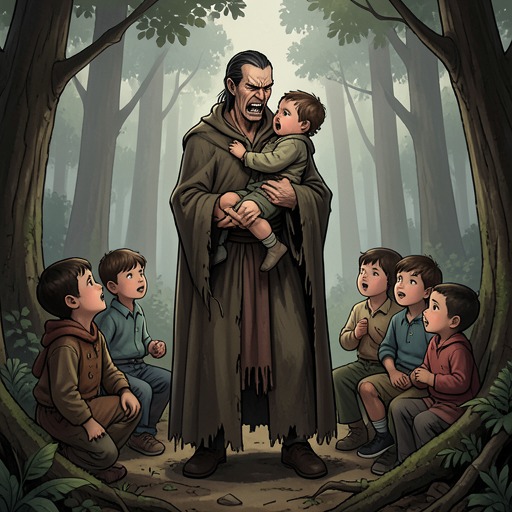
Tad’s discovery of the capture’s setting follows a trail of clues that has made the name-game more than a chance encounter. Earlier, he magicked himself toward the place where the Magic globe had shown Zaen, hoping to find evidence before the day ended. At night, hungry and peering from the trees, he heard a small voice celebrate that Della’s father could not calculate. The speaker’s boast connected the unseen figure to the father’s financial problem, but at that point Tad could only glimpse a hooded figure dancing on a log.
The financial mystery carried much higher stakes than a simple theft. Della’s father had explained that his third wish put the jinn back in the lamp, but that the creature’s claim on Della remained. The jinn possessed her mother’s necklace and her father’s ring as proof; when Della turned twenty-one, he would claim her, and her inheritance would pass to him. Her father had also tried to negotiate over the demanded firstborn child, only to find the jinn unwilling to accept another bargain. These details established why identifying and recapturing the creature mattered: Della’s approaching birthday threatened both her freedom and her inheritance.
The Magic globe later showed Tad how Zaen and Della’s father entered a hidden treasure chamber. Zaen shut the storage-room door, Della’s father lit two candles with a small device, and then took one candle to a pile of straw. His words, “Open sesame,” caused a rug to lift and uncover a staircase; after the men descended, it settled back into place. In the chamber, candlelight played across heaps of treasure. This secret passage made the hidden fortune tangible, while Zaen’s observation that the thief had not taken very much kept the precise connection between the treasure and the jinn in question.
Tad’s library research supplied a second route to the culprit. He learned that jinns, or genies, were half fairy and half something else, mischievous and unpredictable, and capable of being helpful or harmful according to their nature. One story about a miller’s daughter and a creature who spun straw into gold seemed to describe the same jinn who had tricked Della’s father, though the version Tad found did not mention a lamp. The clue supplied a familiar story pattern, but not yet the name or the identity needed to solve the case.
The name and the disguise
Tad and Claire reached the marketplace after exhaustion had left them magicking themselves away together. They landed at the edge of a crowd around a merchant addressing a young man. The merchant offered necklaces and bracelets from his cart, not for sale in the ordinary way, but as prizes: anyone who guessed his name could choose an item, and wrong guesses cost nothing. He laughed at the crowd’s increasingly fanciful attempts, rejected each one, and broke into songs and dancing. The performance made the challenge look like a game, even as it recalled the name-based contest in the miller’s-daughter story.
Tad recognized the connection but could not retrieve the name. He remembered only that it was unusual, silly, and began with R. Then a voice called out, “How about…Rumpelstiltskin?” Tad recognized the speaker as Tante Iezavel. The merchant paled and turned toward her. His sudden reaction answered the riddle more forcefully than another failed guess could have: the name was not merely an allusion to a library story, but the key to the disguised figure before them.
Tante Iezavel’s intervention also brought the spinning wheel into the open. She held the wheel Tad had bought among Claire’s science projects, explaining that she had recognized at once who it belonged to because there was only one like it. The merchant, now identified as Rumpelstiltskin, demanded it back and stamped his foot three times. The wheel thus connected the marketplace impostor to the object associated with his power to spin straw into supposed gold—and to the investigation’s earlier evidence about the treasure and the jinn’s bargains.
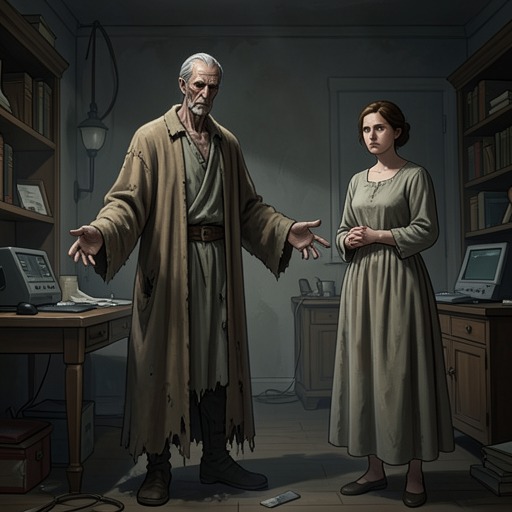
Paribanou made the identity visible as well as spoken. Tante Iezavel introduced the winged woman beside her as her sister, Paribanou, then identified Rumpelstiltskin as their brother and ordered him to abandon his disguise. He covered his ears and insisted that the name was not his. Paribanou snapped her fingers; the merchant’s face became a mass of wrinkles with golden eyes, and his body shrank to a child’s size. The onlookers murmured and backed away. What had been a noisy guessing game became a public transformation, with the crowd witnessing the creature’s exposure.
Family authority and confinement
Paribanou’s rebuke framed Rumpelstiltskin’s conduct as a repeated choice, not an isolated trick. She accused him of playing games with humans again by offering them what he had spun on the wheel and claiming it was gold, though he knew they could not tell the difference. He lowered his eyes. Her words explained the merchant’s jewelry display as part of a continuing deception, and joined that deception to the fairy-gold episode that had brought the investigators toward him.
The family’s response also revised what Tad understood about Tante Iezavel. Seeing Rumpelstiltskin identified as her brother, Tad concluded that she too was a jinn, even if her local reputation was that of a witch. In an earlier conversation, she had said that she never cooked the food Claire gave away: people refused it because they believed it came from a cauldron, while the rumors helped her business. She also joked that Claire was good for business. The marketplace revelation gives those exchanges an added context: Tante Iezavel knowingly works with the reputation people have made for her, while the actual magical family behind that reputation is stranger and more literal than Tad had understood.
Rumpelstiltskin’s punishment rests on his age and his refusal to govern his desires. When Tante Iezavel reminded him that their mother had told him to want something sensible, he answered that he could not help what he wanted. Paribanou replied that three hundred years was old enough to be accountable for misplaced desires. She announced that he would go back to timeout, and that this time the lamp would be placed somewhere humans could not go. Rumpelstiltskin responded with escalating sobs, wails, stomping, and shrieks. His tantrum did not undo the order; instead, it underscored the gap between his great age and his childish behavior.
The capture’s aftermath extends beyond the immediate return to confinement. Paribanou said the family should have pixies change the stories about Rumpelstiltskin so that they would no longer encourage humans to seek him out. She described him as a good patron to humans when he persisted in benevolent deeds, but condemned his pursuit of a firstborn child. Tante Iezavel supplied the blunt characterization that he was acting like a spoiled halfwit. Paribanou then said they must tell their mother, a prospect that made Rumpelstiltskin wail louder. The plan to alter the stories addresses the same cycle that helped bring Tad and Claire to him: a tale can preserve a warning, but it can also make the dangerous creature desirable to seek.
Revelations and stakes
The capture brings together several strands of the investigation without making their consequences interchangeable. The name identifies the merchant as the jinn from the miller’s-daughter story; the unique wheel ties him to the spinning and counterfeit gold; and his family confirms that he has a history of misleading humans and pursuing a firstborn child. The earlier bargain with Della’s father explains why this case is urgent, while the marketplace confrontation shows that the jinn has again used a human-facing disguise to entice people into a game whose real terms they do not understand.
The scene’s most consequential reversal is that the creature is not subdued through force by the investigators. Tad and Claire arrive as observers; Tante Iezavel recognizes the wheel and Rumpelstiltskin, and Paribanou compels the transformation and orders the return to timeout. That division of roles redirects the case from a contest of detection toward a family’s responsibility for restraining one of its own. The public setting makes the reversal visible: the merchant who had controlled the crowd by demanding guesses becomes the exposed figure from whom the crowd recoils.
Rumpelstiltskin’s return to confinement is not presented as the whole resolution of Della’s danger. Her father’s account had tied the claim to the jinn’s possession of family heirlooms and the deadline of her twenty-first birthday, while the marketplace scene establishes the culprit’s identity and captures him. Those facts clarify what the capture solves and what remains at stake for Della: the investigation has found the creature and interrupted his freedom to deceive, but the scene’s stated consequence is renewed confinement and family intervention, not an account of the curse being lifted.
Narrative significance
The episode adapts the familiar name-guessing motif into a detective revelation. Tad has encountered a story about a straw-spinner without knowing the creature’s name; in the marketplace, the same kind of challenge supplies a live test of identity. The name does not merely complete a puzzle. It triggers the merchant’s visible fear, allowing a remembered folktale pattern to become evidence about the case in progress.
At the same time, the capture complicates the moral simplicity of a tale about a trickster. Rumpelstiltskin has genuinely deceived people, falsely presented his spun product as gold, and pursued a firstborn child, but Paribanou also describes a capacity for benevolent patronage. Her distinction is conditional: his nature does not excuse his behavior, and his family treats his desires as choices for which a three-hundred-year-old being can be held accountable. The punishment, the threatened loss of his wheel, and the proposed revision of stories all respond to different parts of the problem—his conduct, his preferred instrument, and the narratives that draw humans toward him.
The marketplace capture therefore serves both as a solution to the identity mystery and as a change in the story’s scale. What first appeared to be a human investigation into a hidden fortune and a threatened inheritance opens onto a magical family with its own rules, history, and means of discipline. The case’s central clue is a name, but its consequences reach beyond recognition: the creature is exposed, his disguise and wheel are connected to earlier evidence, and the danger surrounding Della is set within the wider history of the jinn who made the bargain.