Shub-Haramb
One Thousand and One NightsShub-Haramb is the city at the center of Tad’s investigation into Zaen and Della, a vividly crowded but disorienting place where time does not align with Tad’s home realm and apparently ordinary pursuits conceal more than one possible story. Its bustling streets first exhilarate Tad; its stables and secret treasure room later turn the city into a landscape of uncertainty, where his romantic hopes collide with suspicions of theft.
Setting and First Impressions
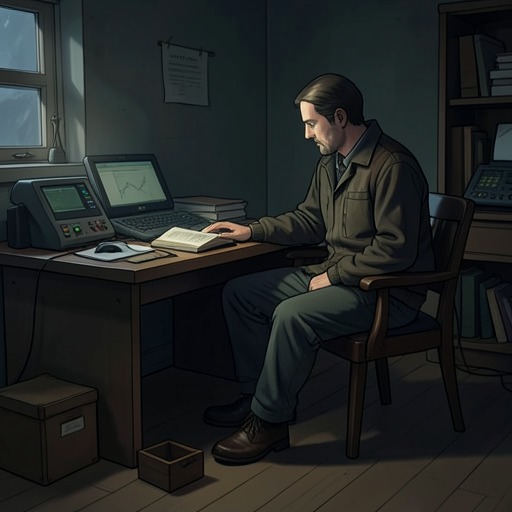
Pip identifies Shub-Haramb as the home of Della and Zaen, and promises to return there in search of spiced rice. The city becomes a destination for Tad after he consults the Magic globe about Zaen. Yet the image he saw in the globe does not correspond to the moment of his arrival: the outskirts had looked brighter in the image, but Tad had asked what Zaen had been doing earlier, not what he was doing now. By the time Tad arrives, night has fallen and the moon is high. Time in Shub-Haramb runs differently from time in Tad’s home realm, and his hunger leaves him unable to work out the difference.
On a later visit, Shub-Haramb seems to Tad almost to glow with the sparks of love. He lands in the middle of a crush of people and animals, where sandal-clad feet nearly trip over him, though the locals do not notice his magical arrival. The city’s crowded vitality overwhelms the investigator’s attention: he threads through merchants’ carts and hears strange tongues in heated exchange, while the vendors’ yodeling cries advertise merchandise as bargains. Gold, silver, jewels, silks, dyes, and jasmine perfumes fill the marketplace. The scene’s glamour is undercut by the smells Tad takes in alongside the spices: he coughs at the perfume, suspects it masks the locals’ infrequent bathing, and catches the whiff of crushed manure. Shub-Haramb is thus introduced through both abundance and comic discomfort, not as a distant backdrop but as a place Tad experiences with his whole body.
Tad’s Investigation in the City
Tad’s first search for Zaen takes him to the stables. At night, the place is dark and creepy, a sharp contrast with the bright outskirts he remembers from the Magic globe. He expects to find Zaen, whom he had seen leading a spirited, arc-necked horse out toward a field, but instead hears an elfin voice among the trees. The unseen speaker boasts of having obtained a woman and says that her father cannot calculate. Tad approaches the tree line to look, unnerved by the voice and by what it suggests. The stables and nearby trees make his search feel less like a straightforward visit than an encounter with concealed activity.
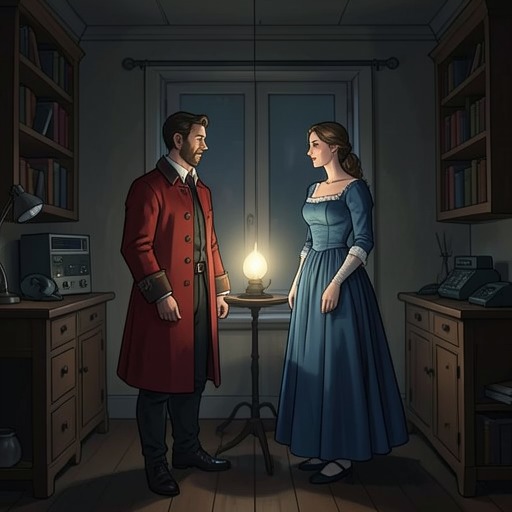
When Tad returns to the stables, he watches Della gallop away on a black horse while Zaen remains behind. Zaen’s clothes have changed since Tad last saw him: the patched trousers, with mismatched fabric sewn over numerous holes, have given way to a new pair, and boots have replaced his marketplace sandals. Tad worries that the change may point to a double life, that Zaen might be both a poor but respectable horse groom and an infamous thief. Yet the evidence is inconclusive. Tad has no proof Zaen sold the jewelry, and possession of a black horse and a gold necklace in his saddlebag does not establish guilt. The city keeps his investigation suspended between suspicion and sympathy.
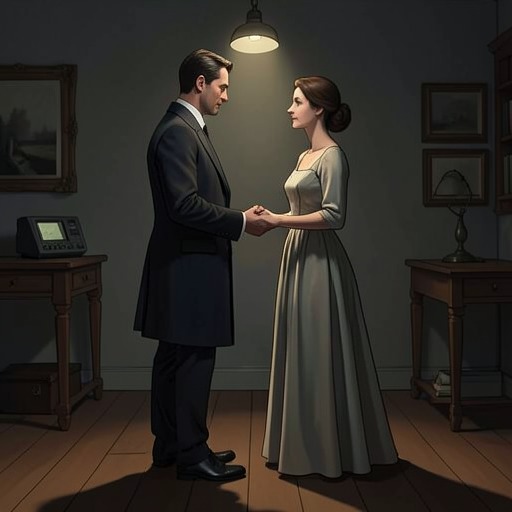
That sympathy grows as Tad watches Zaen after Della rides out of sight behind the trees. Zaen looks mopey, with a frown and downcast eyes, despite having given the woman he loves a special gift. Tad recognizes the disappointment of trying to find something meaningful to offer a woman who seems to have everything. To Tad, love remains what Zaen can give, and he hopes the pigeons have not mistaken the match as Claire has suggested. In Shub-Haramb, the same observations that might implicate Zaen in a crime also make him legible to Tad as a lovesick suitor.
The Hidden Chamber and Its Double Meaning
The city’s most consequential discovery comes through the Magic globe, when Tad catches up on an earlier clue he had abandoned: where Zaen and Della’s father went after entering a storage room. The image shows Zaen closing the door while Della’s father takes a small device from his pocket, lights two candles on the wall, and retrieves one of them. He walks toward a pile of straw and speaks the password “Open sesame.” The rug lifts to reveal a staircase, then settles back into place after the two men descend.
Below the storage room, candlelight makes the chamber seem to glow as if its walls were gold. The apparent radiance comes instead from the candle flickering against heaps of treasure. Zaen looks around and remarks that the thief did not take very much. The moment connects Shub-Haramb’s secret architecture to Tad’s earlier suspicions about Zaen and the jewelry, but it does not, by itself, resolve them: the scene establishes a hidden store of wealth and a theft, while leaving open who committed it and what Zaen’s precise involvement may be.
Narrative Significance
Shub-Haramb repeatedly frustrates simple interpretation. The Magic globe’s image is already out of step with the time Tad reaches the city; a changed outfit raises suspicion without proving it; a gift is shadowed by the giver’s sadness; and a chamber full of treasure becomes visible only through a concealed stairway and a spoken password. The city’s rich surfaces and hidden spaces mirror Tad’s case: he can see more than he understands, and each new clue complicates rather than settles his judgment.
Its sensory contrasts also shape Tad’s changing mood. The spices, merchandise, and crowded streets make his arrival feel exhilarating, even as the stink and crush puncture his romanticized impression. The stables bring darkness and fear, while the candlelit chamber turns concealed wealth into a dazzling but ambiguous sight. Across these settings, Shub-Haramb is both the setting of Tad’s pursuit and an active test of his confidence: what looks like a promising clue may be out of sequence, and what looks incriminating may still admit another explanation.