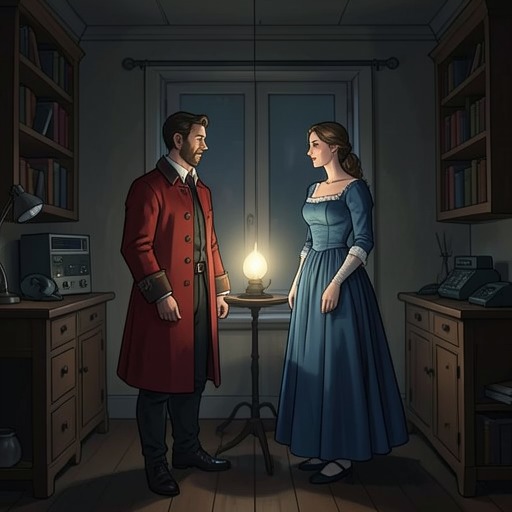
Tad and Claire
One Thousand and One NightsTad and Claire are investigative partners whose sharp disagreement over how to solve cases conceals a deeper, magically imposed interdependence. Their relationship moves from mutual condescension, through a wager that turns their methodological rivalry into a test, to cooperation under the pressure of a deadline; Lady Love eventually discloses that she has entwined their magic so neither can work apart. The pairing makes the case for collaboration more than a practical lesson: each investigator’s confidence in a single approach is challenged by the other’s presence and by the limits of working alone.
Introduction and competing methods
Their partnership is marked from the outset by a contest over competence. When Tad asks whether Claire is suggesting she is more qualified to solve cases than he is, Claire answers with a derisive imitation of his advice to give a client a good kiss, accusing him of having no method. Tad defends true love’s kiss as a tried-and-true way to undo a curse, treating romantic knowledge as a legitimate instrument of investigation rather than the foolishness Claire implies it is. The exchange establishes their disagreement as both intellectual and personal: each challenges not just the other’s conclusion but the grounds on which the other claims expertise.
Tad responds to Claire’s confidence by proposing that their latest clients’ failure to fall in love could be explained by magical mischief. He permits her, pointedly, to quote his theory in her book, then describes her approach as scientifically unsound. Claire accepts his challenge: on this case, they will see whether science or romance works better. The wager converts their habitual dispute into an explicit contest, but its terms also reveal how closely their work is entangled. They are investigating the same case, trying to interpret the same evidence, and measuring rival approaches against a shared outcome.
Rivalry and reluctant cooperation
The contrast between their methods does not immediately produce an easy division of labor. Tad’s confidence in his own reasoning and Claire’s insistence on her own expertise make cooperation feel to each like a concession. When Tad eventually asks whether they should work together, a small flicker of hope accompanies the question; Claire answers that she will share her research if he admits defeat. Her condition turns an opening toward partnership back into a contest over status. Tad rejects it and says he will solve the case by himself, so the opportunity for an unqualified reconciliation closes almost as soon as it appears.
The case’s urgency eventually changes the balance. After spending more than an hour in the library, Tad learns that Della’s curse is already taking effect: the jinn’s hold is making her forget who she is, and, if the claim is not stopped, she will become his when she turns twenty-one. Tad explains the danger to Claire while exhausted enough to struggle through his own account. Claire, yawning, agrees that they can work together just this once; Tad accepts in the same weary register. The shift is practical rather than triumphant. Neither announces that the argument has been settled, but the approaching deadline makes solitary pride less useful than sharing what they know.
A relationship built into the case
Their partnership is repeatedly framed through a question of relative importance. Lady Love has allowed the pair to believe she might choose which of them is more valuable, while secretly instructing her other agents to leave them to their own devices. When she later confronts them, she says they have put themselves through an ordeal only to return to where they began: neither has been acknowledged as more important than the other. That outcome undercuts the premise of their rivalry. The case does not establish a winner whose method can replace the other’s; it exposes the futility of treating the partners as competitors for a single position.
The revelation is also a concrete explanation for why their independence fails. Lady Love tells Claire that she cannot solve a case without Tad, and tells Tad that he cannot solve one without Claire. She has entwined their magic, ensuring that neither can work apart from the other. The bond turns dependence from an inference about their professional strengths into an actual constraint, imposed by their employer and hidden from them while they tried to separate. Lady Love admits that watching them struggle was amusing, but the lesson is more consequential than the joke: each investigator’s work requires the other’s participation.
The revelation does not make them suddenly affectionate. Tad feels caught when Lady Love exposes that she has been watching them, while Claire flushes; after the magical arrangement is explained, Tad regards being stuck with Claire as a calamity, even as he thinks he can have some fun with her. Claire’s immediate reply to his parting observation that Tante Iezavel was not human shows that their familiar, argumentative rhythm remains intact. Their new understanding therefore rests not on the disappearance of friction but on the recognition that friction cannot undo their connection.
Thematic significance
Tad and Claire’s relationship turns the book’s conflict between romance and scientific method into a problem of working together. Their wager asks which approach is superior, but Lady Love’s disclosure refuses the clean victory the contest anticipates: neither can solve cases without the other. The relationship’s development is consequently not a conversion from one method to its opposite. Rather, the story makes their rivalry an inadequate framework for the task they share, and makes cooperation necessary even when neither partner is ready to describe it as friendship.
The case’s other central relationship offers a pointed contrast. Della has received a thousand proposals from Zaen, but explains that poetry and pretty words had not shown her that he understood the person she believed herself to be. The decisive change comes when Zaen offers a friendship bracelet whose materials recall their shared history and calls their friendship his greatest treasure; Della says she wanted to be treasured, not treated as a prize. The episode gives emotional substance to the distinction between persuasive language and demonstrated regard. For Tad and Claire, the evidence is less a declaration than a condition of practice: Lady Love’s revelation makes clear that neither one’s claims to expertise can stand in for the other’s contribution. Their partnership remains argumentative, but the work and the magic bind its two participants into a relationship neither can simply dismiss.