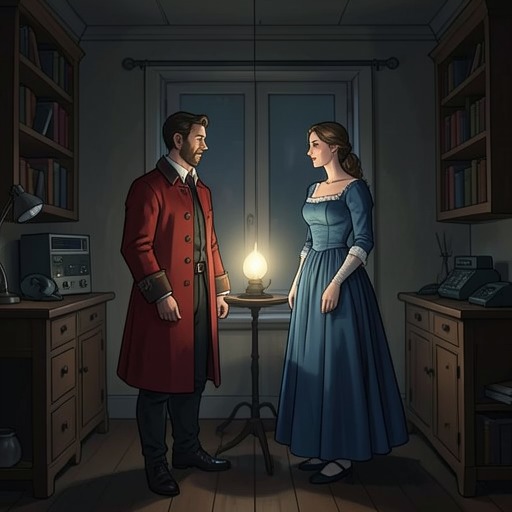
Tad and Claire’s Case-Solving Wager
One Thousand and One NightsTad and Claire’s Case-Solving Wager turns a disagreement over how to investigate into a test of whether either agent can work independently. Tad argues that magical mischief must be keeping Della and Zaen from falling in love; Claire accepts his challenge to compare his romantic, intuition-led approach with her scientifically minded method. Their investigation repeatedly puts the contrast into practice, but it does not produce a simple winner: the case requires both observation and inference, and Lady Love reveals that the agents’ magic has been entwined so that neither can solve a case without the other.
Origins and Terms of the Wager
The dispute begins with Tad’s claim that Della and Zaen would already have fallen in love if no magical interference were preventing it. Claire regards the suggestion that true love is obvious as highly improbable. She draws an unflattering implication from his theory: if it were right, the two current clients would have to be imbeciles for failing to recognize their feelings. Tad counters that magical mischief could explain why they have not fallen in love, and asserts that otherwise they would have done so already.
Claire accepts the challenge after Tad claims that his method is superior to hers. She characterizes her own approach as scientific and his reliance on poetry and romance as scientifically unsound, then proposes that this case decide whether science or romance works better. Tad asks whether the loser will admit defeat. Claire immediately raises a practical problem: who will judge the contest? Pip volunteers, giving the wager a designated arbiter, though the supplied scenes do not establish a final verdict by him.
The wager makes a working disagreement personal. Each agent has reason to prove that the other’s way of thinking is inadequate, while the case itself carries an urgent stake: Della’s curse is worsening, and she may be claimed by the jinn when she turns twenty-one. The investigation therefore tests their methods under pressure rather than in an abstract debate.
The Competing Methods in Practice
Tad’s contribution is often to pursue a promising lead by direct magical access. Seeking a clue before sunset, he uses magic to reach the place where he had seen Zaen in the Magic globe. He arrives at night in Shub-Haramb, where the difference in time between realms complicates his plan. Hungry after missing lunch, he hears a small voice in the trees and sneaks toward it. A hooded figure dances on a log, boasting that Della’s father cannot calculate and that the speaker has got her. The scene turns Tad’s suspicion of magical interference into a concrete lead: the boastful figure is tied to the danger surrounding Della.
Claire’s method is demonstrated through material examination. At the Library of Love, she unwraps a gold necklace with a rectangular pendant, moves a square metal-like object over the metal, then takes a vial with a yellow stopper from a wooden crate. She puts a single drop from the vial on the pendant. Tad sees only a slight fizz, but Claire treats that small reaction as confirmation of her suspicions. Her procedure is specific and controlled: she tests the object rather than accepting its appearance as proof that it is genuine gold.
Her subsequent reasoning shows how she moves from a test to a broader explanation. A merchant would have little reason to sell a finely crafted genuine-gold item for roughly the same amount in gold coin. Claire therefore argues that the necklace must be fake, unless the merchant stole it or acquired it cheaply while knowing it was stolen. She then considers how a dealer in stolen goods could operate without attracting attention: such a merchant could not openly display stolen items alongside legitimate ones and would have to sell them to foreigners. When she asks whether the merchant hid the necklace and produced it only after looking Tad over, Tad confirms that he did. Claire concludes that the merchant knowingly handles dishonestly obtained goods, while Tad’s suggestion that a thief followed him after watching him buy the necklace remains a hypothesis rather than an established answer.
The wager thus does not reduce to a choice between feeling and evidence. Tad’s movement through the magical environment brings him into contact with a revealing boast; Claire tests a physical clue and develops an explanation through alternatives and circumstances. Her reasoning also makes clear why a clue and its interpretation are not the same thing: the pendant’s brief fizz is an observation, while the merchant’s conduct and possible connection to theft are conclusions built from that observation and the circumstances of the sale.
The Case Beyond the Contest
The danger they are investigating comes from a bargain whose consequences extend beyond the immediate theft. Della’s father explains that the jinn’s hold over Della is already beginning to affect her memory. The jinn has her mother’s necklace and her father’s ring as proof of his claim; when Della turns twenty-one, he can claim her and take what she is to inherit. Her father also recalls that the jinn revealed this in a tantrum after the third wish had sent him back into the lamp. He had tried to reason with the creature about its demand for his firstborn child, but it refused another bargain.
The father’s account complicates the agents’ search for a solution. His first wish gave him knowledge of how to obtain wealth rather than wealth itself, and his third wish imprisoned the jinn again; nevertheless, he regrets promising a third gift before he knew what it would be. Della’s mother suggests that the creature may only be able to spin straw into fairy gold, like what her husband found in its cave, and wonders whether Della herself is its true object. Her husband suspects that the inheritance is part of the scheme, but admits he cannot reconcile the jinn’s interest in treasure it could seemingly make for itself. These unanswered questions make the investigation a matter of uncovering the terms and limits of supernatural bargains, not simply identifying a culprit.
Tad and Claire also discover that the case’s clues lead into a hidden space beneath a storage room. In the Magic globe, Zaen closes the room’s door while Della’s father lights two small candles with a device from his pocket. He takes one candle to a pile of straw and says, “Open sesame.” A rug lifts to reveal a staircase; after the two men descend, it settles back into place. Below, the candlelight falls on heaps of treasure. Zaen looks around and remarks that the thief did not take very much. The password and concealed entrance give the agents another concrete instance in which familiar story-like magic and practical investigation meet, while the small apparent loss leaves the theft’s full significance unresolved at that point.
The library research adds a further frame for interpreting the case. After more than an hour searching, Tad learns that jinns, or genies, are described as half fairy and half something else: mischievous, somewhat clever, unpredictable, and capable of either helpful or harmful conduct. He finds a story about a miller’s daughter tricked by a creature that spins straw into gold, which seems related to the jinn who deceived Della’s father, though that story contains no reference to a lamp. The parallel offers a possible clue rather than a complete identification, preserving a distinction between resemblance and proof that mirrors the wager’s larger concern with how conclusions are reached.
Resolution and the Meaning of the Draw
By the time Rumpelstiltskin is in custody and the curse on Della has been removed, Tad is exhausted and eager to close the case. Claire insists on accompanying him to see it through. They find Zaen on a street, where he has been questioning locals, and Claire holds out her hand for the lamp, stating that the jinn has been captured and they will take it. Zaen clutches the lump concealed in his shirt and looks between them. Their exchange shows that even after the immediate danger has been addressed, retrieving the lamp remains a separate piece of the agents’ work.
The outcome of the wager is not recorded as a victory for either investigator. Later, Tad begins to argue that Claire mislaid a gift he had bought for her and that its being found by her landlord should count in his favor. Claire rejects the attempted claim and admits a draw in this particular instance because of unforeseeable circumstances. She proposes that they make a new wager on the next case. The terms of the original contest are thereby left unresolved in the narrow sense: neither method is declared the winner, and the proposed rematch preserves their rivalry.
Lady Love then reframes the contest. She has heard that Tad and Claire decided they did not need one another, and discloses that she arranged for her other servants to leave them to their own devices so they could learn a lesson. She tells Claire that Claire cannot solve a case without Tad, and tells Tad that he cannot solve a case without Claire. The reason is literal as well as instructional: Lady Love has entwined their magic so that neither can work apart from the other. Their ordeal has brought them back to a position in which neither is acknowledged as more important than the other. The wager’s apparent choice between romance and science is therefore overturned by the revelation that their partnership, not an individual victory, is essential to their work.
Significance
The wager gives the investigation a second mystery: alongside the question of what happened to Della, it asks what counts as a reliable way of knowing. Claire’s test of the pendant and her analysis of the merchant’s conduct depend on observations and competing explanations. Tad’s pursuit of leads depends on intuition about magic and on acting quickly enough to witness what others might miss. Neither approach, in the scenes supplied, can stand as a complete account of the case on its own.
Lady Love’s intervention sharpens that point. The agents mistake dependence for a contest over whose contribution matters more, while their magical bond makes separation impossible. Her lesson does not erase the difference between their methods or announce that every approach is equally sound; instead, it establishes that each agent’s ability is necessary to the other’s work. The draw, followed by the offer of another wager, keeps their rivalry alive, but its meaning changes: competition can continue only within a partnership whose necessity they have been forced to recognize.