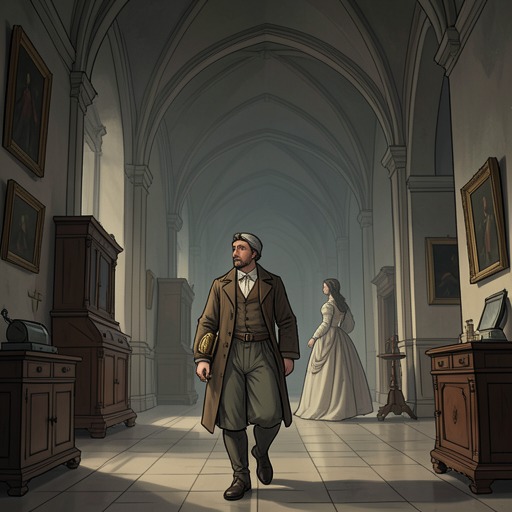
Tad and Roselle
One Thousand and One NightsTad and Roselle’s relationship is an unreciprocated courtship shaped by Tad’s confidence that she is his true love and Roselle’s less romantic, often evasive responses. The mismatch becomes clearest when he presents her with what he believes is a fine gold necklace, only for her to assume it is a bed for her runaway pet. By the end of the case, Tad acknowledges that Roselle has not fallen in love with him, but resolves to keep trying.
Nature of the Relationship
Tad interprets Roselle’s attention as evidence of a special connection. When he tells Claire that Roselle finds him interesting, he points to a recent occasion when she smiled and waved at him in the square. Claire offers a less flattering reading: Roselle was trying to be pleasant while thinking of how to escape, because she did not want Tad to ask about Popo, whom she had promised to look after and then lost. Claire says Roselle and a friend had hidden behind a barrel of ale to avoid him, and that avoiding Tad had become a nuisance. His confidence in the wave and Claire’s account of the hiding place reveal two sharply different understandings of the same courtship.
The teasing matters because Tad is already arguing that love should be obvious to people who spend time together. He resists the possibility that proximity and familiarity might not mean romance, even as Claire describes Roselle’s behavior as avoidance. His certainty is not evidence of reciprocity: it is a romantic interpretation he supplies to gestures that can also be read as courtesy or an attempt to evade an awkward conversation.
Tad’s Courtship and the Necklace
Tad’s interest in Roselle is not merely something he claims during an argument. While away on the case, he leaves Claire and Sev to talk, magicks home, retrieves a box containing Roselle’s necklace, and heads to the square hoping to spend time alone with his true love. He has to search for over an hour, checking her usual haunts before he hears her voice as she leaves a dress shop. When her three companions turn to look at the window display, he seizes the chance to approach.
He bows, offers the box, and says that he saw the gift and immediately thought of her. His carefully planned eloquence has deserted him; the moment is rushed, and Roselle freezes when she sees him. She accepts the box, raises an eyebrow, and opens it. Instead of delight, she responds with confusion: the box contains straw where Tad expected the necklace to be. Roselle asks whether the gift is for Mister Tiddledinks, so that the pet can have a bed. The intended romantic gesture has arrived stripped of its intended meaning—and, in Roselle’s eyes, has become an offering for the animal she had lost.
Tad realizes that the merchant has cheated him, but he cannot explain the mistake. He tries to console Roselle over Popo, speculating that Mister Tiddledinks may already have wandered off, then takes back the box and leaves. The encounter wounds his pride as much as it frustrates his plan: he believes the merchant has made him look foolish in front of the woman he loves. For Roselle, however, the exchange provides no sign that the necklace was meant as a declaration to her.
The Case as a Contrast in Romance
Tad’s courtship takes shape alongside the case’s examination of Della and Zaen’s relationship. Della describes receiving a love letter and marriage proposal from Zaen every week since she was six and he was seven, and says that he has never been put off by weather, occasion, or her repeated refusals. Although she calls him dear, she initially considers them friendly acquaintances and rejects the idea that his persistence proves she loves him. Her account offers a pointed contrast to Tad’s conviction: repeated attention does not by itself establish mutual love.
When Zaen eventually gives Della a friendship bracelet made of horsehair in white, red, and black, its strands recall moments in their shared history, and beads carry their initials. Della explains that what she wanted was not gold or jewels but trust, and the feeling that Zaen knew the person she believed herself to be. She accepts him as a friend and agrees to marry him. The resolution distinguishes romance from a relationship founded on mutual recognition. It also gives Tad a new way to understand his own situation: a beloved person cannot be won simply by persistence or by a gift that the giver considers impressive.
Recognition and Continuing Hope
After the case, Tad reflects on why Della did not fall in love with Zaen at first sight, as he had with her. He admits that Roselle has not truly fallen in love with him, and says he is now man enough to acknowledge it. This is a change in what he can see, not an end to his desire: he determines to win Roselle over as Zaen won Della, even if it takes a hundred cases or a thousand distressing nights as an agent of Lady Love.
The ending leaves the relationship unresolved. Tad’s new understanding is real, but his plan still treats Roselle’s future affection as something he might eventually secure through continued effort. His rueful recognition of her lack of love therefore sits beside, rather than replaces, his romantic optimism. The failed necklace scene and Della’s eventual acceptance of Zaen give him grounds to rethink what love requires; they do not establish that Roselle will reciprocate, or that persistence will change her feelings.